
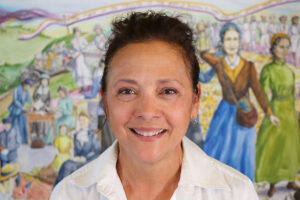
Picture of Phyllis Garibay-Coon

Interview of Phyllis Garibay-Coon, May 13, 2025

Interviewed by Linda Utoff
Phyllis Garibay-Coon, the artist who created Rebel Women, the most recent mural installed in the Kansas Statehouse, describes her journey as an artist including the importance of the support she found in the Manhattan, KS community. Garibay-Coon is the first woman to have her mural installed in the Statehouse. She is interviewed by Linda Uthoff, League of Women Voters of Manhattan/Riley County. During the interview, conducted a few months after the mural was unveiled on the 2025 anniversary of Kansas becoming a state, Garibay-Coon describes the Kansas suffragists who are the most prominent figures in Show Morethe painting. She also describes how the state and local historical societies and families of those suffragists contributed to how she imagined the mural. Garibay-Coon credits the League of Women Voters of Kansas, the AAUW of Kansas, and generous individual donors who made this public art possible.

Highlights -- short excerpts from the interview

Show Less
John Hanna

Interview of John Hanna, December 19, 2025

Interviewed by Jim McLean
John Hanna recalled his long career as one of the top journalists in Kansas in this 2025 interview with Jim McLean. Hanna described how covering the Kansas legislature has changed from the years when several reporters were able to cover multiple committees each day to now where a single reporter has “to tell big, broad stories to the largest audience possible.” He observed that there is “still a need for good journalism to help organize and make sense of what’s going on and to write about patterns and trends and context.” Hanna acknowledged the difficulty of maintaining Show Morethe AP style of balancing every story and giving each side equal coverage when you know one of the sides is demonstrably not true. He observed that there is an organized campaign by national groups that are getting legislatures to act and that it is “important for the reader to understand—where it’s coming from, how money is being spent, who benefits, who doesn’t.”

Highlights -- short excerpts from the interview

Show Less

Interview of Robert St.Peter, January 23, 2026

Interviewed by Jim McLean
This is the opening interview for the series, Healthy Kansans. Dr. Bob St. Peter will be interviewing all the rest of the participants in this series, so Jim McLean wanted to use this interview to establish his expertise. St. Peter was President and CEO of the Kansas Health Institute for 24 years, developing and expanding their services in Kansas. Prior to that he had extensive experience in Washington DC with health policy [see his biography]. For this series of interviews, St. Peter defines health in the broadest terms and points out why the health rankings Show Moreare valuable information for policy makers. The Kansas Health Foundation which created KHI really wanted the KHI to look at a broad set of issues that influenced how healthy we are as a city, as a county, as a state, and how education, housing and transportation influenced a person's health. St. Peter points out that health in Kansas isn't getting worse. People in Kansas are living longer, generally experiencing lower rates of cardiovascular disease, stroke, etc. So, it is not that our collective health is getting worse; it is that our relative standing compared to other states is getting worse. Other states are doing better and are faster than Kansas in improving the health outcomes for their citizens. Kansas should be working on this as well. Show Less

Interview of Gianfranco Pezzino, January 23, 2026

Interviewed by Robert St. Peter
This interview with Dr. Gianfranco Pezzino is the second in the Healthy Kansans series and sets the stage for understanding the concern that Kansas has slipped considerably in the nationwide rankings of health in the states over the last 30 years. His explanation of how the rankings work and why they are important is clear and understandable. Pezzino stated, "In the end, I became more and more convinced that the important thing was not the numbers. It was the communication that we could build around those numbers." His discussion of the social determinants of health Show Moreis important to understanding the rankings. He recalls a controversy covered by the local newspaper that quoted the county commissioner saying, "What does education have to do with health?" He used that as a opportunity to begin a community conversation about those linkages. As an epidemiologist, Dr. Pezzino has played many roles in health policy in Kansas - from the local health officer to state policy maker. He recounts the stresses of being the county health officer during COVID and comments that the "social contract has been broken." He comments that there is still value in providing accurate data as a public health person but now a lot of the authority has been moved from public health officers to local elected officials. That change has created a tension between individual rights and the social good. Show Less

Interview of Bill Graves, September 16, 2016

Interviewed by Michael Smith
Emporia State University Professor Michael Smith interviewed former Governor Bill Graves on the Kansas Wesleyan University campus, Graves’ alma mater, in the fall of 2016 before the November elections. The interview covered events from Graves’ years in office as well as his thoughts on the state of Kansas politics in 2016 and the political changes in the Statehouse. This interview delves into some of the political situations Graves faced, particularly in his second term with challenges from fellow Republicans. Taken together with the 2022 interview by Mike Matson these interviews form a picture of Show Morethe changing nature of conservatism in Kansas politics and help define the meaning of Traditional Republican. Show Less

Interview of Foster Chisholm, December 5, 2025

Interviewed by Joan Wagnon
Foster Chisholm, in retirement after a 25 year career working in the Topeka Post Office, went to work as Doorman for the Kansas House of Representatives. In his 2025 oral history interview he describes growing up in North Topeka, attending segregated schools, and being discouraged by his high school counselor from going to college. Chisholm worked for 35 years at the VA Hospital and at the Post Office in Topeka. After he retired, a friend told him about an opening for a Doorman in the Kansas House of Representatives. He got the job and after Show More3 years became the first Black Sergeant-At-Arms in the Kansas Capitol. Chisholm describes his nonpartisan role in assisting the Legislature as it did its business. He also has a few funny stories about what happened during those 15 years. His biography really showcases his commitment to improving his Topeka community with his volunteerism. A short excerpt highlights his comments about segregated schools; it also appears in the Diversity Collection. The photograph of the armed doormen triggered a conversation off camera about the Legislative Uprising of 1893 and their role, and also the most famous Kansas doorman, Boston Corbett. Materials about both the legislative uprising and Corbett appear in Resources for Educators/History. Show Less

Interview of Pat Roberts, October 14, 2025

Interviewed by Jackie Cottrell and Mike Seyfert
The interviewers were former staffers of the Congressman, and as such, were able to ask the right questions. The anecdotes are interesting and reflect much of the national and world news during his forty year tenure of service. Agriculture was a principal focus, since Roberts chaired the Agriculture committees in both the House and Senate. His anecdote about how the Freedom to Farm legislation came about is interesting, because the suggestion came from a farmer. Roberts also recounts a meeting with President Trump about crop insurance where he was able to convince Trump not to eliminate Show Moreit, which would have been a very negative policy for the President and America's farmers. There is an anecdote where Roberts had to tell President Bush that Saddam Hussein had no weapons of mass destruction. Roberts' role in national intelligence was critical. Roberts had tremendous influence in his 40 years of service. He describes politics this way: "The first thing you’ve got to learn in politics is to listen, and the second thing is there’s no “I” in politics. It’s a “we” thing." Show Less

Interview of Lee Hamm, September 3, 2025

Interviewed by Joan Wagnon
In this interview, Lee Hamm, farmer, dairyman and former state legislator, recalls growing up in rural Pratt County during the Depression years. His descriptions of life on the farm are vivid as are his memories of being educated in a rural school. At the age of 96 his memories of his public service are still sharp. He served on two school boards, Glendale and Pratt, during the time that Kansas was in the process of consolidating its 2800 rural schools down to about 300. He ran for the Legislature in 1972 and served 20 years Show Moreunder 5 different governors before being appointed by Governor Joan Finney to head the Kansas Grain Inspection Department. Hamm closed the interview with some thoughts about the changes he has seen in state government and life in Kansas. Show Less

Interview of Steve Abrams, June 26, 2025

Interviewed by Mark Tallman
Steve Abrams grew up loving to read and as an adult found it incomprehensible that others could not learn to read. His involvement as a member of his local board of education was initially focused on the issue of reading. He later championed Career and Technical Education training as another option for students while he served on the State Board of Education and on the Senate Education Committee. The interview has a substantive discussion of some of the issues the state board encountered during Abrams' term: No Child Left Behind, the Nation at Risk Report, Show Morestate assessments, standards for local schools, Quality Performance Accreditation, to name a few. Abrams states that it’s not easy to solve the issue of “wanting education to be successful for the students in the state of Kansas and still be affordable for the citizens of Kansas.” Show Less
Go to Top