Interview of Tom Bell, March 6, 2026

Interviewed by Robert St. Peter
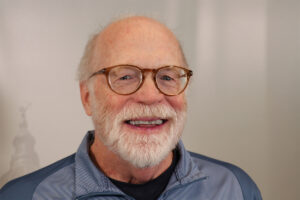
Tom Bell served as CEO of the Kansas Hospital Association from 2012 - 2020 when he retired. As the leader of the trade association representing Kansas hospitals, he provided education and advocacy for the 120 hospitals that were his association's members. Bell describes his work mainly as advocating for hospitals in the Kansas Legislature and with the Kansas Congressional Delegation on federal issues. During his interview he identifies several big state issues that impacted his members: Certificate of Need, scope of practice, rural hospitals, medicaid expansion and reimbursements (DRGs). The passage of the Critical Access Hospital Show Morelegislation saved a lot of hospitals and helped solve some problems. Bell said he was constantly looking for ways to balance the competing interests of all the parts of the health care system. He also noted the COVID pandemic had huge, negative impacts that are still being felt. The interview looks at the advantages or disadvantage of being a non-profit hospital vs a for-profit model. It also discussed the need for a state health planning agency to set policy. In response to the question, what are the "top issues that you think we as a state need to be addressing right now for the well-being of hospitals... and the community", Bell indicated workforce was at the top of the list as well as reimbursement and how to help the community access the best level of health care. He concluded the interview by saying, "...what's good for the hospital ought to be what's good for a particular community." Show Less

Interview of Robert Moser, March 10, 2026

Interviewed by Robert St. Peter
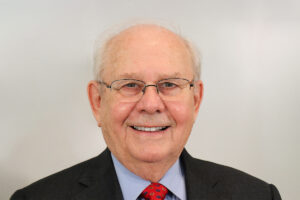
Dr. Moser had an unusual background because he went to pharmacy school before deciding to go to medical school. This interview really highlights the difficulties of practicing medicine in a rural area, and shows Moser's innovations in responding to those challenges. He did his residency in his hometown of Tribune, Kansas. He also credits the business training in Pharmacy school as being helpful in responding to challenges which included workforce issues. To meet that challenge, Dr. Moser used a multijurisdictional approach to expand staffing in both Greely and Wallace counties. Delivering babies was a Show Morerecurring problem - no backup, no personal time. Moser left Tribune in 2010 to work as Governor Brownback's Secretary of Health and Environment but left 3 years later because of opposition to medicaid expansion. In 2014 he joined the Kansas Heart-Stroke Collaborative - a CMS innovation - and also taught population health and family medicine at KU Medical Center. After surveying emergency room data regarding patients who came in with heart attacks and strokes, they were able to develop evidence-based guidelines for rural health care staff that improved patient outcomes. Show Less

Interview of Maynard Oliverius, March 6, 2026

Interviewed by Robert St. Peter
Maynard Oliverius lays out in clear terms the policy choices the federal government made that shaped the health care system in the country today. Starting in 1946 with the Hill-Burton Act that paid for new hospital facilities, then the creation in 1965 of Medicare and Medicaid to ensure that seniors had a way to pay for health care and medical research, he tracks federal changes through the Affordable Care Act and Medicaid Expansion. He also notes that Kansas was leading other states in health rankings in the early 1990's, but now has fallen significantly behind other states' efforts Show Moreto improve the health of their residents. Access to health care has become a major problem for many Kansans. The interview also touches on the growth of Stormont Vail under his leadership and how it is now a major medical center serving northeast Kansas and is a locally owned, locally operated nonprofit organization. Oliverius concludes by offering his opinion that ideally the country needs to move to a single payer system in order to provide access for all - he describes it as "medicare for all." He expressed concern about the current direction of health policy nationally. Show Less
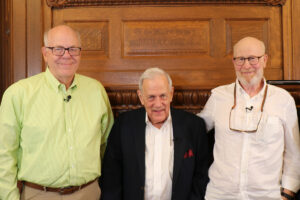
Photo of Dave Ranney, John Marshall, and Mike Shields

Interview of John Marshall, Mike Shields and Dave Ranney, July 30, 2025

Interviewed by Jim McLean
In this 2025 oral history interview, Jim McLean explored with John Marshall, Dave Ranney, and Mike Shields some of the issues they covered as Statehouse reporters and how news coverage has changed over the last fifty years. The three reporters, who all worked at Harris News, describe providing in-depth coverage, such as Marshall’s descriptions of school finance debates, Shields’ work on Kansas water issues, and Ranney’s articles on social services issues that impacted Kansans’ lives. Marshall noted that through Ranney’s reporting on social issues, “we found that for the first time we could raise the consciousness of almost the Show Moreentire community of Kansas. Made this an issue. Made this something that people talked about and were concerned with, especially legislators.” They shared their thoughts on how Harris News made “Kansans aware of Kansas” and the importance of covering local stories about local people and not just Topeka, Kansas City, and Wichita. They noted that today “we’ve lost the quality control of the information being presented out there.” They also recognized Dale Dennis, formerly at the Kansas Department of Education, and Richard "Dick" Ryan, former Director of the Kansas Legislative Research Department, as sources of detailed information to ensure that Kansans received accurate and reliable news from the Statehouse.

Highlights -- short excerpts from the interview

Show Less
Sarah Kessinger

Interview of Sarah Kessinger, December 11, 2025

Interviewed by Jim McLean
In this 2025 oral history interview, Sarah Kessinger described her reporting career before taking on the challenge of publishing a weekly newspaper. Kessinger was Statehouse reporter for Harris News that served many community newspapers across Kansas. At the time of this interview, she was the editor and publisher of The Marysville Advocate. She observed that small, locally-owned newspapers look for ways to get the next generation to understand that “a newspaper is there as a resource for them to become better informed and better citizens in their community.” She also noted that, "there’s a lot Show Moreof rhetoric online that people believe, and that rhetoric doesn’t have to be vetted like we have to vet what we report and make sure that it’s accurate…we have a legal liability to report the truth.” She also highlighted as an issue confronting newspapers the lack of communication from national, state, and local elected officials. Kessinger questioned whether government officials realize the “damage they’re doing by shutting out the media and not being transparent.” In Kessinger's opinion, if media “can’t keep [important issues] in front of the public, then we all lose in the end. It’s a weaker society in general.”

Highlights -- short excerpts from the interview

Show Less
Photo of Leroy Towns

Interview of Leroy Towns, September 5, 2025

Interviewed by Jim McLean
In this 2025 oral history interview, Leroy Towns described how his interest in politics led him to a 44-year career as a reporter, press secretary, and educator. During the interview, Towns recalled his unconventional start as a student reporter covering the Vietnam War for the Kansas State Collegian before beginning a career as a Statehouse correspondent for The Topeka Capital-Journal and then for the Harris News Group. Towns reflected during the interview on his shift from reporting when he became press secretary for Governor Robert Bennett. A significant portion of the interview focused on his decades-long role as chief of Show Morestaff for Pat Roberts, when Roberts represented Kansas in Congress. From that vantage point, Towns recalled witnessing the nationalization of politics and a decline in bipartisan collegiality. Throughout the interview, Towns offered insights into the evolving media landscape and the loss of local news coverage.

Highlights -- short excerpts from the interview

Show Less
Photo of Beverley Olson Buller

Interview of Beverley Buller, October 14, 2025

Interviewed by Jim McLean
In her 2025 interview, conducted at Red Rocks, the historic former home of William Allen White (b. 1868, d. 1944) in Emporia, Kansas, Beverley Buller reflects on her career as an educator, librarian, and author. A lifelong Kansan, Buller describes her transition from a classroom teacher to a school librarian, a role that deepened her commitment to literacy and state heritage. She shares her research on White, the "Sage of Emporia" that informed her books. She emphasizes White’s national significance as a journalist and political observer who remained rooted in small-town Kansas Show Morevalues. Buller describes how White started in the newspaper business, his purchase of the Emporia Gazette, and the influence of some of his famous essays. She also talks about the William Allen White Children’s Book Award, highlighting the award’s role in fostering a love of reading. She describes the award not just as a literary prize, but as a living tribute to White’s belief in the power of the written word.

Highlight -- short excerpt from the interview

Show Less
Photo of Steve Kraske

Interview of Steve Kraske, September 11, 2025

In this 2025 oral history interview, Steve Kraske reflected on his 33-year career as a political reporter and editor for The Kansas City Star covering the Kansas Statehouse. Kraske shared his memories of the Mike Hayden- Joan Finney gubernatorial race, the Bob Dole - Bill Roy US Senate race, and the conservative rise that began when the self-described “Rebels” such as Rep. David Miller, Rep. Kerry Patrick, and Tim Shallenberger were elected to the Kansas House of Representatives. In this interview, Kraske shared his observation that reporters “don’t hope for bad things because we Show Morehave hard questions. You hope all of this makes for a better state, a better community, a better country.”

Highlights -- short excerpts from the interview

Show Less
Dale Goter

Interview of Dale Goter, January 6, 2026

Interviewed by McLean Jim
In this 2026 oral history interview, Dale Goter looked back at the evolving landscapes of Kansas journalism and state politics. Goter, a veteran journalist who later became the lobbyist for the City of Wichita, offered a unique perspective on how the relationship between the press and elected officials shifted over several decades. He described a "golden age" of Statehouse news coverage when major news organizations maintained fully staffed bureaus in Topeka. That presence allowed for rigorous, daily coverage of the Kansas Legislature, which Goter characterized as essential for maintaining public accountability. He expressed concern over the subsequent decline of coverage, Show Morenoting that the loss of dedicated statehouse reporters left a void sometimes filled by partisan messaging rather than objective reporting. Goter stated that as a journalist, “You’re always going after the power structure because that’s where the power is, and that’s where the abuse of power is.” Journalists are "conditioned to look for controversy. You’re looking for conflict, controversy, and corruption. That puts you at odds with government all of the time. You’re perceived as a liberal because you’re going against government.” Goter shared his thoughts on changes in the Statehouse culture. He points out that there used to be a “level of oratory that took place on the Senate floor, people like Ed Reilly, . . . Frank Gaines, and Tom Rehorn. They could get up. They were stem winders." Goter transitioned from the press gallery to a role as lobbyist for Wichita in 2006. He described the nuances of lobbying for the city from a ‘public good’ perspective not commonly found among the ranks of lobbyists. Goter explained that effective lobbying relies on building long-term relationships and providing credible information to lawmakers, a process that became increasingly difficult due to rising political polarization.

Highlights -- short excerpts from the interview

Show Less
Go to Top