
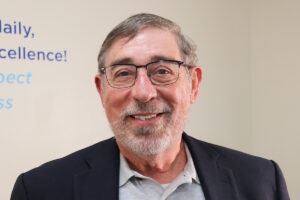
Picture of Jill Docking

Interview of Jill Docking, April 1, 2026

Interviewed by Chris Courtwright
This very thorough and comprehensive interview of Jill Docking, took place on the third floor of the reconfigured Docking State Office Building in Topeka under the portrait of her father-in-law, Governor Robert Docking. The interviewer, Chris Courtright, takes her through a number of significant milestones in Kansas political history, having married into one of Kansas' most prominent political families. She has run for office herself, in 1996 for the U.S. Senate, and again in 2014 as the Lt. Governor candidate with Paul Davis at the head of the ticket. She continues to be a tireless advocate for Show Morehigher education as a member of the Kansas Board of Regents. She serves on numerous boards such as the Kansas Health Foundation and promotes health, financial fitness and philanthropy. The stories she tells are entertaining, but they also illuminate important events in Kansas history. As the interview moves to its conclusion, Docking talks about gaps in the health care system and comments on the divisiveness in our political system as being "a cancer in this country." She sees the number of people running for public office as a positive swing and she is still engaged, supporting numerous candidates. She is still working, and not retiring!

Highlights -- short excerpts from the interview

Show Less

Interview of Cynthia Hornberger, April 10, 2026

Interviewed by Robert St. Peter
Dr. Cynthia Hornberger is a nurse-leader in nursing education and health care. In this 2026 interview she explains how nursing education evolved at Washburn University, and how the status and competency of nurses has grown in hospitals across the country. Hornberger sees advanced practice-trained nurses as critical components of the health care team and critical to delivering health care in rural settings. Today the demand for nurses often exceeds the supply. She traces the history of the development of nursing programs in Kansas to the Axtell Hospital, Axtell, Kansas and overall, to Lillian Wald who in 1893 who Show Moreadvised Dr. Samuel Crumbine, Kansas' most famous public health official. When asked why Kansas is slipping in health rankings compared to other states, she suggests Kansas lacks access to services to prevent, monitor and treat illnesses. Shortage of health care professionals is another cause. She notes there are political ramifications - politicians who do not prioritize the health and well-being of infants and children or people who are socioeconomically challenged. The discussion of how the role of nursing changed over time reflects changing attitudes about gender roles and nurses' desire for more training and a larger leadership role. Hornberger believes some things in health care eventually will be replaced by artificial intelligence (AI), such as diagnostics. The interview ends with her summarizing of her 50 years in nursing and describing her passion for gardening.

Highlights -- short excerpts from the interview

Show Less
Picture of Mary Beck Briscoe

Interview of Mary Briscoe, March 23, 2026

Interviewed by Richard Ross
This interview of Mary Beck Briscoe, a former judge in both state and federal courts, describes being one of the first women in law in Kansas. The interview covers three primary areas, Briscoe's service on the Kansas Court of Appeals and the Tenth Circuit Court of Appeals, a comparison of the two, and lessons learned. Briscoe described an instance of discrimination on the basis of sex from Georgia Pacific Paper when she was denied entry into management training. She cites that experienceas the trigger that led her into the legal profession. Briscoe co-chaired the Gender Bias Show MoreTask Force of the Kansas Bar Association in the eighties. She discusses the concept of merit selection of judges and why, at the time of the interview, she opposed a proposed constitutional amendment to elect Supreme Court Judges. She described the "Blitz Docket" on the state court of appeals and how much the appellate court judges traveled to hear cases which resulted in them getting to know each other very well. In 1990 a position on the federal Court of Appeals opened up. Kansas' US Senator Bob Dole was totally focused on getting her the appointment, despite the fact she was a Democrat. She paints a picture of how differently the federal court operated, as compared to the Kansas court, and suggests the Kansas court process is a better model.

Highlights -- short excerpts from the interview

Show Less

Interview of Tom Bell, March 6, 2026

Interviewed by Robert St. Peter
Tom Bell served as CEO of the Kansas Hospital Association from 2012 - 2020 when he retired. As the leader of the trade association representing Kansas hospitals, he provided education and advocacy for the 120 hospitals that were his association's members. Bell describes his work mainly as advocating for hospitals in the Kansas Legislature and with the Kansas Congressional Delegation on federal issues. During his interview he identifies several big state issues that impacted his members: Certificate of Need, scope of practice, rural hospitals, medicaid expansion and reimbursements (DRG's). The passage of the Critical Access Hospital Show Morelegislation saved a lot of hospitals and helped solve some problems. Bell said he was constantly looking for ways to balance the competing interests of all the parts of the health care system. He also noted the COVID pandemic had huge, negative impacts that are still being felt. The interview looks at the advantages or disadvantage of being a non-profit hospital vs a for-profit model. It also discussed the need for a state health planning agency to set policy. In response to the question, what are the "top issues that you think we as a state need to be addressing right now for the well-being of hospitals... and the community", Bell indicated workforce was at the top of the list as well as reimbursement and how to help the community access the best level of health care. He concluded the interview by saying, "...what's good for the hospital ought to be what's good for a particular community." Show Less

Interview of Robert Moser, March 10, 2026

Interviewed by Robert St. Peter
Dr. Moser had an unusual background because he went to pharmacy school before deciding to go to medical school. This interview really highlights the difficulties of practicing medicine in a rural area, and shows Moser's innovations in responding to those challenges. He did his residency in his hometown of Tribune; he also credits the business training in Pharmacy school as being helpful in responding to those challenges which included workforce issues. Dr. Moser joined Greely county with Wallace county, expanded the staffing and used a multijurisdictional approach to community health in those two counties. Delivering Show Morebabies was a problem - no backup, no personal time. Moser left Tribune in 2010 to work as Governor Brownback's Secretary of Health and Environment but left 3 years later because of opposition to medicaid expansion. In 2014 he joined the Kansas Heart-Stroke Collaborative - a CMS innovation - and also taught population health and family medicine at KU Medical Center. He describes what they discovered about heart attacks and strokes when they surveyed emergency room data which they used to develop evidence-based guidelines. Show Less

Interview of Maynard Oliverius, March 6, 2026

Interviewed by Robert St. Peter
Maynard Oliverius lays out in clear terms the policy choices the federal government made that shaped the health care system in the country today. Starting in 1946 with the Hill-Burton Act that paid for new hospital facilities, then the creation in 1965 of Medicare and Medicaid to ensure that seniors had a way to pay for health care and medical research, he tracks federal changes through the Affordable Care Act and Medicaid Expansion. He also notes that Kansas was leading other states in health rankings in the early 1990's, but now has fallen significantly behind other states' efforts Show Moreto improve the health of their residents. Access to health care has become a major problem for many Kansans. The interview also touches on the growth of Stormont Vail under his leadership and how it is now a major medical center serving northeast Kansas and is a locally owned, locally operated nonprofit organization. Oliverius concludes by offering his opinion that ideally the country needs to move to a single payer system in order to provide access for all - he describes it as "medicare for all." He expressed concern about the current direction of health policy nationally. Show Less
Picture of Phyllis Garibay-Coon

Interview of Phyllis Garibay-Coon, May 13, 2025

Interviewed by Linda Utoff
Phyllis Garibay-Coon, the artist who created Rebel Women, the most recent mural installed in the Kansas Statehouse, describes her journey as an artist including the importance of the support she found in the Manhattan, KS community. Garibay-Coon is the first woman to have her mural installed in the Statehouse. She is interviewed by Linda Uthoff, League of Women Voters of Manhattan/Riley County. During the interview, conducted a few months after the mural was unveiled on the 2025 anniversary of Kansas becoming a state, Garibay-Coon describes the Kansas suffragists who are the most prominent figures in Show Morethe painting. She also describes how the state and local historical societies and families of those suffragists contributed to how she imagined the mural. Garibay-Coon credits the League of Women Voters of Kansas, the AAUW of Kansas, and generous individual donors who made this public art possible.

Highlights -- short excerpts from the interview

Show Less

Interview of Robert St.Peter, January 23, 2026

Interviewed by Jim McLean
This is the opening interview for the series, Healthy Kansans. Since Bob St. Peter will be interviewing all the rest of the participants in this series, Jim McLean wanted to use this interview to establish his expertise. St. Peter was President and CEO of the Kansas Health Institute for 24 years, developing and expanding their services in Kansas. Prior to that he had extensive experience in Washington DC with health policy [see his biography]. For this series of interviews, St. Peter defines health in the broadest terms and points out why the health rankings are Show Morevaluable information for policy makers. The Kansas Health Foundation which created KHI really wanted the KHI to look at a broad set of issues that influenced how healthy we are as a city, as a county, as a state, and how education or housing, transportation influenced a person's health. St. Peter pointed out that health in Kansas isn't getting worse. People in Kansas are living longer, generally experiencing lower rates of cardiovascular disease, stroke, etc. So, it is not that our collective health is getting worse; it is that our relative standing compared to other states is getting worse. Other states are doing better, faster than Kansas in improving the health outcomes for their citizens that Kansas should be working on as well. Show Less

Interview of Gianfranco Pezzino, January 23, 2026

Interviewed by Robert St. Peter
This interview with Dr. Gianfranco Pezzino is the second in the Healthy Kansans series and sets the stage for understanding the concern that Kansas has slipped considerably in the nationwide rankings of health in the states over the last 30 years. His explanation of how the rankings work and why they are important is clear and understandable. Pezzino stated, "In the end, I became more and more convinced that the important thing was not the numbers. It was the communication that we could build around those numbers." His discussion of the social determinants of health is Show Moreimportant to understanding the rankings. He recalls a controversy covered by the local newspaper that quoted the county commissioner saying, "What does education have to do with health.?" He used that as a opportunity to begin a community conversation about those linkages. As an epidemiologist, Dr. Pezzino has played many roles in health policy in Kansas - from the local health officer to state policy maker. He recounts the stresses of being the county health officer during COVID and comments that the "social contract has been broken." He comments that there is still value in providing accurate data as a public health person but now a lot of the authority has been moved from public health officers to local elected officials. That has created a tension between individual rights and the social good. Show Less

Interview of Bill Graves, September 16, 2016

Interviewed by Michael Smith
Emporia State University Professor Michael Smith interviewed former Governor Bill Graves on the Kansas Wesleyan University campus, Graves’ alma mater, in the fall of 2016 before the November elections. The interview covered events from Graves’ years in office as well as his thoughts on the state of Kansas politics in 2016 and the political changes in the Statehouse. This interview, compared to the 2022 interview by Mike Matson delves a little more deeply into some of the political situations Graves faced, particularly in his second term with challenges from Republicans. Taken together, these interviews Show Moreform an excellent picture of the changing nature of conservatism in Kansas politics and help define the meaning of Traditional Republican. Show Less
Go to Top