
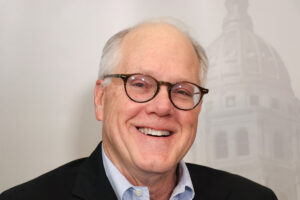
Interview of Robert St.Peter, January 23, 2026

Interviewed by Jim McLean
This is the opening interview for the series, Healthy Kansans. Since Bob St. Peter will be interviewing all the rest of the participants in this series, Jim McLean wanted to use this interview to establish his expertise. St. Peter was President and CEO of the Kansas Health Institute for 24 years, developing and expanding their services in Kansas. Prior to that he had extensive experience in Washington DC with health policy [see his biography]. For this series of interviews, St. Peter defines health in the broadest terms and points out why the health rankings are Show Morevaluable information for policy makers. The Kansas Health Foundation which created KHI really wanted the KHI to look at a broad set of issues that influenced how healthy we are as a city, as a county, as a state, and how education or housing, transportation influenced a person's health. St. Peter pointed out that health in Kansas isn't getting worse. People in Kansas are living longer, generally experiencing lower rates of cardiovascular disease, stroke, etc. So, it is not that our collective health is getting worse; it is that our relative standing compared to other states is getting worse. Other states are doing better, faster than Kansas in improving the health outcomes for their citizens that Kansas should be working on as well. Show Less

Interview of Robert (Bob) Tomlinson, August 2, 2024

Interviewed by Chris Courtwright
Chris Courtwright's interview of Bob Tomlinson, former city councilman, legislator and Assistant Insurance Commissioner is one of the longest and most complete undertaken by KOHP. The entire interview (2 hours 23 minutes) is posted here. But in addition, several shorter clips, taken from the interview, are posted below and will also be used as part of Resources for Educators. Tomlinson's interview covers his wide political experience and lessons he learned. He tells lots of funny stories about other prominent politicians of the era and shares his political philosophy and technics for "vote-counting" for Speaker Glasscock and Show Moreothers. He also comments on the public policy issues at the time of the interview, including health insurance mandates, Medicaid expansion, school vouchers, the need for full funding for special education.

Highlights -- short excerpts from the interview

Show Less

Interview of Eber Phelps, July 26, 2024

Interviewed by Chris Courtwright
Eber Phelps' interview covers the 18 years he served in the Kansas Legislature. Phelps paints a picture of the changes in the political culture and environment that occurred during his tenure. He blamed his loss in 2012 on the Brownback tax cuts, and his win in 2016 on the Brownback tax cuts. He lost because he voted against the tax experiment; he defeated Sue Boldra because of the problems the tax experiment caused in the Kansas economy and her insistence that nothing was wrong. The interview covers how Phelps became interested in politics, and the Show Morework he did on education and economic development. His work on the Insurance committee with chairman Bob Tomlinson stands in stark contrast to the current mode of work in the Legislature. The description of how the Mayor and city council found a way to solve a pressing water problem reveals his belief in community engagement. The interview closes with a discussion of how state government changed during his tenure. He noted there were 18 Democratic legislators elected from west of Salina when he was sworn in in 1996 and tax returns were filed on paper. Today, everything is online, and the makeup of the legislature is completely different.

Highlights -- short excerpts from the interview

Show Less
Photo of Les Donovan in Kansas Senate chamber April 10, 2024

Interview of Leslie (Les) Donovan, April 10, 2024

Interviewed by Chris Courtwright
Les Donovan served twenty-four years in the Kansas Legislature -- four years in the House of Representatives and twenty years in the Kansas Senate from 1993 to 2016. From his position on the tax committees of the House and Senate, he influenced major tax legislation including the tax cuts of the late 1990's. While chairing the Senate Assessment and Tax Committee from 2009 - 2016, he was involved with the efforts to correct the budget problems caused by the Brownback tax experiment of 2012. He often called attention to the high property tax rates on Show Moreautomobiles and finally succeeded in lowering them. He was an advocate for small business during his entire term. Donovan also advocated for using fuel tax to fund highway needs. This interview is a discussion of tax policy at a time of great change in Kansas. Show Less

Interview of Ed McKechnie, February 9, 2024

Interviewed by Chris Courtwright
This lengthy and wide-ranging interview is full of interesting stories about how the legislature worked when its leaders realized the House Democrats were in the majority by one vote (1990 election) with a new Democratic governor. The 1991-92 session was historic because of the major changes in property taxes and school finance. McKechnie built relationships across the aisle which helped him accomplish things and pass legislation. His interview is replete with descriptions of legislators with whom he worked. McKechnie served on the Kansas Bioscience Authority and after its demise, on the Kansas Board of Regents. Show More He discussed the transition of the University of Kansas Hospital to being designated a major cancer center. One particularly interesting story for football fans is about the major conference realignment that occurred from 2011 to 2012. He described in detail the negotiations over which university would stay or leave the Big XII. Ordinarily the Regents would not have been involved, but the impact of these decisions was too great to ignore. McKechnie also talks about the decisions the Regents made about raising tuition.

Highlights -- short excerpts from the interview

Show Less

Interview of Bill Graves, December 5, 2022

Interviewed by Mike Matson
Matson's interview of Governor Graves shows the deep respect Matson has for the man he describes as "the last of the centrist, moderate Republican Kansas governors." The interview reveals the values that guided Graves throughout his 8 years in office--to whom much is given, much is expected. It shows how a well-grounded young man dealt with the news that the career for which he had prepared was no longer an option, and how he earned the respect of 73 percent of the state's voters by winning a second term for Governor. Graves talked about his three most Show Moredifficult decisions: replacing a US Senator (Dole), concealed carry and abortion restrictions. Graves concludes with a discussion of issues he thinks the Republican party should be embracing in the future. Following the interview, Matson wrote a column which summarized Bill Graves' success. It is worth reading. (Download it after the interview transcript.) Show Less

Interview of Kathleen Sebelius, October 28, 2022

Interviewed by Joan Wagnon and Duane Goossen

Kathleen Sebelius ran for the legislature to "go home." Her kids were ages two and five and she was eager to get out of a demanding job to spend more time at home--better work-life balance. In her 2022 oral history interview, she discussed the changes in the culture of the legislature and state government she experienced over the 30-plus years she served in public office. She observed that when both US Senate seats for Kansas came open in 1996, and Sam Brownback challenged incumbent Sheila Frahm for one of the seats, a fissure Show Morewas created in the Republican party. Sebelius observed the insurance industry being very partisan and tilted toward the industry interests. Her discussion of budget issues during her terms as governor reveals her problem-solving process, even though her time in office was bookended by recessions. School finance also posed some unique challenges during her administration because the Great Recession got in the way of the court's mandates. Phill Kline, the Kansas Attorney General at the time urged Republicans to do nothing regarding school finance. The BEST teams created in the Sebelius administration were important to solving the budget crisis. This interview concludes with discussion of her selections of Lt. Governors and her experiences at the US Department of Health and Human Services (HHS) and her activities after leaving government service.

Another oral history interview of Sebelius may be found in the Energy & Environment collection on this site.

Show Less

Interview of Anthony Hensley, September 16, 2022

Interviewed by Alan Conroy
Senate Minority Leader Anthony Hensley was first elected to the Kansas House of Representatives in 1976 at the age of 22. He moved to the Senate in 1992, finishing an unexpired term of Senator Nancy Parrish. His interview covers his 44 years in the House and Senate, and almost every issue the legislature dealt with in those years: taxes, reapportionment, school finance and labor issues, to name a few. His story about negotiating with Dick Bond to increase funding for schools is a "must read". Hensley's description of how the Show MoreBrownback tax cuts were enacted after the Senate reconsidered its vote to kill them is a lesson in how parliamentary maneuvering between House and Senate can have unexpected consequences.

Highlights -- short excerpts from the interview

Show Less

Interview of Melody McCray-Miller, April 21, 2022

Interviewed by Frances Jackson
Melody McCray-Miller describes her job as speaking truth to issues that were relevant at that time, and representing a group of people who were marginalized. Rep. Miller was not the "status quo." She doesn't consider herself a "politician" but instead, a public servant. Her concept of public policy or public service was influenced by the fact that she is a Black woman who was raised in a Black family. She is the daughter of Billy Q. McCray, the first African American Commissioner in Sedgwick County who also served as a state Senator. Show More One of her mentors described her as "tough as leather." Miller was in business with her husband, and also taught school prior to running for office. She detailed how she handled conflicts or incidents of racial discrimination by "pushing forward." The latter part of the interview deals with a variety of legislative issues McCray-Miller initiated or followed. Those issues ranged from early childhood education, to payday lending, juvenile justice and health policy. Show Less

Interview of Carlos Mayans, February 11, 2022

Interviewed by Eric Sexton
Wichita, Kansas seems an unlikely place to find a Cuban-American as mayor. But Carlos Mayans' political career hasn't followed traditional paths. One TV station that supported him for Mayor gave him kudos for his tenacity in lowering airfares at the Wichita airport. Mayans' interview highlights his coming to Kansas because of the revolution in Cuba to join his brother and sister. He started his own insurance agency and later, ran for the legislature before becoming Mayor of Wichita. His interview is replete with examples of his interactions with lobbyists, fellow legislators and campaign stories. Show MoreMayans notes that Americans love to label people, and he is difficult to label. He had an impact on health policy as chair of the committee dealing with health issues such as assisted living and skilled nursing care. As Mayor of WIchita , the development of the Affordable Air Fares program was a significant boost to economic development as was the construction of an arena. Show Less
Go to Top