
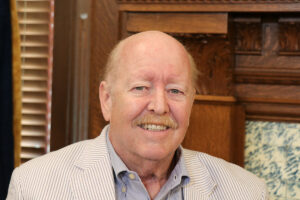
Martin Hawver

Interview of Martin Hawver, August 13, 2025

Interviewed by Jim McLean
In this 2025 interview, Martin Hawver discussed his career in journalism, focusing on his years reporting from the Kansas Statehouse. Hawver’s interview examined the role that his Hawver’s Capitol Report played in providing news and insider analysis about Kansas politics and government for three decades. Hawver reported Statehouse news and described how the issues being debated would affect Kansans. He had a reputation for asking the questions no one else would ask, often in a signature quirky manner. Hawver focused on what people needed to know, and delivered the news in a unique style. His goal was to Show Morewrite “what people think is interesting, what they ought to know, what they wish they know, what they hope other people don’t know.”

Highlights -- short excerpts from the interview

Show Less
Picture of Jill Docking

Interview of Jill Docking, April 1, 2026

Interviewed by Chris Courtwright
This very thorough and comprehensive interview of Jill Docking, took place on the third floor of the reconfigured Docking State Office Building in Topeka under the portrait of her father-in-law, Governor Robert Docking. The interviewer, Chris Courtright, takes her through a number of significant milestones in Kansas political history, having married into one of Kansas' most prominent political families. She has run for office herself, in 1996 for the U.S. Senate, and again in 2014 as the Lt. Governor candidate with Paul Davis at the head of the ticket. She was a tireless advocate for higher education Show Moreas a member of the Kansas Board of Regents. She serves on numerous boards such as the Kansas Health Foundation and promotes health, financial fitness and philanthropy. The stories she tells are entertaining, but they also illuminate important events in Kansas history. As the interview moves to its conclusion, Docking talks about gaps in the health care system and comments on the divisiveness in our political system as being "a cancer in this country." She sees the number of people running for public office as a positive swing and she is still engaged, supporting numerous candidates. She is still working, and not retiring!

Highlights -- short excerpts from the interview

Show Less
John Hanna

Interview of John Hanna, December 19, 2025

Interviewed by Jim McLean
John Hanna recalled his long career as one of the top journalists in Kansas in this 2025 interview with Jim McLean. Hanna described how covering the Kansas legislature has changed from the years when several reporters were able to cover multiple committees each day to now where a single reporter has “to tell big, broad stories to the largest audience possible.” He observed that there is “still a need for good journalism to help organize and make sense of what’s going on and to write about patterns and trends and context.” Hanna acknowledged the difficulty of maintaining Show Morethe AP style of balancing every story and giving each side equal coverage when you know one of the sides is demonstrably not true. He observed that there is an organized campaign by national groups that are getting legislatures to act and that it is “important for the reader to understand—where it’s coming from, how money is being spent, who benefits, who doesn’t.”

Highlights -- short excerpts from the interview

Show Less

Interview of Wint Winter, August 9, 2024

Interviewed by Chris Courtwright
This oral history interview covers not only the decade of Wint Winter, Jr's legislative service, 1983-1992, but also his continued involvement with politics up to the time of the interview in 2024. The 1980s and early 1990s saw considerable change in taxes, education funding, and abortion law, to name a few. The mineral severance tax, the "booster" tax, classification and reappraisal for property tasation, and a new school finance law that lowered property taxes were all discussed in this interview. During his time in the Kansas Senate, Winter chaired the Judiciary Committee and was Vice-chair of the Show MoreWays and Means Committee during that period. Winter was involved in shoring up the KPERS fund for state employees and appropriating funding for educational institutions, including colleges and universities. Senator Winter was a strong advocate for bipartisanship, saying, "No Party has a monopoly on good ideas." After leaving the Legislature, remained active in politics as a founder of Traditional Republicans for Common Sense.

Highlights --short excerpts from the interview

Show Less

Interview of Eber Phelps, July 26, 2024

Interviewed by Chris Courtwright
Eber Phelps' interview covers the 18 years he served in the Kansas Legislature. Phelps paints a picture of the changes in the political culture and environment that occurred during his tenure. He blamed his loss in 2012 on the Brownback tax cuts, and his win in 2016 on the Brownback tax cuts. He lost because he voted against the tax experiment; he defeated Sue Boldra because of the problems the tax experiment caused in the Kansas economy and her insistence that nothing was wrong. The interview covers how Phelps became interested in politics, and the Show Morework he did on education and economic development. His work on the Insurance committee with chairman Bob Tomlinson stands in stark contrast to the current mode of work in the Legislature. The description of how the Mayor and city council found a way to solve a pressing water problem reveals his belief in community engagement. The interview closes with a discussion of how state government changed during his tenure. He noted there were 18 Democratic legislators elected from west of Salina when he was sworn in in 1996 and tax returns were filed on paper. Today, everything is online, and the makeup of the legislature is completely different.

Highlights -- short excerpts from the interview

Show Less

Interview of Bruce Larkin, April 12, 2024

Interviewed by Chris Courtwright
Larkin's interview focuses extensively on his involvement with tax issues during his 20-year tenure in the legislature, and after, at the Board of Tax Appeals (BOTA). He tells lots of funny stories in the interview, particularly about legislative strategy. Larkin got interested in the legislature because of the American Agriculture movement in the mid-1980's. He joined the Department of Revenue's Use Value Advisory Group at a time when appraising farm ground was difficult. Larkin was a small family farmer who farmed ground that his great grandfather had bought in 1878. Larkin was also interested in education; Show Moreparticularly how small rural communities were faring under the school finance formula. But his consistent interest was in taxation. He was involved in almost every tax issue that surfaced during his 20-year involvement with the legislature, and afterward, as a staff member at the Kansas Department of Revenue or on the Court of Tax Appeal as a judge or as Chief Judge. His discussion of issues surrounding classification and appraisal is very informative. He described changes in the use value appraisal of agricultural land. Show Less

Interview of Richard Carlson, February 9, 2024

Interviewed by Chris Courtwright
Richard Carlson held several important positions in Kansas government -- Secretary of Transportation, Chair of the House Taxation Committee, County Commissioner of Pottawatomie County -- in addition to being a farmer/cattleman, banker, businessman. In his interview he describes his efforts as Tax Chairman to pass and implement Governor Brownback's tax plan of 2012. He acknowledged the plan as finally passed was "unsustainable." In 2016 Governor Brownback appointed Carlson to the position of Secretary of Transportation (2016-2019). During his time as Secretary, he oversaw the implementation of various transportation projects around the state.

Interview of Jim Denning, April 13, 2023

Interviewed by Alan Conroy
Jim Denning served four years as Majority Leader for the Kansas Senate. His interview reveals his Western Kansas leanings, despite having worked, lived and represented Johnson County. HIs legislative interests included health care policy, funding KPERS and school finance. He described Senate Bill 9--KU Cancer designation--as one of his important contributions. Denning found that Governor Brownback’s tax plan was creating problems for Kansas – “too deep and unsustainable.” His philosophy was, "At the end of the day, you have to govern." Throughout his tenure in the Senate, Medicaid expansion was a pressing issue, but Show Morehe didn’t like the way the bills were constructed, so he developed a Republican alternative that he thought would be a model for the country. His interview details how he kept the Democratic alternative from passing, but his own bill was caught up in abortion politics and failed to pass. Denning led the Senate during three special sessions: school finance, COVID, and repealing the Brownback tax plan. Show Less

Interview of Paul Feleciano, February 11, 2022

Interviewed by Eric Sexton
Paul Feleciano served from 1972 until 2003 in the Kansas Legislature, primarily in the State Senate. During his 31 year tenure he served on almost every committee. His interview discusses a wide range of issues including groundwater management, mental health reform, and changes in the penal system. His descriptions of the personalities of Senate leadership make that era come alive. He characterizes the men and women serving in the 1970's and 80's as giants --articulate, caring, compassionate problem solvers who would work "across the aisles" to make things happen. As the legislature moved into the 21st Show MoreCentury, Feleciano noted the split in the Republican Party between conservatives and moderates became a real problem because, "they didn't want to compromise." After leaving the legislature, Feleciano was appointed to the Kansas Parole Board and served there for six years. Show Less

Interview Series of Don Hill by Janice Huston, Spring, 2017

Interviewed by Janice Huston
In a wide-ranging series of interviews conducted by Jan Huston of the Lyon County Historical Society, former Representative Don Hill talks candidly about his experiences over 14 years of service to the 60th district in the Kansas Legislature (2003-2016). During those 14 sessions Hill experienced a sea-change in legislative culture as well as a profound shift in political philosophy among its leaders. Hill worked closely with three governors - Sebelius, Parkinson, Brownback-- and several Speakers of the House. His interviews reveal the intricacies of creating public policy and making change happen. For Show Morestudents of Kansas government, this set of interviews is invaluable to understanding the shifts in leadership which occurred during this period, as well as policy failures and successes with tough issues such as Medicaid expansion, a 10-year highway plan, and expansion of a coal-fired plant in the Garden City area. Show Less
Go to Top