Alicia Salisbury, Kansas

Interview of Alicia Salisbury, October 23, 2020

Interviewed by Patty Clark
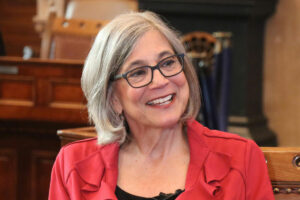
Former Senator Alicia Salisbury grew up in a political family--both father and grandfather served in the legislature--so her sixteen years of service as a Kansas Senator continued the family tradition. She also was a serious legislator who believed in community service as witnessed by the numerous boards and committees on which she served, both volunteer and elected. Salisbury's driving interests were improving the economy of Kansas and bringing growth in wealth to her community and state. Salisbury's 2020 oral history interview chronicles her work ethic. With her children no longer at home, she had the Show Moretime and the interest to dive into a wide assortment of issues, from workforce development, to interstate banking, to telecommunication reform, to a blue ribbon panel on workers compensation. Salisbury worked long hours and focused on constituent services. She boldly asked for the committees that interested her and championed changes where necessary. Salisbury succeeded in changing the Labor and Industry Committee into the Commerce Committee to handle everything from economic development strategies to workers compensation. She tackled tough issues with a sense of humor and the skills of collaboration learned as a volunteer leader. This interview describes her determination, her commitment, and her legacy to the state of Kansas as Vice President of the Senate. Show Less
Dale Dennis, Kansas

Interview of Dale Dennis, August 28, 2020

Interviewed by Andy Tompkins
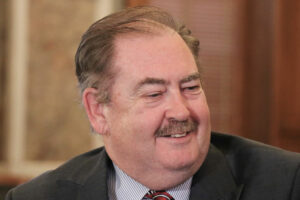
People interested in the development of education policy in Kansas will find no better resource than this 2020 oral history interview with Dale Dennis, Deputy Commissioner of Education. The interview was conducted by Dr. Andy Tompkins, a former Kansas Commissioner of Education. During the interview, Dennis speaks candidly about policy development, identifying the issues and the legislators who were intrinsically involved. The interview covers the 1972 lawsuit which was the first dealing with issues of equity in school funding. Twenty years later, a 1992 school finance lawsuit again challenged the lack of equalization which rendered the formula unconstitutional. Dennis explains Show Morein detail the process by which the Legislature, Governor Joan Finney, Speaker Marvin Barkis, and others went about addressing the Court's concerns. By 2000 the Legislature had again failed to fund the school finance formula fully and the Montoy lawsuit arose. Another case, Gannon, began in 2010. This time the problem was the adequacy of the funding to meet constitutional requirements. Moving on from school finance lawsuits, the interview covers school consolidation and related issues of local control. Dennis explains why he started offering budget workshops to school administrators, including the development of software and the use of computers. This interview includes a brief discussion of the 1999-2000 legislation that moved state oversight of community colleges and technical schools (later termed technical colleges) from the Kansas Department of Education to the Kansas Board of Regents.

Highlight -- short excerpt from the interview

Interview of Tim Shallenburger, September 25, 2020

Interviewed by Alan Conroy
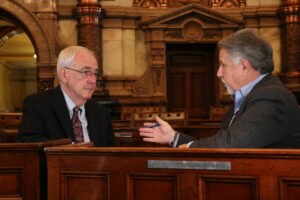
This interview with Tim Shallenburger, former Speaker and twelve-year House member is packed full of interesting anecdotes covering his philosophy of leadership, antics in the House, battles fought and won. Shallenburger was the first "conservative" Speaker following a wave of conservatives being elected beginning in the early 1990's. He candidly discusses why he ran for office in a largely Democratic district, how he moved up in the leadership and developed relationships with other legislative leaders in both House and Senate. Early in his time in the House, Shallenburger was part of a group known as the "rebels". Show More He watched other people's leadership styles and learned how to be a leader himself, first getting elected Speaker Pro Tem and then Speaker, beating Speaker Bob Miller in a "not-so-close" race. Shallenburger learned how to count votes. He doesn't see himself as having an "agenda", other than being fair as a leader. Shallenburger describes the rules changes the rebels made in the House when Jim Braden was Speaker to allow more bills to be heard or pulled out of committee. Bill Graves was Governor throughout all four years of Shallenburger' s term as Speaker. Shallenburger left the legislature to become State Treasurer. After 2010 he served as legislative liaison for Governor Brownback. Shallenburger talks openly about his relationships with numerous governors and senate leaders. The interview closes with a discussion of redistricting. Show Less
tim emert kansas

Interview of Tim Emert, October 4, 2019

Interviewed by Jim McLean
Tim Emert's interview covers his Senate career in the last decade of the Twentieth century, following passage of a markedly different school finance bill in 1992 and with a divided Republican caucus in the Senate--a time of big change. Emert stepped into the chairmanship of the Senate Judiciary Committee immediately and later moved up to become Senate Majority Leader, elected to that post with a one-vote margin. In this oral history interview he described coalitions he formed to get legislation passed. As Judiciary chair, Emert dealt with both the death penalty, which he personally opposed, and a Show Morebill restricting late term abortions which no one liked but which passed anyway. He worked with Christine Downey to get a major policy change regarding community colleges. Emert also described his work on the State Board of Education and later, the Board of Regents. He characterizes himself as neither moderate or conservative, but as "a realistic Republican." He talked about his time as Majority Leader being a "juggling act" trying to maintain communication with the conservative House Speakers (Shallenburger and Jennison) and the Senate. He explained the tension in having both the poorest and richest counties in his district and trying to provide equalization of school funding. Emert also talked briefly about on the renovation of the Capitol and the renovation of Cedar Crest (the Governors Mansion). Show Less

Interview of Jene Vickrey, September 11, 2020

Interviewed by Alan Conroy
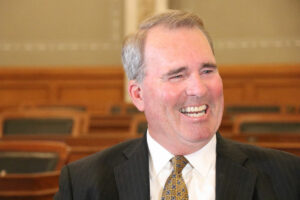
In this oral history interview, Jene Vickrey recalls his first campaign (where he narrowly defeated then-Speaker Marvin Barkis) as having not much money but "a lot of shoe leather." He discusses his political mentors, Melvin Neufeld and Tim Shallenburger and the advice they gave him in the early years, about lobbyists and handling hot-button issues. He learned not only from his mentors, but other colleagues who helped him, some of whom were Democrats. The interview covers bills he sponsored, many of which were pro-life legislation. He describes the "tough challenges" such as Show Morefoster care systems (he was a foster parent), school finance and taxes. He didn't support casino gambling although his constituents were in favor of it. The interview concludes with Vickrey reflecting on the changes he saw in 28 years, the growth in the number of conservatives and a loosening of the control of the House from leadership to the body itself by rules changes for more transparency as well as becoming more partisan. Show Less
Kansas House Speaker Robin Jennison

Interview of Robin Jennison, October 4, 2019

Interviewed by Jim McLean
Jim McLean’s interview of Robin Jennison is lengthy but full of interesting stories and anecdotes about what went on in the legislature in the last decade of the 20th Century. McLean teases out both the politics and policy from Jennison’s experiences in the House with the 1992 school finance bill and his Republican alternative. Jennison shares his philosophy on how to fund schools, lower property taxes, leadership races and his rapid rise to Speaker in the 1999-2000 sessions. The strategy he used to pass the 1999 transportation bill out of the House is clever. There is Show Morean anecdote about replacing carpet in the Judicial Center and what it took to get that appropriation passed. Jennison describes his role as Secretary of Wildlife and Parks and working under Governor Brownback. Show Less
Susan Wagle, Kansas

Interview of Susan Wagle, December 18, 2020

Interviewed by Alan Conroy
Former Kansas legislator Susan Wagle describes her interest in politics as "evolving over time." In this interview she candidly talks about her journey to become the first woman to break the glass ceiling and be elected to the top leadership position in the Kansas Senate. And she held onto the Senate Presidency for two terms. Wagle cites several events as having shaped her decision to run: getting a free pregnancy test and learning it was from an abortion clinic; seeing the huge property tax bills resulting from classification and reappraisal and how they angered people; enactment Show Moreof bingo legislation that affected he business negatively--all of which led to awareness that government could have an impact on families and businesses. Once in the Legislature, Wagle developed legislation to control property taxes. When an incumbent left a Senate seat, Wagle moved to the other chamber. She formed alliances in both the House and Senate with a group of conservative legislators enabling her to attain leadership positions. Wagle authored the Woman's Right to Know Act and solicited support from a prochoice Senator to get it passed--the first pro-life legislation. As a committee chair Wagle felt she had greater ability to pass bills that were needed. The issues she addressed ranged from protecting ground water from corporate hog farming, to tax-limiting measures, to ethics. Wagle credits her many years of service to listening to her constituents on issues such as taxation, quality of life, and education. In the closing of this interview, Wagle talks about her last year with COVID which she describes as "horrific" and disruptive. She reflects on her accomplishments changing the Board of Healing Arts and dealing with the Bioscience Authority. Show Less
Jerry Karr, Kansas

Interview of Gerald (Jerry) Karr, May 11, 2017

Interviewed by Janice Huston
This interview of Senator Jerry Karr by Janice Huston for the Lyon County Historical Society is lengthy, but gives great insight into the 18 years Karr spent in the Kansas Senate. It also covers his academic career which preceded his election and delves into rural life in Kansas. It begins with his Sierra Leone experiences teaching agricultural economics and other teaching jobs in the Midwest. Karr was elected to the state Senate in 1980 which is the time the farm crisis started boiling over in Kansas. During those first 10 years he developed legislation addressing Show Morethe farm crisis, including changing the method of selecting the Secretary of Agriculture, altering the classification and reappraisal of land, and regulating corporate hog farming. His service on the Joint Rules and Regulations Administrative committee helped him shape agricultural policy. He became Minority Leader ten years after his first election. Redistricting in 1991 ended up in the courts and spelled the end of many rural Democrats. There are numerous examples of policy making, particularly the details about the 1992 school finance legislation that amplify others’ accounts of that legislation. His examples of effective leadership and effective campaigning will be of interest to many. The interview also covers communication with constituents in a large district and has anecdotes about issues leaders have to deal with. Karr covers just about all aspects of leading a caucus and life in the Senate in the 1980s and 1990s. Show Less
Dave Kerr, Kansas

Interview of Dave Kerr, August 23, 2019

Interviewed by Dale Goter
In a 2019 oral history interview Dave Kerr recalls nearly 20 years in the Kansas Senate including his terms as Chair of the Senate Ways and Means Committee and President of the Senate. His tenure in the senate spanned the period when state resources were directed toward economic development, an effort he thought was much needed. Kerr also recalls the revamping of the public education funding formula in 1992 and reorganization of governance and oversight of postsecondary education. He observes that key characteristics of a leader are willingness to listen to various points of view and endure the Show More"slings and arrows" of leadership. Show Less
Audrey Langworthy

Interview of Audrey Langworthy, October 18, 2019

Interviewed by Joan Wagnon
This 2019 oral history interview of former Kansas State Senator Audrey Langworthy covers her first race to unseat long-time State Senator Norman Gaar, a race she won in 1984 and her four subsequent terms--a total of 16 years. Some of her new colleagues in the Senate steered her to the Assessment and Taxation Committee which she ultimately chaired and loved. Langworthy's tenacity comes through in the interview as she talks about the steep learning curve when she got to the Senate and to the Tax Committee. She received death threat letters after her vote on capital punishment which she sent Show Moreto the Kansas Bureau of Investigation. This interview includes an interesting discussion of strategy developed to pass the 1999 transportation plan and Langworthy's role in it. Her depiction of her views on leadership, her "personal first bill" on the Oregon Trail, and the Bi-state Cultural District bill are worth reading for insight into how Langworthy operated in the Senate and how the increase in the number of women Senators changed the culture of the Senate. Show Less
Go to Top