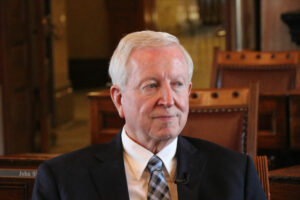
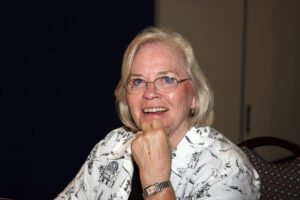
Janis Lee, Kansas

Interview of Janis Lee, October 14, 2019

Interviewed by Joan Wagnon
Former State Senator Janis Lee's 2019 oral history interview covered her 22 years in the Kansas Senate as well as several years on the Kansas Court of Tax Appeals (formerly the Board of Tax Appeals and later returned to that name). The interview covers many topics, including how she campaigned in a rural district that increased in area over those 22 years, driving as much as 45,000 miles in an election year. Lee developed expertise in tax issues that was important to the agriculture community and in funding rural schools. Water supply was an important issue in her district, Show Moreas was adapting federal regulations so they would work in rural communities. She witnessed the shift to a more conservative legislature and more anti-abortion legislation. Funding for schools dominated most sessions.

Highlight -- short excerpt from the interview

An interview of Lee and her former colleague in the House, Laura McClure, may be found in the Energy & Environment collection on this site.

Show Less
Janis Lee, Lana Oleen, Joan Wagnon, Kansas

The Ladies Room – Conversation with Lana Oleen and Janis Lee, October 14, 2019

Interviewed by Joan Wagnon
The Ladies Room is a short Statehouse Conversation with former Kansas State Senators Janis Lee and Lana Oleen facilitated by former State Representative Joan Wagnon. The conversation centers around the culture of the Kansas Senate when Lee and Oleen served their first session in 1989. Altogether, eight new women Senators began their service that year. Lee and Oleen rose to leadership positions in their respective caucuses.
Speaker Doug Mays

Interview of Doug Mays, September 25, 2020

Interviewed by Alan Conroy
This interview with former Speaker Doug Mays contains good insight into how the Kansas House of Representatives functioned at the end of the Twentieth Century and the first decade of the Twenty-First. The institution was changing as its membership became more conservative. Mays describes in great detail how its leadership dealt with controversial issues such as school finance and taxation. Mays cites two issues as his proudest accomplishments: passing a sales tax to lower property taxes for Washburn University and neighborhood revitalization legislation. Speaker Mays notes that every time a bill came through, he read Show Moreit. His discussion of the power of the speaker is illustrated with numerous examples. “ I believed in the process. I believed that the speaker was the keeper, the protector of the process.” He promoted civility in the body and developed a good relationship with the Minority Leader Dennis McKinney which allowed him to end the 2005 Special Session without adjourning sine die. Mays promoted greater use of technology for the legislature and tightening of deadlines to ensure smooth operations. There are several examples of his relationship with governors. Anyone interested in being a speaker should read this interview. Show Less

Interview of Dennis McKinney, August 23, 2019

Interviewed by Dale Goter
Dennis McKinney developed many insights in his sixteen years as a leader in the minority party into how the legislature did work, and how it should work. He recounts numerous instances when things worked well because of bipartisan cooperation and compromise. McKinney's experiences on the House Energy and Natural Resources committee working with Carl Holmes and Ken Grotewiel helped shape water policy in Kansas. His experience as a farmer and rancher in south central Kansas coupled with his focus on problem solving led to his reputation as a "middle of the road legislator" who would work Show Morewith both political sides as well as urban and rural. McKinney was committed to public education as well as conservation. The pursuit of fair and balanced tax policy shaped his actions. The interview highlights the importance of leadership from the governor's office and other legislative leaders (Mays, Shallenburger, D. Kerr, Morris). There is an interesting segment about the 2005 Special Session on school finance where McKinney talks about using the courts as leverage. The interview concludes with a brief discussion of the Greensburg tornado. Show Less
Picture of Steve Morris in Kansas Senate chamber

Interview of Steve Morris, July 15, 2020

Interviewed by Joan Wagnon
Senate President Steve Morris gives a lengthy and detailed account of his twenty years in the Senate and his eight years as president. A former Hugoton school board member, Morris challenged a 16 year incumbent Democrat (Leroy Hayden) and won by a 2:1 margin in the 1992 election. During this period there were several high profile issues which Morris championed. Casino gambling passed in 2007 after a 12 hour filibuster. A coal-fired plant (Sunflower Electric) in Holcomb wanted to expand but Governor Sebelius vetoed that bill, twice. The Special Session of 2005 dealt with a Show MoreSupreme Court order to increase education funding to constitutional levels which took 12 days to develop a consensus. A 2010 transportation plan was passed during a recession. Morris initiated a three-university plan to increase the number of engineers in the state by 65 percent beginning in 2011, assisted by Senator Carolyn McGinn. Governor Sam Brownback's "tax experiment" which was passed in 2012 took huge amounts out of the transportation plan to close budget gaps. The interview contains a detailed account of the shenanigans that took place after the Senate refused to pass the Brownback bill. The Governor pleaded with Morris to reverse their action and send the bill to conference, which Morris did, only to find the House concurring to pass the original bill. Morris ran again, but was defeated in a Republican primary.

Another oral history interview of Morris is included in the Energy & Environment collection on this site.

Show Less
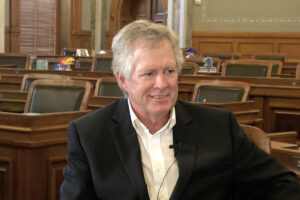
Marge Petty, Kansas

Interview of Marge Petty, September 11, 2020

Interviewed by Patty Clark
This oral history interview of former Senator Marge Petty covers her 12 sessions in the State Senate representing a Topeka district (Senate 18). Petty talks about why she registered as a Democrat, challenged a sitting Republican woman Senator in the 1988 election, and won. She discusses specific issues such as the investigation of the KPERS venture capital investments with other Senators, healthcare issues, foster care, and education. The interview also chronicles her career after leaving the legislature in 2000. Petty talks candidly about losing that last election, after which she began working for the Kansas Corporation Show MoreCommission. Later, she decided to move back to Dallas and worked to secure an appointment from President Obama as a regional representative of Health and Human Services. Petty describes the process of going after that appointment. This is a wide-ranging interview that shows the energy and skills Petty brought to the public arena. Show Less
Go to Top