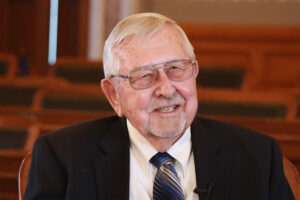
Chief Justice Lawton Nuss

Interview of Lawton Nuss, July 27, 2022

Interviewed by Richard Ross
Retired Chief Justice Lawton Nuss describes his attempts to be appointed to the Court of Appeals (he was not) and to the Supreme Court. Nuss served as Acting Chief during the illness of Chief Justice Davis. After becoming Chief Justice in 2010 he became the chief spokesman and administrator for the entire judicial branch of nearly 1600 employees and 250 judges. In 2014-15 he appointed a Court Budget Advisory committee to help resolve an eight million dollar budget shortfall. He discussed at length the legislative reaction to the Gannon v State school finance case which was Show Morefiled in 2010 and not finally resolved until 2019. Nuss describes his work with the conservative leadership in the state legislature, and a conservative governor, and their attempts to gain more control over the courts. He dealt with budget shortfalls that resulted in closing the courts; attempts to elect rather than appoint judges; and threats to change the role of the courts in the constitution. Nuss was a vigorous defender of the judicial system's independence against legislative interference. He cited the Supreme Court’s Solomon case which essentially answered the question, "‘Should the judicial branch have to give away some of its power granted directly by the people in their Constitution in order to get funding from the legislature.” The court's decisions on school finance continued to provoke the legislature during his tenure. Show Less

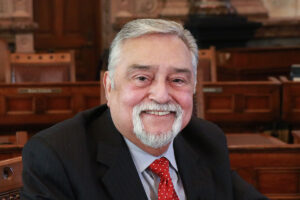
Interview of Raphael Wahwassuck, February 28, 2022

Interviewed by Brad Hamilton
The Tribal Council of the Prairie Band Potawatomi Nation selected Raphael Wahwassuck to interview with KS Oral History about public policymaking by tribal governments. The interview covers how tribal governments relate to local, state and federal governmental units and how Wahwassuck, as a tribal council member, develops effective working relationships. He gives examples of local cooperation using emergency services and law enforcement. He also speaks to the challenges in ensuring equitable distribution of school funding, COVID relief measures and impact aid. Relationships with local governments are easier than at the state or federal level. Show MoreNation to Nation conversations are more difficult. The development of casino gaming produced increased and adequate revenues for the Tribe since they have no tax revenue from property taxes. Their services to their tribal members and surrounding communities have increased as a result of gaming. Show Less

Interview of Paul Feleciano, February 11, 2022

Interviewed by Eric Sexton
Paul Feleciano served from 1972 until 2003 in the Kansas Legislature, primarily in the State Senate. During his 31 year tenure he served on almost every committee. His interview discusses a wide range of issues including groundwater management, mental health reform, and changes in the penal system. His descriptions of the personalities of Senate leadership make that era come alive. He characterizes the men and women serving in the 1970's and 80's as giants --articulate, caring, compassionate problem solvers who would work "across the aisles" to make things happen. As the legislature moved into the 21st Show MoreCentury, Feleciano noted the split in the Republican Party between conservatives and moderates became a real problem because, "they didn't want to compromise." After leaving the legislature, Feleciano was appointed to the Kansas Parole Board and served there for six years. Show Less

Interview of Jack Wempe, September 28, 2021

Interviewed by Alan Conroy
Jack Wempe of Rice County gave a detailed interview about the decade of the 1990's he spent in the Kansas House of Representatives. He played pivotal roles in the passage of the 1992 school finance bill and legislation to consolidate governance in higher education. He worked with members of both parties to pass legislation important to rural communities as well as education. Wempe became interested in taxation and economic development. Wempe also comments on the shift in philosophy of the Republican party during his time in office and its move to a more conservative leadership. Show MoreAt the conclusion of his legislative service, Wempe was appointed to the Board of Regents where he became chair in 2003.

Another interview of Wempe is included in the Leaders in Kansas Education collection on this site.

Show Less
tim emert kansas

Interview of Tim Emert, October 4, 2019

Interviewed by Jim McLean
Tim Emert's interview covers his Senate career in the last decade of the Twentieth century, following passage of a markedly different school finance bill in 1992 and with a divided Republican caucus in the Senate--a time of big change. Emert stepped into the chairmanship of the Senate Judiciary Committee immediately and later moved up to become Senate Majority Leader, elected to that post with a one-vote margin. In this oral history interview he described coalitions he formed to get legislation passed. As Judiciary chair, Emert dealt with both the death penalty, which he personally opposed, and a Show Morebill restricting late term abortions which no one liked but which passed anyway. He worked with Christine Downey to get a major policy change regarding community colleges. Emert also described his work on the State Board of Education and later, the Board of Regents. He characterizes himself as neither moderate or conservative, but as "a realistic Republican." He talked about his time as Majority Leader being a "juggling act" trying to maintain communication with the conservative House Speakers (Shallenburger and Jennison) and the Senate. He explained the tension in having both the poorest and richest counties in his district and trying to provide equalization of school funding. Emert also talked briefly about on the renovation of the Capitol and the renovation of Cedar Crest (the Governors Mansion). Show Less
Jerry Karr, Kansas

Interview of Gerald (Jerry) Karr, May 11, 2017

Interviewed by Janice Huston
This interview of Senator Jerry Karr by Janice Huston for the Lyon County Historical Society is lengthy, but gives great insight into the 18 years Karr spent in the Kansas Senate. It also covers his academic career which preceded his election and delves into rural life in Kansas. It begins with his Sierra Leone experiences teaching agricultural economics and other teaching jobs in the Midwest. Karr was elected to the state Senate in 1980 which is the time the farm crisis started boiling over in Kansas. During those first 10 years he developed legislation addressing Show Morethe farm crisis, including changing the method of selecting the Secretary of Agriculture, altering the classification and reappraisal of land, and regulating corporate hog farming. His service on the Joint Rules and Regulations Administrative committee helped him shape agricultural policy. He became Minority Leader ten years after his first election. Redistricting in 1991 ended up in the courts and spelled the end of many rural Democrats. There are numerous examples of policy making, particularly the details about the 1992 school finance legislation that amplify others’ accounts of that legislation. His examples of effective leadership and effective campaigning will be of interest to many. The interview also covers communication with constituents in a large district and has anecdotes about issues leaders have to deal with. Karr covers just about all aspects of leading a caucus and life in the Senate in the 1980s and 1990s. Show Less
Senator Fred Kerr

Interview of Fred Kerr, March 30, 2015

Interviewed by Burdett Loomis
This is the first of two oral history interviews of Fred Kerr in this collection. Kerr reflects on his 15 years in the Kansas Senate representing the 33rd Senate district. He recalls Senate leaders and fellow Senators who helped him as a freshman and the influence of those mentors on his career. Fred talks extensively about the process involved in securing a leadership position in the Senate and the dynamics of leadership races. He also reflects on the urban-rural divide in Kansas politics that during the late 1970s and early to mid 1980s was often more Show Moreof a force than the partisan divide. A version of this interview is also posted on KansasMemory.org, the website of the Kansas Historical Society.

The other oral history interview of Kerr is included in the Statehouse Conversations collection on this site.

Show Less
John Strickler, Kansas

Interview of John Strickler, May 22, 2019

Interviewed by Rex Buchanan
During John Strickler's 2019 oral history interview, he recalled meeting and becoming friends with newly-elected State Representative Mike Hayden. Later, from 1987 to 1989, Strickler served as Special Assistant to Governor Hayden on environmental matters. During the 1989 legislative session, Strickler assisted Hayden in his efforts to secure funding for implementation of the State Water Plan. He describes in some detail the debateed among the various interests over whether water plan funding should come from the State General Fund or from water user fees. Strickler observed the dynamics of the governor's office, legislature, and various interests in Show Morethe passage of the Water Plan funding. He noted that subsequent governors and the legislature have not maintained funding levels as originally proposed. Strickler discussed the difficulty of managing water resources in Kansas and elsewhere and the problems of implementing environmental education. Show Less
Go to Top