
Interview of Matt Allen, Tom Nguyen, Atim Longa and Anthony Calderon, August 21, 2026
Interviewed by Robert St. Peter
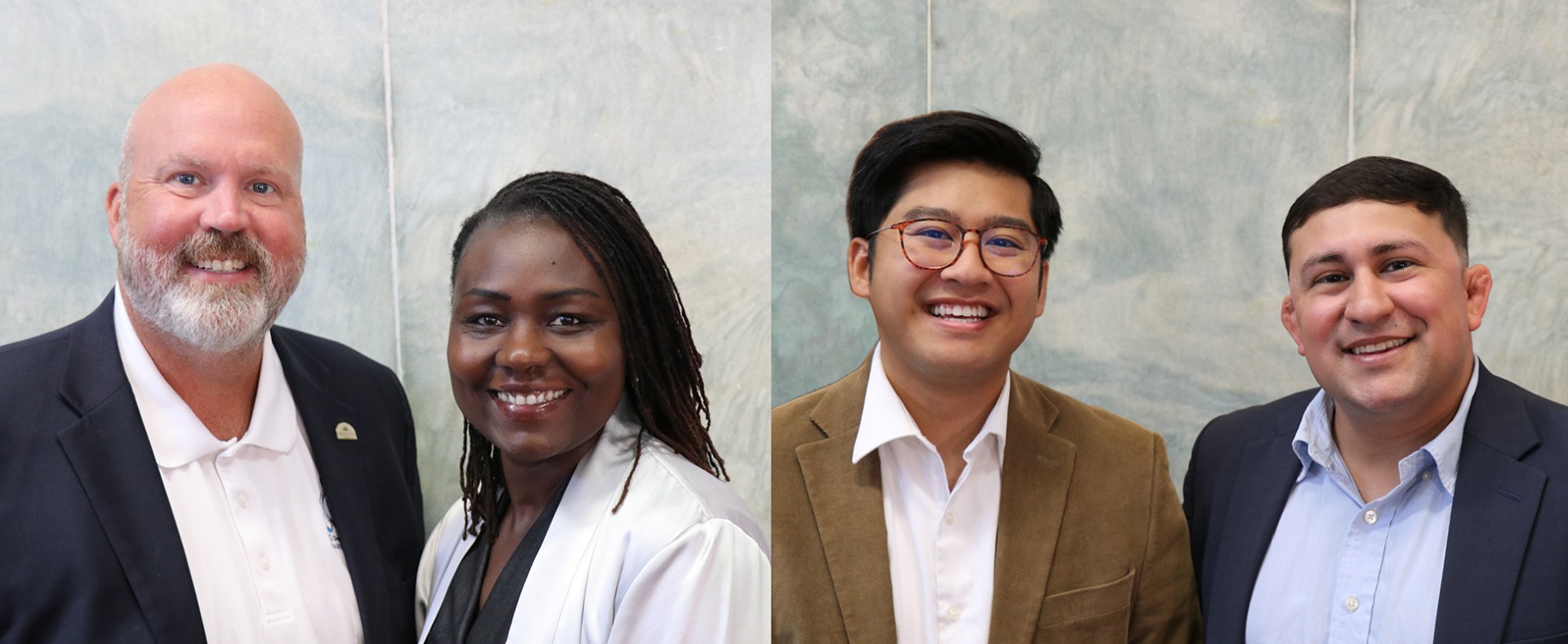
This interview of four community leaders in Garden City is different from most of the interviews done in this series, first because it is a conversation among a group of people, and second, instead of talking about medical care or healthcare, they talked about things that are really important to how healthy Garden City is as a community. Participants are Matt Allen, current city manager of Garden City, Tom Nguyen, current Mayor and city commission member, Atim Longa, director of the Kansas Office for Refugees for the International Rescue Committee and Anthony Calderon, a wrestling coach and highway patrolman. Their stories about how they came to Garden City are fascinating. Their accomplishments, working individually and together have made Garden City an innovative, welcoming place for a diverse population that has created economic growth for the area.
Access to Health Care; Beef-packing Industry; Belonging to a community; Demographic Makeup of Garden City; Health policy; Health Rankings; Infrastructure Challenges; Language Barriers; Mental health services; Mentoring Programs for Youth; Public Health; Refugee System; Risk-taking spirit; Rural Hospitals; Rural population change; Secondary Migrations; Social Determinants of Health; Welcoming community spirit
Matt Allen leads a talented municipal government team that regularly receives state and national recognition for achievement and innovation. He has been the City Manager for the City of Garden City, KS since June 1, 2008. Prior to that, Matt served Garden City as Assistant City Manager for six years. In 2017 Matt was named Alumnus of the Year by Leadership Kansas and was profiled in Ingram Magazine's 50 Kansans You Should Know. In 2018 he was awarded the Kansas Association of City/County Management's highest honor, the Buford Watson Award for Excellence in Public Management and in 2019 the Kansas Chapter of the American Society of Public Administration named him the Kansas Public Servant of the Year. In addition to serving the City of Garden City, Matt devotes considerable time and attention to statewide matters. He served for nine years on the Kansas Health Foundation Board of Directors, including two years as board chair. He is currently co-chair of Economic Lifelines, a statewide transportation advocacy group and is a member of numerous other organizations.
Tom Nguyen was elected City Commissioner for Garden City in 2024. He is currently serving a rotating one year term as Mayor in 2026. In this role he oversees policy development, budget allocation and city planning initiatives to promote sustainable growth his community. He often engages with community leaders, businesses and local officials to promote cultural and recreational programs and support initiatives to enhance the quality of life in Garden City. He is active on Live Well, a community county health coalition. Mayor Nguyen has also worked in youth programs as a coordinator and as a substitute teacher in the schools. He is also active with St. Mary's Catholic Church and its programs. He is a graduate of St. Joseph's University in Brooklyn, NY.
Atim Longa is an experienced and results-driven leader with over 22 years of expertise in human services management, refugee resettlement and advocacy. She demonstrates success in strategic planning and problem solving as well as staff leadership, program development, budget management and grant administration. Atim is skilled at cultivating collaborative partnerships with diverse stakeholders and team building. She came to Garden City 16 years ago with her family and has settled in this community. A native of Uganda, she survived being a refugee from war in her own country. She has held several different positions with the International Rescue Committee in New York, Wichita and Uganda. She is fluent in several languages and has a law degree from Makerere University in Uganda and a Master's degree in International Diplomacy.
Anthony Calderon is a Technical Trooper with the Kansas Highway Patrol who is stationed in Finney County. He is currently assigned as a public Information officer covering twenty-four counties in his area. Anthony is a Garden City native and a graduate of Fort Hays State University in May 2017 with a degree in Justice Studies. In addition to his law enforcement responsibilities he is Assistant Women's Wrestling Coach at Garden City Community College and has coached women's wrestling in the high school. Anthony enjoys coaching because he gets the opportunity to influence the youth in his community in meaningful ways.
Bob St. Peter: Hello, I’m Bob St. Peter, a pediatrician and the former president of the Kansas Health Institute. Today is August 21, 2026, and I’m in Garden City, Kansas to have a conversation with members of the community about what it means for a community to be healthy. Beyond just having a doctor and access to high-quality medical care, what is it that makes a community really healthy and thriving?
This interview is part of the Kansas Oral History Project, exploring health issues in Kansas. The Kansas Oral History Project is a nonprofit corporation that collects and preserves oral histories of Kansans. This series is supported by generous individuals as well as a grant from the United Methodist Health Ministry Fund. We’re recording this session in the High Plains public radio studio here in Garden City, a beautiful old building. I want to express our thanks to them for letting us use the facility. Our audiovisual team is led by Michael Quaide, a producer and director of many video and audio productions and assisted by former State Representative Dave Heinemann. Thank you both for helping us with this.
This is going to be a little bit different than most of the interviews that we’ve done in this series because we’ve got a group of people, and we’re not going to talk about what most people may think of as being medical care and health, but we’re going to talk about things that are really important to how healthy we are as a community. I’m so excited to hear about the things going on in Garden City, the things that you guys are doing in your roles professionally as well as individuals, members of the community to make this a great place to live and to thrive. So, thank you for being here.
I’m going to introduce you all, and then I’ll have a couple of questions to get us kicked off here. We have Matt Allen who is the city manager of Garden City since 2008. We have Anthony Calderon who’s a Kansas highway patrol trooper and a women’s college wrestling coach. We have Atim Longa whos’ the director of the Kansas State Office for Refugees for the International Rescue Committee, and Tom Nguyen who is the current mayor of Garden City and a member of the City Commission. Thank you all for being here today.
I’ll just say that you’re all speaking as individuals, not as official representatives of your organizations or anything like that. So, just to start, and we’ll go in the alphabetical order I started with, just tell me a little bit about yourself and your connection with Garden City, how you or your family came to be here. Matt, let’s start with you.
Matt Allen: Thanks. Thank you for having all of us. My story with Garden City starts in 1979. My mom and I moved out here when I was about five years old. The region was experiencing a boom with the new packing plant in Finney County. She was a recently single parent and a teacher by trade. There was a call for a lot of new teachers in some of the area’s school districts. So, we moved out here, and she was able to find a job in Deerfield, where she continued her teaching career until her retirement in the mid-two-thousands.
So, I wasn’t born in Garden City, but I was raised in Garden City. I moved away after high school and came back in the early 2000s to work in city government as the assistant city manager. So, I’ve been able to experience this community through a couple of different significant growth cycles—the 1980s as a grade school, junior high, and high school student. Then the 2000s, 2010s as a professional, experiencing kind of an additional wave that were similar in cause. It was obviously around the ag industry and the growing economy in southwest Kansas, but definitely different flavors where we saw new arrivals in the eighties primarily from Mexico, Central America, and Southeast Asia. In the 2000s, that was Africa, Burma, and while there were still some Mexican and Central American new arrivals as well. It was certainly kind of a unique opportunity to live and experience that and be able to compare and contrast how the community handled that.
BSP: And a lot of those issues are things I hope that we get to talk about today. So, thank you for that background. Anthony?
Anthony. Calderon: My name’s Anthony Calderon. I work with the Kansas Highway Patrol as well as coach wresting here in Garden City. For me, I’m a Garden City Native, a third generation here in the United States. My great-grandparents were emigrated from Mexico. My grandma worked over in Deerfield, the sugar beets that were a pretty huge defining moment of the area, and then just being from this area, being a native growing up, seeing a lot of the changes and the growth that we’ve had has been truly phenomenal. I think it’s fast tracked pretty quickly in the last I might say ten years, but from just growing up, the involvement that is available for our community, I think we celebrate quite a few different cultures and then truly embrace that.
That’s something that I love about Garden City, us trying to bring athletes here is the same thing. I sell them on the community, not necessarily, the college. Yes, education is a key to get them to somewhere else, but the community itself is very accepting, and that’s something that I found that they truly value. They’re looking for a place of belonging, which I think we do a great job here in Garden City.
BSP: Before you joined the community colleges as an assistant wrestling coach, you were coaching with the girls’ wrestling program at the high school, two-time defending state champions, as I understand.
AC: Yes, they’ve been nationally ranked in the top 10 in the last three years. For a Kansas school as well as out here in southwestern Kansas, that’s a pretty awesome accomplishment.
BSP: Awesome, cool. Atim?
Atim Longa: Well, I came to Garden City sixteen years ago, in 2010. My husband and I were living in the Minneapolis, Minnesota area. In 2010, he had just completed pharmacy school, and Walgreen’s was actively recruiting in the Midwestern states. Kansas was one of the states. We had Kansas, Oklahoma. We had Texas and many other states. So, during his residence at the hospital in Minneapolis, one of the resident’s doctors at the time was from Garden City. So, just in their conversations, “Hey, You’re almost finishing school. Where do you plan to go?”
So, he told him the story and said one of the locations was X, Y, and Z, and he mentioned Garden City. She got so excited. She said, “You must go to Garden City. You must choose Garden City,” and she started talking about Garden City being diverse, how it would be great for raising children. We had three children at the time.
So we took her on her word and moved to Garden City in 2010. At the time, my oldest was three. I had a two-year-old and a two-months-old. We moved to Garden City and never left since. Our oldest now is in K State. My second is in Garden City Community College. It’s been a beautiful journey.
BSP: That’s awesome, thank you.
Tom Nguyen: Thanks for having us. Just listening to you guys, I’m joyful and very excited to be here, joining such impactful leaders in very different spheres of our community. For myself, the story kind of happens more around 1980’s, when my uncle sought asylum as a priest in the diocese here, and landed here and wanted to move the rest of his extended family into Garden City.
So, my parents and I when I was two-and-a-half in 2005 planted roots here. It’s been a very welcoming place for us, just to be involved in different community projects and now especially on the City Commission, thankfully earning the trust of our community back in the 2023 election and starting the term in 2024.
But I think another involvement that is really important to me is also in my role at LiveWell, a community county health coalition, just being able to work with the youth in our community and interacting with them and kind of understanding what is going on for our youth today. It actually humbles me to recognize that they are a lot more independent and stronger than we can recognize even in our own communities.
BSP: Remind me, how old were you when you became mayor?
TN: I was twenty-two years old. I was elected when I was twenty years old.
BSP: Awesome. Well, what an amazing and set of different stories, right? Each one of you has a very different story. So, I heard very clearly in your comments that you all consider yourself Garden Citians and Kansans. What does it take in your opinion for someone to become a Garden Citian? What do you have to do? What do you have to do to become one? What do you have to do for the community to accept you as a part of Garden City? Just throw that out there.
MA: I’ll take a first shot at this. In my profession as city management, the last twenty years for me has been an exception to this rule. There’s a lot of bouncing around early on in your career. I’ve had a chance to live in Salina, Joplin, Oakley, Kansas before moving here. All of those communities, I really enjoyed, but it seemed like if you want to know who your family was, there was a hierarchy or a credibility—if there was third generation, fourth generation, fifth generation Joplinite—and here, it was a little bit foreign to me because I didn’t recall that growing up here. Meanwhile, there’s longstanding families and that type of thing. I really feel like in this community a quick adoption to calling this home. It isn’t challenged. The genuineness of your ties to this community, if you’ve only lived here for a couple of years, three or four years, you can pretty quickly get engaged in community activities, community leadership opportunities, and weave immediately into the fabric of the community.
So, some of that is the transient nature of the community. Out of necessity, we have to maybe welcome folks earlier on than maybe some of those other communities that are less transient, but I do think it’s kind of a welcoming spirit of the community, and that’s not a new thing. I bet if you asked people what it was like in the seventies or what it was like in the sixties, they would tell you the same thing.
AL: Thanks for that. I’ll speak about my experience when I came in 2010, being a stay-at-home mom with three children. I knew that this place perhaps would be the place where I would start to raise my children. I had no other relatives, no other contacts. I knew it was upon myself to start to understand this community and build connections.
One of the first things I did was to enroll at the Garden City Community College even though I had my bachelor’s degree already. That was an easier place for me I felt that I would start to introduce myself. That was the beginning. I made connections, and I continued to step out whether it was to volunteer as board member or just interpret some cultures and through that stepping out and making connections and making friends, I started to feel that sense of belonging, not just as it was coming to me but being in every space that I showed up. I have never felt questioned when I showed up in a place. Instead I always felt this energy of like come back.
Of course, there’s a curiosity of “Who are you? How did you end up here?” I take those as a question of “I want to know you more. Your story’s beautiful. Tell me a story.” This is very courageous, and that acceptance, engagement kept me coming out again and again.
So, how do we know what’s the sense of belonging? For me, it’s through active engagement, the giving and the showing up and receiving how it’s been a very positive experience. Yes, we are very curious beings, and that’s a good thing, but the more we engage in our curiosity, the more we feel, and for me included, the sixteen years that I feel more of a Garden City person.
Last but not least, I have grown over the years with my other experience of this placement to not really sit around and wait to be welcomed and belong. It is I give, and as I give, I feel that sense of belonging, and I don’t feel questioned whether I’m from Garden City or not. This is my home.
AC: Yes, we’ve heard it twice, the engagement aspect, and I think through my eyes, just engaging with the community is putting yourself out there, stepping up to the plate, and taking on just the diversity as a whole. The. diversity that we have to offer here as well as the pride that you can continue to have in your own beliefs and cultures. I think that’s what makes somebody from Garden City. You’re accepting. You accept challenges. You help out other people whenever they need that. But at the same time, you’re also engaging yourself. You also have to take those steps and get out of your comfort zone, and for some people like you, it’s very natural to just hop out there, and some people need that additional guidance or hand to say, “Let’s go do this today,” and then it just starts that way. The next thing you know, you’ve got different roots everywhere throughout the surrounding area, not just Garden City in its own, but the smaller communities that definitely follow around us as well.
TN: I think that spirit of risk-taking is very evident in all of our answers. I think that is one of the elements of what you would say someone’s from Garden City because all the people from Garden City take big risks, whether that be from a city level, from a big-scale level or from an individual level. A risktaker at Matt’s degree is different from Altim’s degree, from Anthony’s degree, and also for the young professional who just moved here because they got a job somewhere.
But I think that same spirit paired with this understanding of pride for this community is very easy to point to of how proud you can be and also what makes you from Garden City. It’s funny that you guys also did mention the practical part. Anyone who has a mailing address in here, I would consider a Garden Citian.
MA: Yes. I’d be curious of you all’s perspective on this idea of “Where are you from?” that you can only come up with—like everybody’s only got one answer. You’re either from here, or you’re from here. I feel like in Garden City, it’s like an “and” conversation rather than an “or” conversation. You can be from Garden City and be from somewhere else. Like your origin story may have been another state, another city, another country, but you still after becoming part of the fabric of the community may always have a little bit of an anchor in Garden City and say, “I am from Garden City” or “I’m also from Garden City.”
TN: There’s always that additive that’s added, or it opens to some back story that reveals who that person is, when you ask them where they are from.
AL: I agree, yes. It’s a little more complex for people with my history background. Born in Uganda, at a very early age, a few years old, my mother had to leave Uganda for political reasons and went to then Sudan. And Sudan is now two countries out of Sudan, a Northern Sudan and Southern Sudan. In the eighties, going to civil war, she had to run again to Northern Sudan, Khartoum, where we lived for years. Then we had to leave back and come back to Uganda, but Uganda in the eighties and in the nineties had civil war. Our hometown was in war. We couldn’t go home. We had to find ourselves in a refugee camp while we’re in Uganda where I was born.
So, that’s a story of constantly being displaced and always moving, the question of “Where are you from?” becomes very abhorrent, and I’ve experienced that so many times. And to adding another layer to it, I told this story today about I didn’t know who my father was. I had never asked my mother who my father was. And yet, I came from East Africa that is patrilineal. Where you come from is dependent upon where your father came from in the community. I didn’t know who he was. I didn’t ask the question until I was twenty-one when I was in college. I asked my mom, “Let’s go for dinner.” I took her out for dinner and popped the question, “Who’s my father?” So, she gave me information that would lead me to who my father was. One year later, I met him. I met my father at twenty-two, and I was really growing up, an adult, eventually got married.
I then found myself in Garden City. I have lived here sixteen years. This is the place I’ve lived the longest. This is my highest place of values and additions. And that gave me this mentality concept to not wait to be invited to come to the table to belong because society always excluded me. If you don’t know who your father is, then you don’t belong because you don’t know who your tribe it. If you’re not a Garden City native, then you don’t belong here. If you don’t speak in this accent, perhaps you don’t belong. I stopped waiting for society to call me in and invite me. I moved forward. I give what I can give. I give my value, and then with that, I feel the sense of the concept of belonging.
So, yes, I have a history of displacement, and, yes, I’m originally born in Uganda, raised in South Sudan, and and now raising my family in Garden City. So, yes, we can have all the “ands,” but I really put my energy in the now. I am here now. What am I bringing on the table? How can I make this place best for me, my neighbors, and our community.
BSP: Wonderful. You said something when we were talking earlier that “I pay taxes. I have a job. The kids are in the school. I participate in the community. What more do I have to do to be considered from here to belong here?” I think that’s a very powerful question to ask. Other comments about this? I want to get into this concept of belonging, which is actually a very important health concept. So, we’ll come back to that.
AC: I think for me, I’d go back to you and ask, “Do you feel like you are a Garden Citian now?” I feel like you were still shaping your identity as you continued to move, and then eventually you moved here, and you’re raising a family and continuing to raise an amazing family is what it sounds like. Would you consider yourself a Garden Citian at this point?
AL: A 101 percent, and it is a feeling that I have. I know that I could wake up at 2:00 a.m., if I needed to reach out—I have no other relatives, no blood relatives here, but I have a lot of sisters and brothers and uncles to my children and myself. I know who I can call. And that sense of support system that I feel I have gives me that sense of “Yes, I’m from here.” I may have a different accent and look differently, but I am from Garden City. If someone challenged me, I would ask, “What is missing? What is it that might indicate I’m not from here?” These are all the things I feel to belong to a family, to belong to a community you should value, and I always strive and work towards that.
And I don’t feel that it is work. I don’t feel that it is a negative, heavy obligation. It feels so natural.
BSP: So, the word “belonging” came up several times in your comments. In the public health realm, there’s actually very, very compelling studies that show at a community level, they ask questions like if your neighbor had the opportunity to take advantage of you, would they? And how people answer that question at a community level is very closely related to life expectancy and disease rates among people in those communities. So, there’s something very strong about that sense of civic trust, this concept of social capital. People define that as mutual trust, civic engagement, and norms of reciprocity in the community, that is, how you treat each other and how you come to expect others to treat you. So, that concept of social capital is tightly related to health, and I’m going to conclude from the comments that I’ve heard from you all that there’s a significant amount of social capital. You all are participating in it, benefiting from it, and contributing to it. Does that resonate to you and how you think of the community?
TN: Yes, absolutely. I think it’s people helping people. Like you said, just being comfortable in where you live and in your environment. Given the question, would I feel like my neighbor would take advantage of me? Absolutely not. I think if anything, it’s watching out for each other and just being there, whether it’s in support or security or comfort, just in different areas and aspects. I think that a majority of most Garden Citians probably feel the same way, that your neighbor is going to be somebody that’s here to help.
MA: There’s a common thread for all of us; we’ve been through whatever door that we need to get through to feel that way or to be able to meet that kind of definition of help. I think that the challenge for us is to not just say, “Okay, Garden City has got to figure it out,” if it’s that way for us, it’s that way for everybody. Each day in this community, somebody’s arriving. They don’t magically get that feeling. They have to experience it themselves. So, really there’s an obligation I think on the part of everybody that lives in this community to sort of continue to build on that or continue to practice the behaviors of reaching out to strangers, like trying to find a level of comfort in something that is exceptionally uncomfortable, right? Meeting somebody that you recognize visibly or when you hear their voice or when you understand where they worship compared to where you worship, that there’s a difference. That’s just as hard to do in Garden City as it is anywhere else in the world. That’s just a natural human barrier.
So, while we have a long history in this community of having several citizens kind of leap over that wall and figure it out and then help model that for other people in the community, that’s only as good as that moment, and that’s only impacting those folks. We’ve all got to keep practice on that. So, every day, new arrivals in this community, are we making sure that they’re being welcomed, that they can begin to build confidence slowly, that they won’t be taken advantage of, that they can trust the people that are visiting with them and interacting with them even if they look like them, sound like them, worship like them?
TN: Yes, I think that social capital does in a way live in its own bubble, and it’s not always permeable to anyone that first arrives here, but the question of “Would my neighbor take advantage of me?” I actually see as much more of a positive affirmation question of “Yes, I actually hope that my neighbors take advantage of me” because I think our community in its fabrication, any newcomer, anyone who needs help at a certain point in their lives, at a certain point in time, they don’t know where to go, there’s a great chance that they do know someone who can connect them to the right resources without asking for anything in return.
So, I do think that those moments of belonging feel for me particularly is when I’m able to connect someone in need of some resource with the person who has a great resource, or much more capable of aiding them in their problem. I think that’s when that feeling of belonging occurs, when people get to help someone else. I think we can find it amongst our community very concretely.
BSP: You mentioned, Matt, in your opening comments some of the tremendous changes that have occurred in Garden City over the last fifty years and maintaining that sense of belonging in a community that is experiencing such change in the make-up of the population is a real challenge, and it’s not unique to Garden City. There are lots of other communities in our state that are experiencing that.
I want to just throw out a couple of numbers to give the reason that I think Garden City is such an excellent place to have this conversation. In 1990, the population was around 24,000; now it’s 27,000 to 28,000, according to the latest numbers that I found, the ups and downs that you mentioned over that time. But the other significant changes have been the changes of the demographic makeup of the citizens who live here, the people who live here. In 1980, Garden City was 82 percent White and about 16 percent Hispanic. Today, Whites make up about 32 percent of the population and over 55 percent is Hispanic or Latino, and significant populations, as you mentioned from Southeast Asia, from East Africa, the Caribbean culture. So, about 1 in 4 current residents of Garden City was born outside of the United States—so, again, this tremendous change over that period of time.
Tell me, first of all, what led to those significant changes? You touched again a little bit on that, but let’s get a little bit more into what led to those changes. Why this dramatic change in the population of many parts of southwest Kansas including Garden City?
MA: The beef-packing industry is, I would say, that fifty years prior to that, it was another history, but kind of starting in 1980 or the late seventies, the meat-packing industry certainly changed it. And it’s an available work force, and the economy of southwest Kansas needs bodies. It’s agnostic to race, ethnicity, language, country of origin, anything else. It needs physical labor. And the employer the size of a meat-packing plant, 3,800 employees I think now, isn’t getting it from neighboring population. That’s a giant of an employer in any neck of the woods, especially in a place as remote as southwest Kansas.
So, really the only avenue for them over the last fifty years many times is through the refugee system. So, that’s going to at different times because of what’s going on in the rest of the world, it’s not going to be a pipeline from one location. It’s going to be a moving pipeline from where there is political unrest around the globe. I think we’re kind of a sociology map, I guess, for what’s geopolitically going on in the last fifty years on the planet.
BSP: But it’s an economic development imperative, it sounds like.
MA: Absolutely, and there’s different ways to go about it. That’s not a phenomenon unique to us. Even in southwest Kansas, it’s not unique to us. It’s got a presence in Liberal. It’s got a presence in Dodge City as well. It’s kind of what we do in response to that; I think each community has choices and has made different choices over the last fifty years. So, it’s less about I think what happened to us demographically versus what did we do with the opportunity that a diverse demography gave us? Did we take full advantage of that as a community to extract all the riches of having folks from all over the world?
AL: And just adding to what Matt mentioned, in my line of work in understanding how the refugee program works is that Garden City is not necessarily receiving its highest population directly to our airport. We have what we call secondary migrations. This population may have arrived in either neighboring states or states somewhere in the country, and when they yearn for financial independence, for that feeling to be able to put food on the table, and they hear about Garden City, they pack and leave and come here.
So, they would come here again could be sort of similar to mine, where we’re like, “After three years, we’re out of here. We’ll be here just for the contract time, for three years, and we’ll be gone.” It’s been sixteen years because you find that this is a place if you have a family and you’re raising children, I want to raise my children here. I am able to raise my four children. I ‘m able to work full time. I’m able to volunteer in the community. Where else are you able to meet all this? It’s because of how strong the community is, how small it is. We don’t have traffic jams. I can do things very quickly within the space of ten, fifteen minutes. It became ideal for me. And I believe that’s the same story for the rest of the communities. They hear about Garden City. They come here, and they make this a home.
AC: Stories like that, that will make you proud as somebody from Garden City, just knowing that other people have heard the connection and the community that we have and we hold and opportunities that we have to offer. That’s pretty exciting.
TN: I also would point to Catholic charities and Catholic social services that are in a way adopting some of these migrants, whether primary or secondary migrants, but I think Matt is right. I think the question is actually more of what are these communities doing with these migrants. How have those people been welcomed, and how has that aided in the economic boon? I would be curious to see just based on that demographic data and the changes how much our economy has grown since then in comparison to these political pipelines that have caused unrest in certain nations that have brought us these valuable people into our community and have stayed to make very impactful changes.
BSP: I think the economic performance of the region over the last few decades is a testament to the success and the value of that. I want to talk a little bit about as a community and as a community worried about providing infrastructure and services to their residents, what sort of challenges are presented by the relative growth compared to other surrounding rural areas where the population has decreased and the increasing diversity of the population? What challenges does that present at an infrastructure capacity level related to health, but other aspects that are important as well?
TN: One of the first things that comes to mind to me would just be the communication piece of the infrastructure that we have in place. I think for city services, it is very difficult to provide great customer service if you can’t communicate with the customer. Those are the first things that come to mind. I know that all across the board, all of our organizations, nonprofits to the private sector I think is recognizing that and making a very concerted effort to do the best that they can to communicate even though it’s on communication languages, but it’s actually more the problem of communicating ideas and concepts that are very foreign.
When my parents came over here, they had no understanding of what the public system is supposed to be like. I don’t know if it makes sense for their five- or six-year-old to explain to them how school works for them to get me signed up. I think things like that.
BSP: You mention schools, the communication challenges in schools. How many languages are handled in the public school system here? What demands are placed on the school system and the ability for the community to raise money to build schools and support all the children? Talk a little bit about that.
MA: Well, it’s a moving target, a moving number each year. On average, I would say thirty to thirty-five different languages are spoken at the high school, in the school district. Some years, it’s been reported to be as high as forty, some years, maybe a little bit lower than thirty, but that’s a tremendous number of languages representing every continent of the country. It absolutely presents difficulty. I think Tom hit it right on. The way we did it in the eighties was well intentioned, but it was a little forced and clunky, and then we got a little bit better in the nineties. I think in the 2000s and even now, that’s kind of a continually evolving sort of performance measure in how do you adapt to new arrivals. And if you don’t have an experience with this language, how are you going to integrate the children into the school district. Again, it’s not a—we’ve done it, checked the box. We’re a place where you can show up, and everything happens like magic. It’s constant work. Kudos to the school district to recognize that and really be at the leading edge of how you pivot and continue teaching people that come with brand new languages, brand new cultures, brand new personal stories because they differ from people group to people group.
BSP: What’s been the support in the community for funding, your district created demand for money for schools and infrastructure? How has that gone at the community level? Support for that, have there been bond issues, elections? How has that been raised, the money?
MA: The bond issue in 2010, 2012? That was the most recent bond issue, and it passed. It was for primarily a new high school, but also the expansion of the middle school, a doubling of one of the grade schools to make an early childhood center.
BSP: Was it controversial? Did the community understand the need for it?
MA: It passed. The back story is it was largely around the high school. There had been at least three other votes over the previous thirty years to address the overcrowding of what was the old high school. It kind of bounced back between the two high school proposal and the one high school proposal. You kind of had three camps in town. You had ones that wanted two high schools, one that wanted one high school, and one that didn’t want anything at all. The one that didn’t want anything at all would always team up with the other side of the issue. I think it finally came down to folks that recognized, the kind of two-thirds of people that recognized something needed to be done ended up consolidating their support around the proposal that was presented in 2010. Even if it wasn’t their favorite idea, they recognized that the community couldn’t keep limping along.
BSP: What about demands on the other sectors of the economy, public safety, health care, transportation, housing? I commented driving around Garden City in the last couple of days that the housing out here is impressive to me compared to a lot of communities in the state where I drive to. Talk about some of those issues and the demands placed on those sectors.
AC. On the public safety realm, then you get into driving and different aspects of how people function daily is a challenge because the high school is a great representation of how many folks we have here, how many different cultures we have here, and then you tie that into now how do I explain that what somebody is doing as far as in the law enforcement profession. How do I explain that what someone is doing is against the law or violating some sort of protected area then just traveling across the roadway in general, and even crashes and some sort of things like that, trying to explain to people where this individual that just got injured, where are they going? How are they getting there? How are you going to get there? Explaining how to get a vehicle. There’s a lot of challenges that come with that.
I think it takes a very persistent person to not necessarily put up with but to take on those challenges because I think it would be really easy just to wash your hands away and say, “You figure it out. It’s not really my problem,” or you take the extra steps and say, “How can I figure out how to help you?” And most of the time somebody else will come on to scenes that knows somebody that knows somebody that will say, “Hey, this is where this person is from. Here’s a person that you can contact,” and then that way they can begin the next steps, which I see quite frequently, whether it’s a crash outside one of the meat-packing plants or just in one of the areas in Garden City where multiple people will show up. It’s not out of—they don’t mean any harm. They want to know what’s going on and then how they can help that person. There are definitely some challenges and some ways that we can move forward. I think to have folks from each individual area kind of step up and take that role on, which is probably tough to be that person that’s relaying information.
BSP: I think even complex medical situations where language and health literacy, really understanding all the complexities with adding the language issues becomes a real challenge to providing high-quality health care. Any particular reflections on challenges to the health care system? I’ll ask separately in a moment about behavioral health, mental health care, but what about just health care in general? How is the community dealing with that across a couple of decades?
AL: I can go in and just talk about the systematic competence of our health care. The access to quality health care on a very high level is dependent upon health insurance as one of the concepts of how we get our health care here. As we mentioned, most of the newcomers by numbers, by default may be working at Tyson, and that has its own concept of health insurance to be able to access the medical services. But the health insurance concept is more than just a card that you present. You need to understand what is this card, how do you present it, what does it cover, deductibles and other lines of responsibilities and understanding that as a whole concept, is a whole culture that can take a while for a new American to understand.
BSP: In many countries they’re coming from, health care is available to whoever walks in the door of the facility. That’s not the case here.
AL: Right. It’s either that or you pay cash up front if you can, and if you don’t have the cash, you don’t go to a medical facility. So, the whole culture around access to health care, being in health insurance is already complex enough to us Americans let alone for a newcomer to this country, that’s clearly a challenge. That’s one.
Two, the concept of preventative health, not to wait until when you’re ill to be able to go and get ahead of the work and do all of those preventions. I have seen in the community, generally where we work, that that is a challenge and takes a lot of engagement, education for us to be able to get ahead of that, to mitigate some of the negative health impact if you don’t do preventative health care. And I will just stop there, just introducing the concept of preventative health care and health insurance being a challenge for some of these communities.
TN: I think you can also understand those cultures systematically and also more I would say specific to whatever a person’s background they’re coming from, but you kind of find that in different pockets. There are people in certain ethnic groups, in certain circles of spheres where there naturally is a person who kind of rises up to kind of lead them in other things, certain systematic cultures. I think that even for the Vietnamese group, there is definitely people that naturally rise up to the surface to advocate for preventative health, to be able to advocate for understanding how insurance works to the best of their ability, and even those who kind of assign themselves to be translators. I think those moments kind of in its own kind of naturally help out this big growth that isn’t really sustainable for one organization just to solve it all on their own, but I think that everyone kind of takes it upon themselves to find someone that can.
MA: If you look over the arc of like a fifty-year history and back into the eighties and the groups that were arriving, I think one of the exciting substories in Garden City is that you see professionals come out of the first generation or children of first generation that are in health care, that are in law, that are in law enforcement, and then come back and practice or choose to live their professional lives out in Garden City or southwest Kansas. So, the bridge can then become not just can somebody give you access, but, hey, like I see myself in my doctor. I see myself in my lawyer. I see myself in the police officer out in the street. It’s not, “Everybody in a professional setting is white or all new arrivals. Somebody help me translate or somebody help them understand my situation.”
Now you have people who have firsthand life experience being a new arrival that are now police officers. They’re now firefighters. They’re now lawyers. They’re now doctors. They’re now professionals in whatever capacity, and they’re doing that in their home communities. Now I can look back and see that and say, “Okay, what was true for the Vietnamese community or the Mexican community, or the Central American community can also then be true for the Somali community or the Ethiopian community or the Burmese community or the Haitian community.” It takes time. It takes investment through not just the public school system, but the higher education system. Building those ties has worked for us. It’s going to continue to work for us.
AL: I just wanted to add one more on the question of health, access of health care. It is also beyond just the new Americans, the new Kansans, the newcomers to Garden City. I’m going to give a very quick summary of my experience ten years ago, expecting, pregnant, and went into labor twenty-seven—
BSP: Twenty-seven weeks.
AL: A twenty-seven-week pregnancy. I didn’t have an understanding that our local hospital didn’t have the capacity to be able to take care of [me and the baby] should a preemie come out at that age. I learned quickly I needed to be airlifted to Wichita, which I did. I left Garden City at twenty-seven weeks, didn’t come until I was full term. The baby was born at thirty-one weeks. We still had to stay in for care until he was able to be released at the full term, forty weeks.
The impact of me being taken out of my community, being a mom of already three children, meant my children had to get out of the school system. There was no one to take care of them. They had to find ways for other caretakers. My husband, working out of town, had to find a way to commute my mother who had just had her knee surgery at the time, found herself in the house with no care. Now my other community members had to come in and help to take care.
So, access to health care, you may have all the knowledge to navigate the health care system. You may have insurance, which I was fully insured. But I had to leave my community because my community didn’t have the system in place to take care [of me], and all of this has tertiary impact. That has been ten years ago. I hope, I haven’t checked, if we are able to now take care of twenty-seven-weeks old babies, should we have a preemie, but that had been part of our history as well here in southwest Kansas in terms of access to specialized medical care.
BSP: That’s a great example of low-birth-weight babies and the special care they need. There are a lot of situations, whether it’s a neurologic condition, an orthopedic condition, a heart disease issue that may be difficult to provide those special services in communities even as big as Garden City, much less communities that are thousands of people smaller than Garden City. Is that an issue that comes up and people talk about it? Employers must care about availability of health care at the local level as well.
MA: Absolutely. There are many areas and aspects where you would consider, not just Garden City, but anywhere in southwest Kansas, a health desert, really kind of rivaling the most remote places on earth to go for health care. In fact, kind of within our era, there was a regional county hospital health care center that took young doctors or aspiring doctors that might want to go into like a rural health organization or go abroad and say, “Hey, before you make that leave, why don’t you consider practicing out here in western Kansas because you won’t get that experience. We’ll let you work three days a week here at our county hospital, and then you can volunteer at United Methodist Mexican-American Ministries now rebranded as Genesis in Garden City and get that experience if this is really what you want to do. Then you can go make the international jump.”
One, that idea really did meet a need.
BSP: You’re talking about the Kearny County Hospital?
MA: The Kearny County Hospital. Benjamin Anderson was the CEO at the time, really kind of an innovative recruitment strategy. We were at a low-water mark for health care provision in southwest Kansas at the time. He did that, which really kind of bolstered that era until kind of the rest of the area systems could catch back up from a recruitment standpoint. But I think it speaks to, it’s not an urban or a metropolitan statistical area, you just count on everything’s there, right? If I need something done with my heart, there’s going to be somebody in Wichita that’s going to do my heart or somebody in Kansas City can do my heart. If I have a knee replacement, there’s going to be somebody—I don’t have to worry about whether or not that service is present. It’s just always there.
In rural Kansas, that’s not a given. If you can check as many of those boxes as possible, that’s great. There are still going to be some gaps. How is that infrastructure? What’s the current state of that infrastructure? It’s slim. It’s slim for all of us.
BSP: And it’s not a problem unique to Garden City, obviously. Rural parts of our country and other parts of Kansas are dealing with this.
MA: Sure.
BSP: Any other thoughts on how the community has responded from an infrastructure perspective to support this growth? I want to touch on mental health before we leave health more broadly. Some of the displacement and the moving that you’ve talked about, communities that have come here, they come with significant amounts of stress, accumulated stress and trauma from those experiences. Again, in general, in Kansas, one of the areas that we rank low compared to other states is in the availability of behavioral health services, particularly in rural areas and particularly for young people, for children. Tell me about how the community deals with mental health, behavioral health challenges.
AC: I think overall we’ve got services available. I think we still have a long way that we can move, like Compass Behavioral Health here being integrated with children and then on through adults. Outside of that, it’s tough to find care when it comes to the mental health aspect. Then you’re looking at outside of Garden City, anywhere from three to four hours before you get to some quality care and trained professionals that are going to be there to see you through crisis moments. I would say with newcomers coming here, you have the aspect that they are still trying to find their place. The stresses of where they’re going to live, when they’re going to make money, how they’re going to spend money, and then back to the driving situation, just getting a driver’s license, obtaining that can be a stressor. Every step that they go through is continuously adding on to that. And then how can someone from here if they don’t speak the same language or know how to properly care for them mentally, how can they help them through that process?
So, I think we definitely have a far way to go, but we have come a far way, I think in general in normalizing the mental health aspect, that overall it’s not just about the health care itself. It’s mental health; it’s social health, and how those all kind of tie together.
BSP: You mentioned normalizing. Again, a lot of cultures, mental health is something you don’t talk about to your family or publicly and helping populations that are moving here understand the acceptable nature of seeking that sort of help, it can be a challenge. Other thoughts on that?
TN: Anthony, I think you’re right. I think we’ve come a long way in the community, but there’s definitely a lot more we could do. I think of our community health assessment through the voluntary experience [the issue] we always see resurfacing is resources to mental health. But I think it still traces back to this cultural understanding of what mental health is, that it is part of preventative health and also part of our current health because I think growing up is very sometimes shocking to be at a dinner table listening to your grandpa or your uncle share some pretty horrific trauma about their war stories or about how things happened, come to be, and you’re like, “You know, those are things you guys probably should have addressed in therapy or in some sort of mental health resource at some point,” but I think it’s more of this understanding, but I think second generation or those that come after are kind of understanding the necessity of it that maybe those first-generation migrants have such a hard time knowing or understanding the concept or the philosophy of mental health being preventative health and it just being a part of our active daily health. As we develop a trust, the practice is more, but still it is kind of weird sometimes to hear your family talk about trauma that you’re like, “I don’t think you should have told a twelve-year-old that.”
MA: Atim, we worked on a project together, and you really shed a light on what Tom just described. You might talk about that project, setting up the funds for the United Way to disperse to families who were coming out of the secondary resettlement experience to kind of face head on and early on in their time in Garden City the trauma that may have led to their coming to our community.
AL: Yes, I’m trying to think which project is this. There are a lot of projects going. But, yes, I’ll take a look at it and mention two more projects. The concept and question of mental health is very complex. It takes into account personal experiences and history as well. For one, for a household to be able to have effective mental health assistance, the institution that gives that should also have that cultural context understanding for one to have effective assistance. So, to us as leaders and to us as institutions or even educational institutions, that aspect of understanding backgrounds is very, very key even as cultural and mental health as defined in the states is very new and very foreign. How do we introduce it? It is not that we have PTSD. That is horrific. You are bound for the mental health institution line of context. How do we approach that? That to me is a very important question that we can ask ourselves as providers to be able to meet the need of this individual or the family themselves.
But back to your line of questions. It is in terms of institutions in Garden City, Tom, you mentioned Catholic Charities, that our institutions, it’s very important that we don’t only recognize our diversity, not only embrace the history of the different movements of individuals and newcomers to our community, but that when we build an infrastructure assisting, we take this into account and invest in it because when we invest our capital, our assets to it, then we work towards a health community to be able to reach to this place that they’re longing for. Whether it’s a sense of belonging, healthy community, thriving economy, it can’t happen without investing capital in it, and this is one way to invest in the capital.
Catholic Charities has for years and today it still does receive funding from different sources. I do sit on their board, advisory board to the commission and one of the conversations we ask ourselves, how could we rechannel some of this funding? And we say Catholic Charities serve our newcomers in the community who have different challenges, depending on the season, one of them could be to hold this fund so that if it is secured in the home if it is the deposit because when you get a job, your first check comes in how many weeks? Three weeks plus. You have a job today; you’re not going to have your money up front. Can we do a deposit? Or it could be have a mattress so that you have a bedding on the floor or the shoes for the kids to go to school. This a symbol of we as leaders, we as institutions being aware of our community and making sure we provide that line of resource to it. So, that is line of institution. That is the line of education, acknowledging and embracing the line of culture.
The last one of these that access and provision of mental health is not just that one-on-one counseling. It could be “How do we support a community to access our public parks, to get out of the four walls of your house and take the kids to the park. We have our zoo that is free of charge. How do we enhance knowledge of the zoo and access to the zoo so that we can be healthy and enjoy the infrastructural systems that we have? We have the library, early childhood program, the reading program. How do we introduce these to all the children in our community and help them reach and access it?
The last one of these is we have this Head Start home visit, 0 to 3, I think 0 to 5, I forget the age now, that was great when someone in the community, someone at the community college said, “You must call this number. You can have a teacher come to your house and be connected to your 0 to 3-year-old before they go to preschool.” That may be education. That was mental health to me. I would clean my house every Wednesday morning because I knew someone was going to walk into my home on Wednesday. It was the only time when I had someone in my house. Coming in for early childhood was mental health to Mama.
So, it’s a very complex holistic, but it’s very in content-wise it doesn’t matter where we sit. We can be mindful that health, yes, it’s medical care, but the mental health, the social integration, the sense of belonging, it’s very met in everything we do, and we may be mindful and thoughtful about that.
BSP: Interesting. For immigrants, refugees in particular, there’s a pressure in some ways to assimilate, to learn the language, become part of the community, and maybe not have as many ties back to your cultural heritage. But we know in health care that maintaining those ties to that cultural identity and the resources and the support, that’s actually a great buffer to some of the stresses around mental health for people who are new to a community. So, having to balance taking advantage of the traditional cultural types of things with integrating and assimilating into a new community, again, additional challenges.
AL: I agree. Again, this is very unique to me. In 2025, three of my Garden City friends traveled with me to Uganda. I invited them to Uganda. They’d never been to the continent of Africa. We went to Uganda and didn’t go to four-star hotels. We went to our home as traditional as it could be. What I learned from that is since we came back, the friendship is even more close and more tied because now they have a context of my history, where I came from.
When they come into my home, I still cook the Ugandan way of cuisine. I’ll give you one example. We eat a lot of this green vegetable with peanut butter with corn meal. It is very traditional to Uganda. We call it posho. That green vegetable was not here when I came to Garden City, but I still had my peanut butter, my green vegetable with my posho. I went to Walmart. I saw spinach. Spinach was as close to this green vegetable as it could be. So, I buy the spinach, buy peanut butter, make my sauce. You can find corn flour, come and make my posho. So, it is still the Ugandan cuisine made with what I could find and still be able to blend it. I don’t have to lose either of my sides. I can have my Garden City, my American me and still have the Ugandan part that makes who I am and have my meal on the table. You don’t have to lose either side.
Yes, you need to understand your context. Communication becomes very key. How do you get the health insurance becomes very key. But I don’t have to give up my spinach peanut butter and posho.
BSP: Great. I want to talk a little bit about young people and youth. One of the wonderful things about the influx of new populations in the community is it tends to bring a lot of young people. Non-white populations tend to have a very younger population than white populations, particularly in rural parts of Kansas. As we think of our future, what is happening in Garden City? I’ve heard a couple of examples of home visits for new mothers and preschool programs for school, but is there a particular emphasis in your coaching opportunities? Talk to me a little bit about taking advantage of the opportunity in building and developing the future workers and leaders of Garden City and rural parts of our state.
AC: We have a local program; Real Men Real Leaders is an example of one. It goes back to what you said as they get to see this is what a doctor looks like.
BSP: Explain, what is that program for those who don’t know?
AC: It’s an organization that a group of leaders in the Garden City community take on youth. There are different levels and stages to each progression that they go through based off of their age and grade.
BSP: Mentoring types of relationships?
AC: Yes. It starts out teaching them about how to present yourself, how to eat a meal out at a restaurant properly, just some fundamental aspects of leadership, and then they move on to the next level. Then after that is “What all does our community have out there that’s possible for you to become?” and expose them to those different areas. Then eventually they transition into that high school age, and they are starting to become the mentors for the younger generation that’s coming up. They do do a lot of community service, and I think that’s what a majority of some people may see them doing. It’s the background work that a lot of great Garden City folks have invested into them.
And then there’s now She Leads is another one that they’ve branched off of that for young women to begin that process as well. I think just for our youth in general, it’s just being exposed to leadership, what it looks like, and that it can be different, either way. I think that’s why we see a lot of younger leaders today. Tom, a perfect example of that, young leaders stepping up to the challenge and stepping up to the plate, and it’s okay to be nervous, and it’s okay to be, this sense of being scared that you may fail. That just means that it’s something worth failing for. And we just need more young people like that to show everybody, “Hey this is the way that you can do it. This is the way that you can get it done.”
I take advantage of that with the coaching aspect of working with our youth programs, working with the high school, and now with the college. There comes a part where coaching the athletics is obviously a huge part of it. The other part of it is growing them as a person, realizing that there’s a lot harder things out there in life than this game, than this sport that we’re playing. And then another thing that I added in, the coaching staff added in in Garden City at the high school was having our kids recognize things they could be grateful for and then investing in their mental health as well, working with the sports psychologist and letting them understand just competition, but then also the external factors that may influence their ability to perform.
I think we’re moving in a great direction. I think a lot of younger people are stepping up to the plate and becoming leads of a lot of different areas that our community has to offer.
TN: Anthony is kind of pointing to a lot of different moving pieces that actually generate a much bigger wheel. Just in seeing our school administrators across the district are placing a really big emphasis on career technical education, even from a young age to bring in career days and inviting everybody from different backgrounds and different industries to be able to give students an awareness of, “Oh, I can really comprehend and understand the steps and what I need to take to do what that person does.”
I think that as our organization in the city is very open to engaging with youth, and I think even the commission as a whole is very open in engaging with youth, you see younger students, the youth start to recognize the people in leadership. The more these leaders in the community are public about what they do, the more they recognize their role and say, “Oh, I recognize them doing something positive for leadership in this community.” So, I think the idea for youth engagement, creating new leaders, I don’t think we’re looking for activists. I don’t think that’s what any community is actually looking for. I think what they’re actually looking for is young people who are beginning to recognize what role they can play in the organization and what role they play in the institution as a whole and how they can care for that because you’re not looking for somebody who can run a marathon. You’re looking for someone who just enjoys walking, and then they can start doing like running and jogging and sprinting.
AL: Yes, and just to bring it some of the very small evidence of this is I have had guest speakers go to our classrooms from the lowest elementary to the high school that our school system actively invites guest speakers, as Tom just mentioned, coming to the classroom to speak to whatever area of specialties that they provide. And I was a witness that the guest speakers again really mimic how the diversity of Garden City and classroom students, how they look like it’s a great example that I’m very proud of.
Secondly, I also recently Have seen that we are growing in soccer as a sport. Soccer as a sport is becoming a thing in Garden City, different age groups wide coming up and beginning to see not just high school playing soccer, not just college, but even the lower school system beginning to develop the soccer system. During summers, we have soccer teams growing up. That is really beautiful to watch that our different examples of the sports which we all know how Americans love, we love our sports, growing the soccer as an addition to Garden City and getting people out into our fields and actually playing is another example of the overall community line of interactions and engagements.
BSP: Wonderful. Other thoughts about that?
MA: The Career Fair that Tom mentioned, I think in other places and other contexts, that’s something that employers go to colleges to do, and Career Day begins at the junior high level, and we continue to talk about it at the high school level. We traded the emphasis on engaging youth from twenty years ago, a mayor’s Youth Council that took. nine people, usually super exceptional students that were identified by the counselors that were engaged, but a high percentage of those, given their academic achievement and maybe life and career choices are probably going away. They’re going away to school and going away to careers. We kind of shifted several years ago to say, “If we’re going to engage youth, we can engage more than nine.”
So, we had this community-wide capital improvement planning process that would have thirty or forty adults in it. We take that into the schools and talk to as many students as we could. There may be some years two or three hundred students contributing to our capital improvement plan. And we didn’t put an asterisk by all the asterisks that someone gave when they were fourteen or fifteen years old. We didn’t discount that opinion. We kept that opinion in.
So, I think shifting more of intentional public sector and private sector employer engagement to all of the high schools or a big swath of the high school students creates hope of a big contributor of capital “H” Health to just say, “I’m optimistic about life after high school in Garden City,” that it’s not a loss. It’s not a life loss if you graduate from high school and stay in my community, which I think is a switch in the normal narrative. No matter where you’re from when you’re growing up, it’s like, “I’m going to get out of this one-horse town.” That isn’t the case here. I think there’s a hard sell by leaders in the community and folks being able to hold up examples of people from Garden City, now a coach and now in Highway Patrol, now a leader in this area, this are, or this area. They begin again to see themselves. It’s the story of someone from Garden City who stayed in Garden City and had success, no matter what their background was.
BSP: Historically, children who are members of minority groups have underachieved from an educational perspective—high school completion, college attendance, those sorts of things. When we were doing some demographic work years ago and looking at the growth, the real growth in the minority population in our state, it became apparent, “Wow, if those numbers don’t change, and the academic achievement doesn’t improve for those groups of people that the numbers are increasing in our state, we’re going to have a real challenge. So, I think the focus on educational attainment for all the diverse populations coming through our state and Garden City in particular is a really critical measure of where we’ll be ten or twenty or thirty years from now.
I was very happy to read, coming out to Garden City that more than half the graduates of the Garden City Community College now are Hispanic, which is greatly reflective of the community as it should be. I know these numbers have changed and improved a lot.
I want to switch gears just a little bit to talk about some challenges for rural Kansas. Certainly they’re reflected in Garden City as well. I mentioned this demographic study that the Kansas Health Foundation commissioned in 2018. I’m going to read the first sentence of the report. It says, “The population of Kansas is growing more slowly than the population of the US as a whole, and it is aging, becoming increasingly diverse, and concentrating in urban areas.” So, all three of those trends, slow growth, aging, and increasing diversity, and then the sort of rural flight to urban areas presents significant challenges from every aspect—economic development, health care, education, all of those sorts of things.
I want to talk about between 2000 and 2016. The population in Kansas, we lost a little bit in our overall population, and the White population in Kansas decreased slightly over that period of time, but rural counties experienced a 12 percent decline in the White population, and frontier counties, the ones that are the least populated actually had a 20 percent decline in the White population. At the same time, these counties, rural and frontier counties, experienced a 63 percent increase in minority population, those communities.
As we’ve talked over the last couple of decades about the population loss in our rural parts of the state, I think what hasn’t been talked about is the communities that are barely hanging on to their population, it’s because of an influx of new people into that community that’s non-White. And if that influx had not happened, the population loss from so many parts of rural and frontier Kansas would have been much more dramatic, the impact on the economic viabilities, the school systems, everything.
As we think of that trend, especially in the rural parts of our state, it presents a very complex set of challenges, the population loss, the increasing diversity, the aging, the things that we found in the study, but it creates a very interesting set of opportunities as well. Talk to me about—is that something people talk about here in Garden City in the work that you do with your rural partners in the western part of Kansas? How much do people talk about that? How much do they account for the shift in the population being partly what’s helping many communities just hang on to a steady population level?
MA: For many years post-1980, the average age in Finney County was twenty-six. The average age in any surrounding county would be more than twice that, kind of to your point. I think in the context of the data you bring up, we probably take on more of the characteristics of an urban area than we would of a rural area. So, it’s only been in the last four or five years that that average age has crept up. I think it’s now thirty or thirty-one for us, but we held pretty steady for four decades at a really young age. We’ve had conversations, you and I, from a community health perspective in the county health rankings, how that impacted our county health rankings. We were great in health outcomes because we were twenty-six. Nobody’s unhealthy at twenty-six. Even if their health behaviors were like bottom five counties, but our health outcomes were like top third.
For a long time from a health perspective, we were just creating unhealthy people for other counties later down the road. Come here, work hard, play hard, and then leave Finney County, and then those health behaviors began to manifest themselves in bad health outcomes. But we keep bringing in healthier people and leaving them more unhealthy.
I take a little bit of excitement or solace or whatever in the last few years, that age creeping up, I think is an indicator of a few positive health things. I think career attainment, educational attainment is contributing to that. There are opportunities to stay in Finney County above and beyond what may have brought you to Finney County. I think we’re figuring out the education thing across a diverse demography again that contributes to educational and professional attainment. And I also think we’re offering the other things that make you want to stay in a community and allow you to do it longer.
I don’t know where we are purely in the numbers you’re calling out. I certainly don’t think we’re frontier. I almost don’t think we’re probably rural. I think we are kind of a little bit more the urban center out here where people are gravitating to it, either not just from other countries but maybe from the surrounding counties. As opportunities decline in those counties, they’re coming to Finney County.
Overall from a Garden City perspective, I think that the trends are healthy. Economic and personal health is improving, population level is improving. There is no doubt though in this full southwest Kansas region right now, it’s a net loss. Right now, it’s probably got negative trends in health behaviors that we have to address as a state. I think groups like the Kansas Health Foundation that are raising the heat on “Why did we go from 8th healthiest state to 30th healthiest state in a generation?” I think it’s appropriate to have that conversation. Are we a little pocket of where maybe some good things are going on? Yes. What can the rest of us learn from that? How can we recognize that we’re doing a little bit better, but we’ve got a role to help take everybody else up, too?
BSP: I think Garden City is in a unique spot. It doesn’t fit into the frontier or rural county definition. It’s a category of densely settled rural area that’s somewhere in between. But you’re surrounded for miles and miles to the west and north by counties that are squarely in the rural or even frontier category with all of these challenges. I think you’re right on. The average age in Garden City is between thirty-one and thirty-two years, and statewide, I think it’s closer to thirty-six. That makes a big difference to demographers and public health people, that five-year difference in median age.
What do you guys think of—Matt mentioned some very compelling numbers that got some attention recently about—the United Health Foundation puts out a ranking every year called America’s Health Rankings, and they rank states. At the high point in the early 1990s, Kansas ranked as high as 8th in terms of health compared to other states. We decreased to a low of around 31 in 2022. We’ve increased a couple of spots now. We’re about 27th.
I want to be clear. Health in Kansas didn’t get worse. We were improving in many, many health metrics, but we weren’t improving as much or as quickly as other states. So, our relative ranking decreased over that period of time. It has raised some really challenging questions about what we need to do differently as a state to try to improve health at the population community level. I don’t know if that’s news to you. Have you guy sheard anything about that, the decline for Kansas? What’s your reaction to that? What are some ideas of what we need to be doing as community leaders to reverse that trend?
AL: I’ll go. I did hear about this outside this space a little bit, a few months out here. One of the first things that came to my mind, being Garden City is the community where I moved to in the States, it’s really, my definition and understanding of this country to me is Garden City. This is all pretty much I almost know as far as the experience in the US is.
So, the curious part of my mind came out and asked, “What is it that other communities have or do that made them rank that high? What is missing in Kansas to make us rank that low?” I still don’t have a good understanding of what that is. However, I do encourage us as a government of the state of Kansas, we as community leaders, as organizations, to engage with that question. What is it that we are missing here? What can we do to help move us a little bit, one step farther and not shy away from that question, and not just ask that question in one space, but always ask that question whether in a space of politics, in a space of resource identification, and distribution in understanding of our population and our civic engagement, we should engage with that question and see what it is that we want, we need to do in this case and this era now to help boost the health of Kansans. And to remind us again that health, yes, it’s clinical, but health is more than clinical and be able to embrace that this other aspect of health requires and demands investment just as it would be in terms of the clinical health and other things that would help boost the quality of life of Kansans. It’s just as important.
And when we say “Kansans,” it is all of us. With all of this diversity of us as Kansans, we must think and be very intentional and take all of those into account. Those are some of my thought processes when I engage with those statistics.
AC: I think it does take all of us. I think that’s definitely the answer. I do kind of—that information I think I’ve learned over the last couple of years. It’s hard to really point out because there’s part of me that really wants to say it’s a political issue in terms of money, etc. and whatnot, but I feel like that’s a very weak answer to say that “It’s just a select group of people who have all the power to change this,” but that’s entirely not true. It does involve individual commitments for the collective growth of that. But to me, reading the data, it’s hard to parse out that you can just pick, “I can look at that and say, ‘Let’s have a task force that goes and attacks that exact issue.’” That’s really difficult I think that the interwoven technicalities that make it so hard to understand what the issue is of why we’re not growing as fast as other states.
BSP: Thoughts or comments about that?
TN: I think it was news to me, just the numbers there. It definitely gets your brain thinking of what specific issue could help solve this. The first initial thought that I thought, “Is it possibly, since we are such a diverse group of Kansans, could it be maybe not necessarily intentional or willing, but the means and the ability to evolve, to continue to progress forward and seeing it as a progression versus this is a tradition. I think we see that across all different types of careers and within health in general, but that tradition versus evolving—you’re not going to lose everything by taking an additional step forward and putting yourself out there to just grow more as people. The numbers, that’s the first time I’ve heard that. That’s pretty outstanding in my mind.
MA: That comment about that willingness, that courage to take an action to see if it helps, the spirit of experimentation. I think there’s a couple of examples. First of all, I think we have probably the best community health coalition in Kansas, super active, great history of accomplishment. We were either first or second to have a clean air ordinance. We have a fixed route transportation system that was a point of advocacy for that group. So, for a town of our size to have a fixed-route bus transportation to address something that they identified as “This is a major barrier to health in our community,” health being not just the ability to get the doctors’ appointments and things like that because we have twenty-four-hour call-ahead services, and you know about appointments. That would meet that need. But just transportation to get food, transportation to go to emergency care, transportation to go to your job. The fixed-route transportation network, the built environment network, and the trail system which is more robust in Garden City than I think in most cities our size.
All of those things are infrastructure investments and capacity investments that this community consciously made. We had to have good, elected officials make those final decisions. But elected officials don’t make final decisions. Advocates don’t compel larger groups of people to raise their voice and say, “This is a need. It’s an unmet need in this community. Here’s what we’re willing to try. Here’s what we’re willing to invest in.”
&So, I think there’s a track record of what Anthony’s talking about. Did all those things work? I don’t know. Had we not done them, would we have been 32nd? There probably does need to be some review or analysis of that, but I’m at least encouraged down the road, especially with leaders like this that the community will continue to have the courage to take steps to try to improve public big “H” Health.
BSP: I think that addressing health through the many, many ways that you’ve talked about—the community infrastructure, the built environment, the schools, the public outdoor activities, all these sorts of things that you’ve talked about clearly are the ticket to better health overall. I think that the conversation has broadened. In the years that I’ve been in Kansas working in this space, the conversation has broadened. The policymakers are beginning to understand. The communities are beginning to understand the need to invest in those things. It’s not just hospitals and doctors and clinics that make us health as a community.
And again, I look at what you guys are doing in Garden City. I look at the changes that have occurred and the way you’ve responded as really very encouraging, and I think a message that could be shared with lots of other parts of our states that are either already facing or going to be facing these challenges down the road. So, this has been a great conversation to touch on a lot of things about how healthy we are as a community. I’ll give any of you the chance to make the last comment if you want to say anything before we wrap up here.
TN: I’m just really grateful to be joining with you all. There’s also a very big learning experience to hear from all different of your backgrounds of what being healthy means and how you guys have seen the impact of your individuals but also the community roles in playing that. That’s been very humbling to hear.
AL: I’m so grateful to be in this space to your organization and the persistence in the selection of this group, in particular with me, really to me signaled your commitment to ensure that the communities you go to to conduct interviews have representations from a different aspect of the community. So, I do appreciate that intentionality and hope you continue to do that in other communities as well.
AC: I think it’s an amazing opportunity to be here and have a conversation. This is a beginning, kind of us checking ourselves. Where are we at, and how much more we can move forward, and then how to do that definitely with connections. Another thing that I learned is Tom’s perspective is extremely positive which is great. Just back to the first question of your neighbor taking advantage of you. Whereas somebody in my experience in law enforcement and dealing with a lot of the negative side of things and then transitioning to Tom that’s like, “Pick me. Take advantage of me. I’m here to help you.” That’s refreshing to know that a leader in our community leading our city has that sort of mindset.
MA: I would say in the context of a history project, if we’re to learn from our history, certainly the actions we’re taking now are informed on the history of the giants of 1970, 1980, 1990, and the 2000s in our community. It’s kind of our lap with the baton at this point in time. So, if somebody from the future watches this, it would be—I think the message would be there’s been good things done in this community, especially in the context of the health, specifically in the health of new arrivals. But that helps develop some infrastructure that may be of some assistance to the person that arrives tomorrow or a year from now or ten years from now, but humans have to interact. The common thread is people, neighbors choosing to intervene and choosing to engage. People have to do that
BSP: That’s a great way to end. Thank you.
[End of File]
January 22, 1973
City Manager, City of Garden City 2008-Present
January 16, 2003
Mayor, City Governing Body 2024-Present
February 15, 1976
Director, Kansas Office for Refugees, International Rescue Committee 2021-Present
August 9, 1994
State Trooper, State of Kansas 2017-Present
Garden City, Kansas
 Download transcript