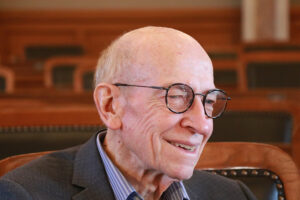
Dave Heinemann, Kansas

Interview of Dave Heinemann, July 10, 2014

Interviewed by Burdett Loomis
In this 2014 oral history interview, Dave Heinemann recalls his long career in the Kansas House representing Garden City, a career that spanned the years during which there were important changes in Kansas government. He served during an era when rural influence in the Legislature was waning due to fundamental changes in legislative districts. Heinemann's recollections of how legislators serve their constituents and how they worked with one another to craft legislation paint a picture of collaboration in the creation of public policy. His perspective points to the importance of personal relationships with colleagues within the chamber, Show Moreacross the rotunda in the Senate, and with the Governor's office.

Another oral history interview of Heinemann is included in the Reflections on Water collection on this site.

Show Less
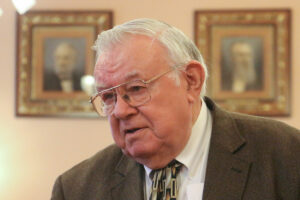
Interview of Patrick (Pat) Hurley, March 23, 2018

Interviewed by H. Edward (Ed) Flentje
Pat Hurley had a wide ranging career for over 40 years as a legislator, administrator, lobbyist and lawyer where he had a profound impact on Kansas public policy and government. Hurlely's rapid rise to a leadership position in the House is unprecedented; he credits his legal training with his ability to analyze legislation. His close association with former Governor John Carlin led to his becoming Secretary of Administration and centralizing and standardizing many of the processes of that agency. While Hurley was Majority Leader, he developed working relationships that were critical to his success. The death Show Morepenalty and a proposed new prison were two issues he dealt with as Majority Leader. Hurley was attracted to working for Governor Carlin by the opportunity to manage policy issues, functioning as a de facto chief of staff to the governor while he was Secretary of Administration. Hurley developed a process for policy analysis in this role. Hurley left the governor's office after five years and began working as a contract lobbyist on big state issues such as multi-bank holding companies and several transportation plans with Economic Lifelines for several governors. He also did contract procurement work for corporations and businesses. This interview is a good look behind the scenes at how government functioned and how policy is developed and passed. A version of this interview is also posted on KansasMemory.org, the website of the Kansas Historical Society. Show Less

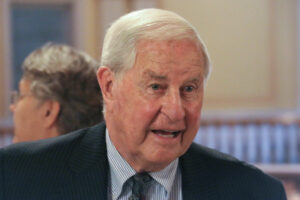
Interview of James (Jim) Maag, July 17, 2014

Interviewed by Burdett Loomis
In this 2014 oral history interview, Jim Maag reflects on his service in the Kansas House of Representatives (1969-1976) including his term as Speaker Pro Tem (1975-1976). It was a time of significant change and modernization of the Kansas Legislature and its processes. Maag provides a clear view into the evolution of the Legislature into a more professional organization. He comments on the bipartisan approaches to policymaking during that era when the urban-rural split affected the dynamic more often than purely partisan considerations. He was witness to the impact of the one person, one vote Show Morecourt case as well as the increased number of women legislators and the reduced number of attorneys. Jim's recollections draw a vivid picture of an institution in transition. His connection with the Legislature continued in his role of legislative liaison for Governor Bennett and later as a lobbyist for the Kansas Bankers Association.

A video recording of a portion of this interview is available on this site.

Show Less
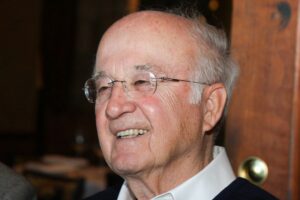
robert bob miller kansas representative

Interview of Robert (Bob) Miller, November 9, 2017

Interviewed by H. Edward (Ed) Flentje
Former Speaker of the Kansas House of Representatives, Robert (Bob) Miller recalls his many years of service to the State. He describes his involvement with the Young Republicans at K-State, his first campaign to represent his area of Sumner County, and moving up through the ranks in the House despite not having ambition for any other elected position. Miller reflects on his sometimes arms-length relationships with fellow House members and with lobbyists. From his position as chair of the House Federal and State Affairs Committee he oversaw the development of implementing legislation for liquor-by-the-drink, parimutuel wagering, and Show Morethe State Lottery by building subject-matter expertise within the committee. Miller describes instances when legislators' positions on policy issues did not break along purely partisan nor on purely urban-rural lines. He also witnessed the early development of what eventually became the conservative movement in the Legislature. Show Less

Interview of Ralph Skoog, July 17, 2015

Interviewed by Burdett Loomis
In his 2015 oral history interview, former Representative Ralph Skoog recalls a Kansas Legislature in transition. Ralph was initially elected to represent Topeka and Shawnee County in 1961, prior to the U.S. Supreme Court's Baker v. Carr 'one-person, one-vote' decision. His first 'district' was one-third of Shawnee County. When he returned to the House in 1967 after an unsuccessful campaign for Congress in 1964, he represented a more equal-size district of approximately 17, 000 residents of the County. Ralph recalls a legislature very much in transition at the beginning of the decline of rural domination of Show Morethe policymaking process and at the beginning of institutional change that came to fruition after the end of his last term. He recalls passage of important highway, prison, and school district consolidation legislation during his time of service in the House. Show Less
Bob Storey, Kansas

Interview of Robert (Bob) Storey, February 5, 2015

Interviewed by Burdett Loomis
In his 2015 oral history interview, Bob Storey recalled his service in the Kansas Senate from 1969-1976. His recollection is of a Senate that was in transition in terms of urban-rural influence on policymaking due to the one-person, one-vote principle enunciated by the U.S. Supreme Court in the mid-1960s. He recalled intricacies of interactions among Senate leaders and governors and occasional intrigue in Senate leadership elections. He also reflected on improvements in the functioning of state government during the years when reorganization and modernization of many state functions took place.
John Carlin, Kansas

Interview of John Carlin, June 14, 2019

Interviewed by H. Edward (Ed) Flentje
This 2019 interview focuses on the experiences of John Carlin during his legislative career in the House of Representative from 1971-1978 where he led his caucus to achieve the majority party status, and his becoming only the second Democratic House speaker in the 20th Century. The interview contains anecdotes about his experiences in 4-H which he believes developed his leadership skills as well as the issues he embraced during his terms in the House. Carlin also candidly discusses the challenges he faced in working to overturn a veto of a governor of his party. Issues discussed in this interview included Show Moreprisons, the death penalty, reorganizing government, due process for teachers, court unification, centralization of the welfare system at the state level and the politics of roads and transportation. Carlin points to livestock judging as training for making decisions. Carlin believes learning to make fast, accurate decisions contributed to his political success. Show Less
Go to Top