
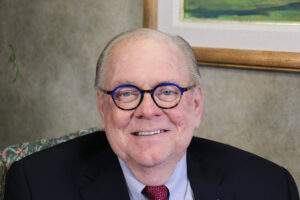
Interview of Patrick (Pat) Hubbell, April 9, 2025

Interviewed by Mike Lennen
Long-time legislative lobbyist, Pat Hubbell describes in this oral history interview, how lobbyists work, how they interact with legislators and other advocates, and talks about the importance of this "at the rail" part of the Kansas Legislature. His chief lobbying duties were on behalf of the railroads; Hubbell also had other clients. He worked in the 1970's with Kansas Senators and Representatives in Washington. particularly while the 4-R Act was being developed. The railroad industry plays an important role in transporting Kansas agricultural products. At that time, several railroad companies were going bankrupt, and a Show Moreloss would have been devastating to Kansas farmers. He emphasized that the railroads were lobbying for fair taxation. They wanted to be treated as a competitive business model rather than as a monopoly. “Railroads offer a list of opportunities for people locating businesses in Kansas to have rail service.” Hubbell described his philosophy on lobbying: “we try to find an answer that everybody can agree to. . . Just the fact that you have a lobbyist doesn’t mean you ought to be taking a bill every session to the legislature.” Show Less
Joseph Hoagland

Interview of Joe Hoagland, January 23, 2023

Interviewed by Richard Walker
Kansas government underwent a massive change in the 1970's. Governors Docking and Bennett began reorganizing state government and bringing together a lot of independent commissions and state agencies that were operating autonomously into a cabinet system under the direction of a Secretary, such as the departments of Revenue and Transportation. Joe Hoagland's interview expands the understanding of how Kansas government was modernized during that period and how new legislative leaders were developed and empowered to act. Hoagland was involved with several significant legislative issues: the 911 emergency phone system, the comparative negligence act, Show Moremandatory prison sentence for crimes committed with a firearm, banning the sale of handguns, small claims process. Hoagland, himself is an interesting person with many talents and wide-ranging interests. His business activities have been beneficial to Kansas, our country and the world. Sports lovers will like his description of being a professional baseball scout and the first one to discover Albert Pujols. His airline-related businesses took him abroad, living in Brussels, Belgium for over 20 years. He describes traveling around the world 15 times. He als describes his work to develop a new breed of cattle and establish the American Black Hereford Association. He developed a cellphone app to track the movement of cattle in the beef supply chain.

Highlight -- a short excerpt from the interview

Show Less

Interview of Richard Walker, December 2, 2022

Interviewed by Nancy Parrish
Richard Walker's oral history interview shows the human side of being a judge for 30 years in his hometown of Newton. After a brief foray into politics while fresh out of law school and starting the private practice of law, Walker found his niche on the bench in his hometown of Newton in Harvey County KS. His describes of a group of young Republican lawmakers organizing to elect Wendell Lady as Speaker. Walker became disillusioned about the parole board practices during his service there but saw a way as a judge to look for creative, flexible alternatives Show Moreto resolving domestic disputes and preventing children from being damaged in the process. In 2015 he moved to senior judge status and worked with the Court of Appeals, largely because "he had had it with domestic cases." Show Less
image of Mike Hayden

Interview of Mike Hayden, November 23, 2021

Interviewed by Rex Buchanan
Former Kansas Governor Mike Hayden talks about how his life-long concern for wildlife and natural resources informed his entry into electoral politics, service in the Kansas House, time as Governor, and his subsequent career. This interview provides insight into how one Kansan was able to make a lasting impact on the state in a key public policy area. Hayden provides perspective on policies that were initiated during his time in office that remain in place and some that may need to be re-examined in the light of recent developments.

Highlights -- short excerpts from the interview

Another interview of Hayden may be found in the Kansas Governors collection on this site. Show Less

How Things Got Done

How Things Got Done in the Kansas Legislature

In this video, compiled from interviews on this site, 12 former Kansas legislators who served from 1960-2010 talk about why they ran for public office, how they developed and executed strategy, and how different leaders perceived their roles and what they accomplished. Among others you will hear Dick Bond describe initiating renovation of the Capitol, Steve Morris recall creating a plan to train more engineers, and Fred Kerr explain the need for reappraisal and classification. You also hear Mike Hayden recount lessons learned from two Speakers with vastly different styles who preceded him – Pete McGill and Wendell Show MoreLady. Show Less

Interview of John Solbach, June 11, 2021

Interviewed by Alan Conroy
John Solbach served in the Marines, was wounded in combat in Vietnam, returned to Kansas to finish college and law school and ran for the Kansas legislature in 1978. He represented Lawrence/rural Douglas country in the House for 14 years. Solbach's interview is replete with entertaining stories, starting with his Populist ancestors' takeover of the Kansas House in 1890, to stories about how Mike Hayden helped him get a $4,000 appropriation to bring David Eisenhower to Kansas. He teamed up with Wint Winter Jr. to pass a Uniform Conservation Easement Law in spite of Sen. Ross Doyen; Show More he and R.H. Miller stopped a group of rural electric cooperatives from taking the Wolf Creek Nuclear plant out from under the control of the Kansas Corporation Commission. Solbach considers the sentencing guidelines, passed in 1992 while he chaired the House Judiciary Committee as the best legislation of his career. Show Less

Interview of Bill Bunten, February 18, 2015

Interviewed by Burdett Loomis
Bill Bunten's 28 years in the House, 20 of them on the Ways and Means or Appropriations committee, gave him tremendous knowledge about the state budget. He chaired Appropriations from 1983 until 1990 when he left the legislature. He returned to the state Senate in 2003 to fill an unexpired term. Bunten later served two terms as Mayor of Topeka from 2005 until 2013.
Christine Downey, Kansas

Interview of Christine Downey, August 2, 2019

Interviewed by Dale Goter
Former State Senator Christine Downey recalls her three terms in the Kansas Senate (1993-2004) during her 2019 oral history interview. With her background as a teacher, education issues were important to her as the era of school-funding litigation continued. She was involved in water-related policy making, in particular at the nexus of water quality and agricultural practices. She recalls her service in the Senate and on the Kansas Board of Regents first developing the policy and then implementing fundamental changes to the postsecondary education system. Ms. Downey discusses numerous instances of working across the aisle Show Moreto accomplish policy objectives that did not break on strict party lines. Show Less

Interview of Robert (Bob) Frey, August 2, 2019

Interviewed by Jim McLean
Robert Frey had considerable impact on the legal system after he arrived in 1975. Court unification had passed as a constitutional amendment; now the legislature had to implement it. Early in his legislative career Frey took on some controversial issues, such as the hearings he held in the House Judiciary committee on the Posse Comitatus to ban paramilitary training and legislation ensuring every county had a judge. This interview does not deal with the plethora of issues which originated in the House Judiciary committee under Frey's leadership, such as codification of the sexual crimes including marital rape, Show Morebut it does reveal his philosophy about the law, the courts and judges. The interview also provides a glimpse into the rise of the conservative influence from a group know as "the Cowboys." The interview concludes with a discussion of activities on the Board of Tax Appeals. Show Less
Mike Hayden, Kansas

Interview of Mike Hayden, June 13, 2018

Interviewed by H. Edward (Ed) Flentje
This 2019 oral history interview of former Kansas Governor Mike Hayden focuses on his service in the Kansas Legislature and his development as a politician and policy leader. Hayden shares anecdotes about his seven terms in the Kansas House, beginning with his quest to get then-Speaker Pete McGill to appoint him to the Advisory Council on Ecology and his speech on the floor of the House to kill the "mad dog" bill which did away with county welfare departments. The interview includes a discussion comparing the styles of various legislative leaders and what they taught him. Hayden's interest in water Show Morepolicy, conservation, and environmental education extended into his term as Governor. He championed public lands, an issue which he carried into his nine years as Secretary of Wildlife and Parks under three different governors. Hayden discusses the death penalty and many of the issues that were the basis for constitutional amendments under Governor Carlin and which Hayden handled as House Speaker. He also discusses the rising interest in abortion as the start of a more conservative, far-right movement. The interview includes many examples of how leaders with whom Hayden served framed the debate to their advantage. He concluded the interview by discussing the constant need to balance the state's interests with the those of local constituencies. Hayden characterized his service in the Legislature as good training to run for Governor.

Another oral history interview of Hayden may be found in the Reflections on Water collection on this site.

Show Less
Go to Top