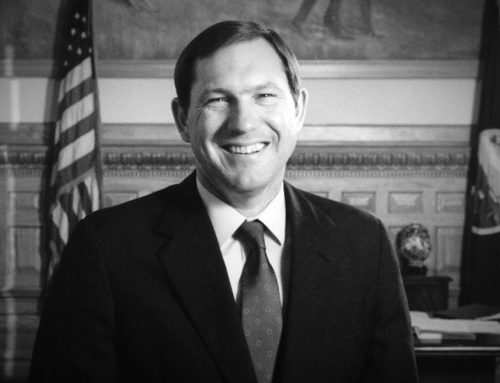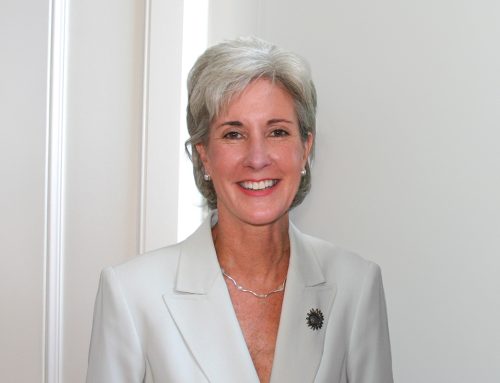
Interviews of seven former Kansas governors conducted by Dr. Bob Beatty of Washburn University during the early decades of the 21st Century for the Kansas Governors Recorded History and Documentary Project provide a view of the lives, political philosophies, and governing styles of governors who led Kansas from the late 20th to the early 21st Century. Beatty generously granted the Kansas Oral History Project (KOHP) permission to house the transcripts of these interviews conducted with former governors John Anderson, William Avery, John Carlin, Bill Graves, Mike Hayden, Mark Parkinson, and Kathleen Sebelius. These interviews are a significant addition to the Kansas Governors Collection, and the KOHP Board is grateful to Dr. Beatty for making the transcripts available.
The Beatty interviews reveal a shared focus on public service ideals that frequently transcended partisan considerations in an era when atmosphere of state policymaking shifted from cross-aisle cooperation to ideological polarization. In this posting we provide a glimpse into the interviews by briefly looking at two themes: early influences and the potential consequences of doing the right thing.
Formative Influences and Governing Philosophy
Several former Kansas governors cite their involvement in business or agriculture prior to seeking elected office as critical to their approach to public service. Bill Graves (governor from 1995–2003) cited his family’s trucking business as the source of his governing philosophy. His campaign slogan, “Load ‘em high and tight,” was a literal reference to the method of maximizing trailer space. Graves translated that practical life lesson into a description of government efficiency. Similarly, John Carlin (governor from 1979–1987) attributed his work ethic and his 1970 election to the Kansas House to his experiences and reputation as a hard-working dairy farmer. He also pointed to his experiences in 4-H and at K-State judging livestock as providing him with the decision-making skills he used to navigate complex legislative issues. William Avery (governor from 1965-1967), also was a farmer after college and before entering state-level electoral politics with an issue agenda. Avery championed the cause of landowners who opposed creation of Milford and Tuttle Creek reservoirs in the 1950s.
Some of the former governors interviewed continued a family inclination to public service. Kathleen Sebelius (governor from 2003–2009) is the daughter of former Ohio Governor John Gilligan. She recalled that in her home, “political involvement was not a voluntary activity… it was sort of mandatory.” Watching her father taught her about leadership in real-time and about approaching the role with moral courage necessary to uphold core values even when they resulted in electoral loss. Mark Parkinson (governor from 2009–2011), who followed Sebelius in the Governor’s office, also pointed to a family history of political involvement which included a great-grandfather in the legislature and a grandfather who ran for governor. However, much like Graves, Parkinson’s perspective in office was informed by his experience in the business world guiding an organization with “mission and metrics.” John Anderson (governor from 1961-1965), who also worked on the family dairy farm until leaving for college, pointed to his father’s service on the local school board and his brother’s service as Mayor of Mission, Ks as indications of a service orientation in his background. Mike Hayden (governor from 1987 to 1991) described his political path as a member of a multi-generation Kansas farm family to the state’s highest elected office citing how his identity as a Vietnam veteran and his family’s deep roots in public service combined to provided him with the drive necessary to rise into legislative leadership and on to the governorship. His experiences also shaped his leadership style and strategic focus on rural support.
The Burden of the “Right Decision”
A defining characteristic of these leaders, as described in the interviews, was their willingness to pursue policies they deemed essential for the state’s future, even at high political cost. Despite the electoral repercussions, these former governors years later continue to stand by their sometimes career-limiting decisions. Perhaps, that is a reflection on their formative influences.
Avery provides perhaps the starkest example. He proposed a state withholding tax and a sales tax increase to fund the School Foundation Program. While these positions led to his defeat after only one term, he remained unrepentant decades later: “Even though withholding tax defeated me, it was the right decision and I would still make it… pick[ing] up, say ten thousand new taxpayers… was in the best interest of Kansas because they were cheaters.”
Hayden likewise attributed electoral defeat to his role implementing property tax reappraisal which he called “politically the kiss of death.” He went on to say, “But you know, I wouldn’t have done it any differently. We did do the right thing from a policy standpoint.” Carlin faced a test when a death penalty bill landed on his desk. He vetoed the bill, shocking even his staff, despite having suggested during his campaign that he might sign it. He recalled telling his staff, “I realize this is not the smartest political move, but I just can’t do it.” Parkinson also recalled navigating this tension during the Great Recession (2007-2009), when he implemented the largest budget cuts in Kansas history up to that time followed by a temporary sales tax increase. He noted that while these actions effectively ended any chance of a future political career, they were necessary to keep the state on a “good solid footing.”
The Beatty interviews serve as a record of gubernatorial leadership in Kansas. They suggest that the essential skills of being governor derive from a capacity to navigate a complex and ever-changing political environment. As Graves reflected, the job requires that, “Once the election is over you somehow have to put the politicking aside and recognize the total responsibility of the governing.” These interviews collectively illustrate that while these governors differed in their priorities and methods, they were focused on the long-term stability of Kansas over short-term political survival.