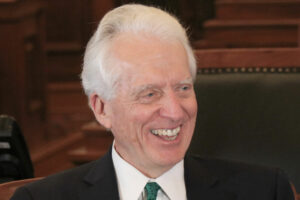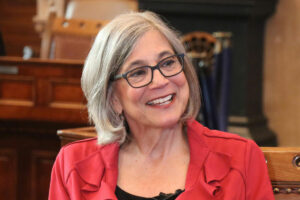

Interview of James (Jim) Maag, July 17, 2014

Interviewed by Burdett Loomis
In this 2014 oral history interview, Jim Maag reflects on his service in the Kansas House of Representatives (1969-1976) including his term as Speaker Pro Tem (1975-1976). It was a time of significant change and modernization of the Kansas Legislature and its processes. Maag provides a clear view into the evolution of the Legislature into a more professional organization. He comments on the bipartisan approaches to policymaking during that era when the urban-rural split affected the dynamic more often than purely partisan considerations. He was witness to the impact of the one person, one vote Show Morecourt case as well as the increased number of women legislators and the reduced number of attorneys. Jim's recollections draw a vivid picture of an institution in transition. His connection with the Legislature continued in his role of legislative liaison for Governor Bennett and later as a lobbyist for the Kansas Bankers Association.

A video recording of a portion of this interview is available on this site.

Show Less
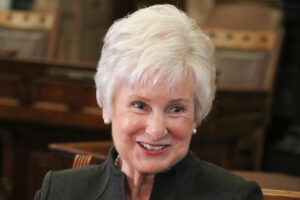
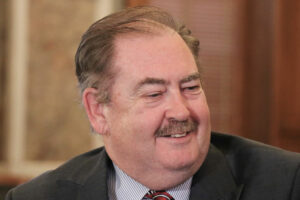
Alicia Salisbury, Kansas

Interview of Alicia Salisbury, October 23, 2020

Interviewed by Patty Clark
Former Senator Alicia Salisbury grew up in a political family--both father and grandfather served in the legislature--so her sixteen years of service as a Kansas Senator continued the family tradition. She also was a serious legislator who believed in community service as witnessed by the numerous boards and committees on which she served, both volunteer and elected. Salisbury's driving interests were improving the economy of Kansas and bringing growth in wealth to her community and state. Salisbury's 2020 oral history interview chronicles her work ethic. With her children no longer at home, she had the Show Moretime and the interest to dive into a wide assortment of issues, from workforce development, to interstate banking, to telecommunication reform, to a blue ribbon panel on workers compensation. Salisbury worked long hours and focused on constituent services. She boldly asked for the committees that interested her and championed changes where necessary. Salisbury succeeded in changing the Labor and Industry Committee into the Commerce Committee to handle everything from economic development strategies to workers compensation. She tackled tough issues with a sense of humor and the skills of collaboration learned as a volunteer leader. This interview describes her determination, her commitment, and her legacy to the state of Kansas as Vice President of the Senate. Show Less

Interview of Tim Shallenburger, September 25, 2020

Interviewed by Alan Conroy
This interview with Tim Shallenburger, former Speaker and twelve-year House member is packed full of interesting anecdotes covering his philosophy of leadership, antics in the House, battles fought and won. Shallenburger was the first "conservative" Speaker following a wave of conservatives being elected beginning in the early 1990's. He candidly discusses why he ran for office in a largely Democratic district, how he moved up in the leadership and developed relationships with other legislative leaders in both House and Senate. Early in his time in the House, Shallenburger was part of a group known as the "rebels". Show More He watched other people's leadership styles and learned how to be a leader himself, first getting elected Speaker Pro Tem and then Speaker, beating Speaker Bob Miller in a "not-so-close" race. Shallenburger learned how to count votes. He doesn't see himself as having an "agenda", other than being fair as a leader. Shallenburger describes the rules changes the rebels made in the House when Jim Braden was Speaker to allow more bills to be heard or pulled out of committee. Bill Graves was Governor throughout all four years of Shallenburger' s term as Speaker. Shallenburger left the legislature to become State Treasurer. After 2010 he served as legislative liaison for Governor Brownback. Shallenburger talks openly about his relationships with numerous governors and senate leaders. The interview closes with a discussion of redistricting. Show Less
Jim-Slattery

Interview of James (Jim) Slattery, March 6, 2020

Interviewed by Jim McLean
The 1970's marked major changes in state government. They are doing away with county welfare offices and creating the Department of Social and Rehabilitation Services (SRS) Concerns over lack of equalization started with Caldwell school finance case. Transportation is being centralized and modernized with the creation of the Department of Transportation (KDOT). Slattery even introduced legislation to decriminalize small amount of marijuana. Campaign finance reform (post-Watergate) and hiring non-partisan, professional staff for the legislature took hold. Slattery and another new freshman, Mike Hayden support legislation to clean up strip mines and reclaim mined Show Morelands. The first income tax reform was initiated despite the governor's veto. Community corrections is emerging as a good strategy. Slattery describes the role of abortion in civil discourse in this interview, how it started in the Dole/Roy race in 1974, and how it continues to distort the American political system in a significant way. He explains why he ran for Congress as a deficit hawk and talked about some of his Congressional experiences. The interview closes with a story about Tip O'Neil and another about former Speaker Clyde Hill who advised Slattery to be accurate when speaking at the Well of the House. Show Less
Susan Wagle, Kansas

Interview of Susan Wagle, December 18, 2020

Interviewed by Alan Conroy
Former Kansas legislator Susan Wagle describes her interest in politics as "evolving over time." In this interview she candidly talks about her journey to become the first woman to break the glass ceiling and be elected to the top leadership position in the Kansas Senate. And she held onto the Senate Presidency for two terms. Wagle cites several events as having shaped her decision to run: getting a free pregnancy test and learning it was from an abortion clinic; seeing the huge property tax bills resulting from classification and reappraisal and how they angered people; enactment Show Moreof bingo legislation that affected he business negatively--all of which led to awareness that government could have an impact on families and businesses. Once in the Legislature, Wagle developed legislation to control property taxes. When an incumbent left a Senate seat, Wagle moved to the other chamber. She formed alliances in both the House and Senate with a group of conservative legislators enabling her to attain leadership positions. Wagle authored the Woman's Right to Know Act and solicited support from a prochoice Senator to get it passed--the first pro-life legislation. As a committee chair Wagle felt she had greater ability to pass bills that were needed. The issues she addressed ranged from protecting ground water from corporate hog farming, to tax-limiting measures, to ethics. Wagle credits her many years of service to listening to her constituents on issues such as taxation, quality of life, and education. In the closing of this interview, Wagle talks about her last year with COVID which she describes as "horrific" and disruptive. She reflects on her accomplishments changing the Board of Healing Arts and dealing with the Bioscience Authority. Show Less
Joan Wagnon, Kansas

Interview of Joan Wagnon, May 11, 2018

Interviewed by H. Edward (Ed) Flentje
Ed Flentje's interview of former Representative Joan Wagnon covers her 12 years in the state legislature, four years as Mayor of Topeka, and eight years as Secretary of Revenue. She talks about the work of the House Taxation Committee in implementing legislation after passage of a constitutional amendment classifying property for tax purposes. Wagnon discusses the 1992 school finance lawsuit which produced massive change in the school funding formula, including how the concepts were developed and what strategies were used to get them passed. Wagnon describes how the House Democrats interacted with Governor Finney in the 1991 session, when Show MoreFinney vetoed the major tax bill and the Supreme Court found the school finance formula to be unconstitutional. Wagnon served as facilitator for the Children's Initiatives Committee which Speaker Marvin Barkis chaired. That committee produced 14 bills that affected children and families. Wagnon discusses economic development issues in the last part of the interview. Those issues link Wagnon's legislative interests to her work as Mayor of Topeka: neighborhood revitalization, spreading the tax base from city to county for Washburn University and the Topeka Public Library, and developing economic development infrastructure to attract growth and new business for Topeka. She also discusses some of her eight years as Secretary of Revenue, particularly her involvement with the Streamlined Sales Tax. A version of this interview is also posted on KansasMemory.org, the website of the Kansas Historical Society. Show Less
Marvin Barkis, Kansas

Interview of Marvin Barkis, October 27, 2017

Interviewed by H. Edward (Ed) Flentje
Marvin Barkis discussed, in detail, the various processes within the House of Representatives in its day-to-day work. He pointed out differences in working as the majority versus the minority party and talked about working with the governors during his terms in office. When Barkis was the minority leader, he tried to build a sense of community among party members to facilitate working together. Barkis also described making changes in legislative procedures to promote efficiency. Much of the interview focused these internal procedures. Barkis' primary legislative passion was children’s issues and the interview covered the various attempts to Show Morework on a variety of topics to aid children. He also discusses his involvement with school finance, reapportionment, and the death penalty. Show Less
Go to Top