
Refine Your Results
  • Interviewee

Topic: African-American
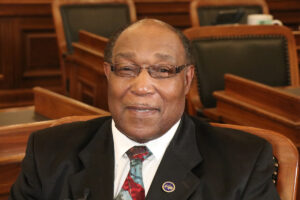
Jack Alexander, Topeka Water Commissioner

Interview of Jack Alexander, October 26, 2020

Interviewed by Michael (Mike) Lennen
In this 2020 oral history interview, Jack Alexander reflected on his early life growing up in Topeka, Kansas in the 1930s and 1940s, and his extensive public service career beginning with enlistment in the U.S. Navy. Alexander describes serving in various roles both in local government, particularly as Water Commissioner for the City of Topeka, and in state government, including appointment to the Kansas Corporation Commission. He also described his contributions to local volunteer organizations. Alexander’s recollections create a portrait of an individual committed to public service based on a solid foundation in family and community and a sincere appreciation Show Moreof and concern for others.

Highlight -- short excerpt from the interview

Show Less

Interview of Barbara Sabol, January 14, 2022

Interviewed by Joan Wagnon
Barbara Sabol, the Secretary of Aging and Health and Environment under Governor John Carlin describes herself first and foremost as a nurse. That nursing background propelled her into high level positions in local, state and federal levels of government, always asking how her actions affected the children and the people she served. Sabol began as a leader in Kansas government and academia before being appointed Secretary of Aging, working with other advocates to establish the Silver-haired Legislature. She worked for Mayor Marion Barry in Washington DC in his office of Policy and Planning within Show Morethe Department of Human Services. Carlin asked her to return to Kansas as Secretary of Health and Environment where she quickly established a reputation as a problem solver for tough issues such as the permanent closure of a waste dump in Furley that leaked toxic chemicals. Sabol talks candidly about the challenges she faced as an African American and a woman and how she met those challenges. The interview concludes with her describing her latest project, housing for young adults who have aged out of the foster care system. Show Less

Interview of Ben Scott, January 14, 2022

Interviewed by Joan Wagnon
Ben Scott describes his life of service as an activist for schools and the community as well as his church. Scott's early experiences with segregation and racism informed his later activities as a member of the Board of Education in Topeka as the district sought to achieve racial balance in its public schools. The desegregation plans he and Sherman Parks Jr. developed in 1990's were instrumental in dismissing the federal lawsuit against the district. Scott was a leader in the Topeka and Kansas NAACP. He pointed out their priorities were finding enough Black teachers as Show Morewell as improving housing. Racial profiling was another NAACP concern that he carried to the Kansas legislature along with his concerns about student achievement and teachers having enough resources. In his interview, Scott talks candidly about racism in the juvenile justice system, racial profiling, Critical Race Theory (CRT), and the role of the church in dealing with racism. His hopes for continued legislative service were derailed by loss of election in 2016; however, he still pushes for developing standards for teaching Black history.

Highlights -- short excerpt from the interview

Show Less

Interview of Carolyn Campbell, March 25, 2022

Interviewed by Eric. Sexton
"Mrs. Campbell", as Carolyn Campbell is known around the Statehouse, has experienced an important part of state history in Kansas government. Following her 1991 retirement from Southwestern Bell, she worked for countless numbers of legislators; then used that experience, to become an elected official in her own right -- serving on both local and state school boards. Campbell was the first African American to serve on the Kansas Board of Education. Campbell started her oral history interview with this: "I am a proud product of segregation. I tell that because folks sometimes think, “Oh, that’s Show Moretoo bad,” but I want everybody to know that as a black child in Topeka with the four all-black elementary schools that we had, we got excellent education, and we were told that we could be whatever we wanted to be, and we were valued every day. " This interview covers her experiences as a 12-year member of the Topeka Public Schools Board of Education, and later her eight years on the State Board of Education.

Highlights -- short excerpts from the interview

Show Less

Interview of Eugene Anderson, April 21, 2022

Interviewed by Frances Jackson
Senator Eugene Anderson's oral history interview covers his 20-year career in Kansas politics, serving in both the Kansas House and Senate and later, in the administration of Governor Joan Finney. In addition, Anderson has been a Wichita business man and author. Anderson described growing up in Georgia and the values he learned in his segregated community - work hard, never quit, build relationships and make your community better. His priority issue when he went to the legislature was making the schools better. Anderson described his friendship with Governor Joan Finney, going back to when she was Show MoreState Treasurer and how he asked her not to invest in the apartheid government in South Africa. Later, she appointed him Director of Aviation and he was able to work with other state directors to support the Kansas aviation industry on product liability legislation. Throughout the interview Anderson revealed his philosophy of effective governance. Show Less

Interview of Melody McCray-Miller, April 21, 2022

Interviewed by Frances Jackson
Melody McCray-Miller describes her job as speaking truth to issues that were relevant at that time, and representing a group of people who were marginalized. Rep. Miller was not the "status quo." She doesn't consider herself a "politician" but instead, a public servant. Her concept of public policy or public service was influenced by the fact that she is a Black woman who was raised in a Black family. She is the daughter of Billy Q. McCray, the first African American Commissioner in Sedgwick County who also served as a state Senator. Show More One of her mentors described her as "tough as leather." Miller was in business with her husband, and also taught school prior to running for office. She detailed how she handled conflicts or incidents of racial discrimination by "pushing forward." The latter part of the interview deals with a variety of legislative issues McCray-Miller initiated or followed. Those issues ranged from early childhood education, to payday lending, juvenile justice and health policy. Show Less

Interview of Frank Henderson, May 21, 2025

Interviewed by Mark Tallman
At the time when a group of high school students discovered that Fred Seaman, the namesake of Unified School District 345 was the Exalted Cyclops of the Ku Klux Klan in the 1920's, Frank Henderson was President of the Seaman School Board. In this oral history interview, he describes the process the board went through to investigate and analyze the students' recommendations to change the district name. At the end of the process, the name remained, but Fred Seaman's photo and memorabilia were removed from the school buildings and placed in the museum. He said the outcome didn't Show Moresatisfy anyone but it was unanimous. Henderson described many challenging situations at the local, state and national levels as he served on various state and national boards of education. Henderson's observations highlights major issues in education that affected school boards and local communities. The interview reflects Henderson's view that "Every Student Matters." He believes, "we, as fellow humans, have the responsibility to see the value in every person and do what we can to ...help that person fulfill their potential." Show Less

Interview of Foster Chisholm, December 5, 2025

Interviewed by Joan Wagnon
Foster Chisholm, in retirement after a 25 year career working in the Topeka Post Office, went to work as Doorman for the Kansas House of Representatives. In his 2025 oral history interview he describes growing up in North Topeka, attending segregated schools, and being discouraged by his high school counselor from going to college. Chisholm worked for 35 years at the VA Hospital and at the Post Office in Topeka. After he retired, a friend told him about an opening for a Doorman in the Kansas House of Representatives. He got the job and after Show More3 years became the first Black Sergeant-At-Arms in the Kansas Capitol. Chisholm describes his nonpartisan role in assisting the Legislature as it did its business. He also has a few funny stories about what happened during those 15 years. His biography really showcases his commitment to improving his Topeka community with his volunteerism. A short excerpt highlights what he said about segregated schools. Show Less
Go to Top