
Refine Your Results
  • Interviewee

Topic: Political campaigns
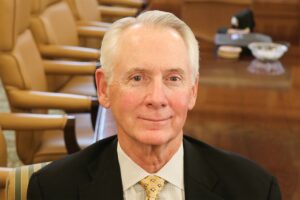
Interview of Bill Graves, September 16, 2016

Interviewed by Michael Smith
Emporia State University Professor Michael Smith interviewed former Governor Bill Graves on the Kansas Wesleyan University campus, Graves’ alma mater, in the fall of 2016 before the November elections. The interview covered events from Graves’ years in office as well as his thoughts on the state of Kansas politics in 2016 and the political changes in the Statehouse. This interview, compared to the 2022 interview by Mike Matson delves a little more deeply into some of the political situations Graves faced, particularly in his second term with challenges from Republicans. Taken together, these interviews Show Moreform an excellent picture of the changing nature of conservatism in Kansas politics and help define the meaning of Traditional Republican. Show Less
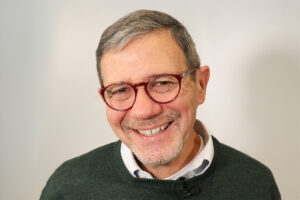
Interview of Gianfranco Pezzino, January 23, 2026

Interviewed by Robert St. Peter
This interview with Dr. Gianfranco Pezzino is the second in the Healthy Kansans series and sets the stage for understanding the concern that Kansas has slipped considerably in the nationwide rankings of health in the states over the last 30 years. His explanation of how the rankings work and why they are important is clear and understandable. Pezzino stated, "In the end, I became more and more convinced that the important thing was not the numbers. It was the communication that we could build around those numbers." His discussion of the social determinants of health is Show Moreimportant to understanding the rankings. He recalls a controversy covered by the local newspaper that quoted the county commissioner saying, "What does education have to do with health.?" He used that as a opportunity to begin a community conversation about those linkages. As an epidemiologist, Dr. Pezzino has played many roles in health policy in Kansas - from the local health officer to state policy maker. He recounts the stresses of being the county health officer during COVID and comments that the "social contract has been broken." He comments that there is still value in providing accurate data as a public health person but now a lot of the authority has been moved from public health officers to local elected officials. That has created a tension between individual rights and the social good. Show Less
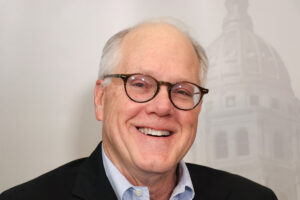
Interview of Robert St.Peter, January 23, 2026

Interviewed by Jim McLean
This is the opening interview for the series, Healthy Kansans. Since Bob St. Peter will be interviewing all the rest of the participants in this series, Jim McLean wanted to use this interview to establish his expertise. St. Peter was the first President and CEO of the Kansas Health Institute; he stayed for 24 years, developing and expanding their services in Kansas. Prior to that he had extensive experience in Washington DC with health policy [see his biography]. For this series of interviews, St. Peter defines health in the broadest terms and points out Show Morewhy the health rankings are valuable information for policy makers. The Kansas Health Foundation which created KHI really wanted the KHI to look at a broad set of issues that influenced how healthy we are as a city, as a county, as a state, and how education or housing, transportation influenced a person's health. St. Peter pointed out that health in Kansas isn't getting worse. People in Kansas are living longer, generally experiencing lower rates of cardiovascular disease, stroke, etc. So, it is not that our collective health is getting worse; it is that our relative standing compared to other states is getting worse. Other states are doing better, faster than Kansas in improving the health outcomes for their citizens that Kansas should be working on as well. Show Less
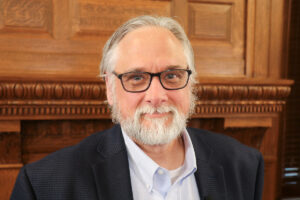
John Hanna

Interview of John Hanna, December 19, 2025

Interviewed by Jim McLean
John Hanna recalls his long career as one of the top journalists in Kansas in this 2025 interview with Jim McLean. Hanna describes how covering the Kansas legislature has changed from from prior years when several reporters able to cover multiple committees each day to now where a single reporter has “to tell big, broad stories to the largest audience possible.” He observed that there is “still a need for good journalism to help organize and make sense of what’s going on and to write about patterns and trends and context.” Hanna acknowledged the difficulty of maintaining Show Morethe AP style of balancing every story and giving each side equal coverage when you know one of the sides is demonstrably not true. He observed that there is an organized campaign by national groups that are getting legislatures to act and that it is “important for the reader to understand—where it’s coming from, how money is being spent, who benefits, who doesn’t.”

Highlights -- short excerpts from the interview

Show Less
Picture of Phyllis Garibay-Coon

Interview of Phyllis Garibay-Coon, May 13, 2025

Interviewed by Linda Utoff
Phyllis Garibay-Coon, the artist who created Rebel Women, the most recent mural installed in the Kansas Statehouse, describes her journey as an artist including the importance of the support she found in the Manhattan, KS community. Garibay-Coon is the first woman to have her mural installed in the Statehouse. She is interviewed by Linda Uthoff, League of Women Voters of Manhattan/Riley County. During the interview, conducted a few months after the mural was unveiled on the 2025 anniversary of Kansas becoming a state, Garibay-Coon describes the Kansas suffragists who are the most prominent figures in Show Morethe painting. She also describes how the state and local historical societies and families of those suffragists contributed to how she imagined the mural. Garibay-Coon credits the League of Women Voters of Kansas, the AAUW of Kansas, and generous individual donors who made this public art possible.

Highlights -- short excerpts from the interview

Show Less
Dale Goter

Interview of Dale Goter, January 6, 2026

Interviewed by McLean Jim
In this 2026 oral history interview, Dale Goter looks back at the evolving landscapes of Kansas journalism and state politics. Goter, a veteran journalist who later became the lobbyist for the City of Wichita, offers a unique perspective on how the relationship between the press and elected officials has shifted over several decades. He describes a "golden age" of Statehouse news coverage when major news organizations maintained fully staffed bureaus in Topeka. This presence allowed for rigorous, daily coverage of the Kansas Legislature, which Goter sees as essential for maintaining public accountability. He expresses concern over the subsequent decline Show Moreof coverage, noting that the loss of dedicated statehouse reporters left a void sometimes filled by partisan messaging rather than objective reporting. Goter stated that as a journalist, “You’re always going after the power structure because that’s where the power is, and that’s where the abuse of power is.” Journalists are "conditioned to look for controversy. You’re looking for conflict, controversy, and corruption. That puts you at odds with government all of the time. You’re perceived as a liberal because you’re going against government.” Goter shares his thoughts on changes in the Statehouse culture. He points out that there used to be a “level of oratory that took place on the Senate floor, people like Ed Reilly, . . . Frank Gaines, and Tom Rehorn. They could get up. They were stem winders." Goter transitioned from the press gallery to a role as lobbyist for Wichita in 2006. He describes the nuances of lobbying for the city from a ‘public good’ perspective not commonly found among the ranks of lobbyists. Goter explains that effective lobbying relies on building long-term relationships and providing credible information to lawmakers, a process that became increasingly difficult due to rising political polarization.

Highlights -- short excerpts from the interview

Show Less
Photo of Steve Kraske

Interview of Steve Kraske, September 11, 2025

In this 2025 oral history interview, Steve Kraske reflects on his 33-year career as a political reporter and editor for The Kansas City Star covering the Kansas Statehouse. Kraske shares his memories of the Mike Hayden- Joan Finney gubernatorial race when he was the reporter assigned to cover the Finney campaign, the Bob Dole - Bill Roy US Senate race, and the conservative push that began when the self-described “Rebels” such as Rep. David Miller, Rep. Kerry Patrick, and Rep. Tim Shallenberger were elected to the Kansas House of Representatives. In this interview, Kraske Show Moreshared his observation that reporters “don’t hope for bad things because we have hard questions. You hope all of this makes for a better state, a better community, a better country.”

Highlights -- short excerpts from the interview

Show Less
Photo of Beverley Olson Buller

Interview of Beverley Buller, October 14, 2025

Interviewed by Jim McLean
In her 2025 interview, conducted at Red Rocks, the historic former home of William Allen White (b. 1868, d. 1944) in Emporia, Kansas, Beverley Buller reflects on her career as an educator, librarian, and author. A lifelong Kansan, Buller describes her transition from a classroom teacher to a school librarian, a role that deepened her commitment to literacy and state heritage. She shares her research on White, the "Sage of Emporia" that informed her books. She emphasizes White’s national significance as a journalist and political observer who remained rooted in small-town Kansas Show Morevalues. Buller describes how White started in the newspaper business, his purchase of the Emporia Gazette, and the influence of some of his famous essays. She also talks about the William Allen White Children’s Book Award, highlighting the award’s role in fostering a love of reading. She describes the award not just as a literary prize, but as a living tribute to White’s belief in the power of the written word.

Highlight -- short excerpt from the interview

Show Less
Go to Top