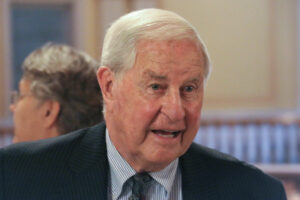
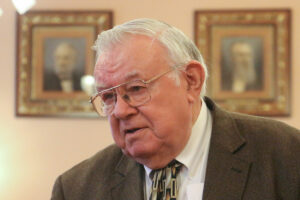
Interview of Ralph Skoog, July 17, 2015

Interviewed by Burdett Loomis
In his 2015 oral history interview, former Representative Ralph Skoog recalls a Kansas Legislature in transition. Ralph was initially elected to represent Topeka and Shawnee County in 1961, prior to the U.S. Supreme Court's Baker v. Carr 'one-person, one-vote' decision. His first 'district' was one-third of Shawnee County. When he returned to the House in 1967 after an unsuccessful campaign for Congress in 1964, he represented a more equal-size district of approximately 17, 000 residents of the County. Ralph recalls a legislature very much in transition at the beginning of the decline of rural domination of Show Morethe policymaking process and at the beginning of institutional change that came to fruition after the end of his last term. He recalls passage of important highway, prison, and school district consolidation legislation during his time of service in the House. Show Less
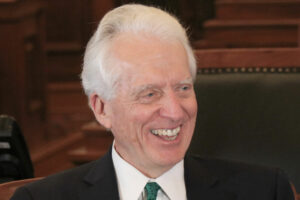
Jim-Slattery

Interview of James (Jim) Slattery, March 6, 2020

Interviewed by Jim McLean
The 1970's marked major changes in state government. They are doing away with county welfare offices and creating the Department of Social and Rehabilitation Services (SRS) Concerns over lack of equalization started with Caldwell school finance case. Transportation is being centralized and modernized with the creation of the Department of Transportation (KDOT). Slattery even introduced legislation to decriminalize small amount of marijuana. Campaign finance reform (post-Watergate) and hiring non-partisan, professional staff for the legislature took hold. Slattery and another new freshman, Mike Hayden support legislation to clean up strip mines and reclaim mined Show Morelands. The first income tax reform was initiated despite the governor's veto. Community corrections is emerging as a good strategy. Slattery describes the role of abortion in civil discourse in this interview, how it started in the Dole/Roy race in 1974, and how it continues to distort the American political system in a significant way. He explains why he ran for Congress as a deficit hawk and talked about some of his Congressional experiences. The interview closes with a story about Tip O'Neil and another about former Speaker Clyde Hill who advised Slattery to be accurate when speaking at the Well of the House. Show Less
Bob Storey, Kansas

Interview of Robert (Bob) Storey, February 5, 2015

Interviewed by Burdett Loomis
In his 2015 oral history interview, Bob Storey recalled his service in the Kansas Senate from 1969-1976. His recollection was of a Senate in transition in terms of urban-rural influence on policymaking due to the one-person, one-vote principle enunciated by the U.S. Supreme Court in the mid-1960s. He recalled intricacies of interactions among Senate leaders and governors and occasional intrigue in Senate leadership elections. He also reflected on improvements in the functioning of state government during the years when reorganization and modernization of many state functions took place.
Joan Wagnon, Kansas

Interview of Joan Wagnon, May 11, 2018

Interviewed by H. Edward (Ed) Flentje
Ed Flentje's interview of former Representative Joan Wagnon covers her 12 years in the state legislature, four years as Mayor of Topeka, and eight years as Secretary of Revenue. She talks about the work of the House Taxation Committee in implementing legislation after passage of a constitutional amendment classifying property for tax purposes. Wagnon discusses the 1992 school finance lawsuit which produced massive change in the school funding formula, including how the concepts were developed and what strategies were used to get them passed. Wagnon describes how the House Democrats interacted with Governor Finney in the 1991 session, when Show MoreFinney vetoed the major tax bill and the Supreme Court found the school finance formula to be unconstitutional. Wagnon served as facilitator for the Children's Initiatives Committee which Speaker Marvin Barkis chaired. That committee produced 14 bills that affected children and families. Wagnon discusses economic development issues in the last part of the interview. Those issues link Wagnon's legislative interests to her work as Mayor of Topeka: neighborhood revitalization, spreading the tax base from city to county for Washburn University and the Topeka Public Library, and developing economic development infrastructure to attract growth and new business for Topeka. She also discusses some of her eight years as Secretary of Revenue, particularly her involvement with the Streamlined Sales Tax. A version of this interview is also posted on KansasMemory.org, the website of the Kansas Historical Society. Show Less
Go to Top