
As we celebrate Women’s History Month, the voices at KsOralHistory.org remind us that Kansas history is a tapestry woven with female threads. The women interviewed for these collections—the educators, the “Steel Magnolias,” the advocates, and the artists—remind us that leadership is often a quiet, persistent act of showing up, day after day, and refusing to be ignored.
Their stories are not “women’s stories.” They are Kansas stories. And thanks to your support, they are stories that are preserved for future Kansans.
Women’s History Month is a time for looking at the broad strokes of progress—the right to vote, the first woman in space, or the first female governor. However, the texture of history is found in the granular details of lived experience. For those seeking to understand how Kansas was shaped, the archives of the Kansas Oral History Project offer a window into the minds of the women who didn’t just witness policy, but shaped it.
Throughout our collections you find stories of women who were pragmatic, bipartisan in their efforts, and friends who worked with a relentless focus on the human impact of policy.
The “Ladies Room” and the Power of Proximity
A recurring theme in the Kansas Oral History Project (KOHP) interviews is that of informal moments as engines of political change. In the late 20th century, as women began to enter the Kansas Senate in larger numbers, they found themselves navigating an institution that was not originally built for them—physically or culturally.
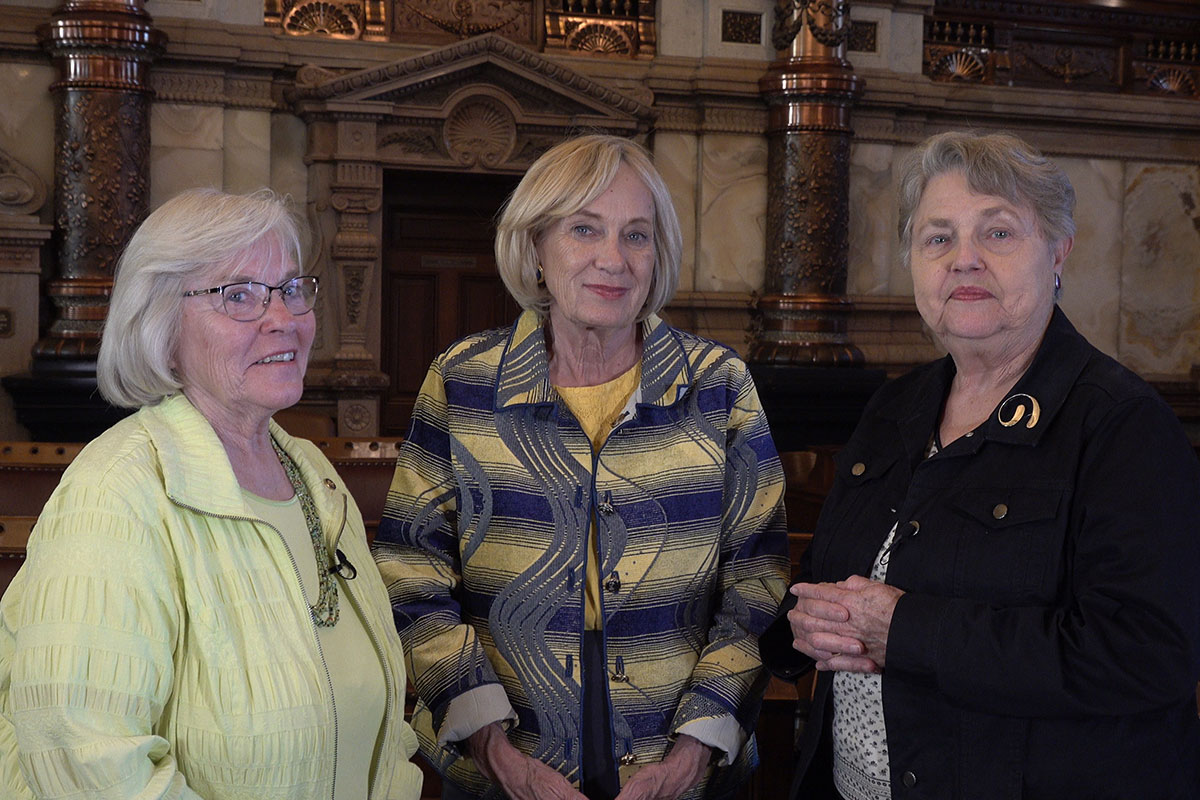
In an interview titled The Ladies Room, former Senators Janis Lee and Lana Oleen shared memories of moments in a small, windowless room behind the Senate chamber — the long-awaited women’s room. Because there were so few women senators, that shared space became a sanctuary for strategy. Other informal encounters described in the interviews paint a picture of the atmosphere. Janis Lee recalled, “When I think about women’s issues, I think about one day, Senator McClure and I got on the elevator. Senator Gaines was there. He said, as we got on, ‘Well, how are you girls doing today?'” That question encapsulated the paternalistic atmosphere of the Statehouse.
Yet, these senators turned outsider status into a coalition. Lana Oleen noted that the small numbers created a “circle of trust” that transcended party lines. This wasn’t just about socializing; it was about effectiveness. When women gathered in that room, they weren’t checking their makeup; they were counting votes on education and child welfare legislation.
The Steel Magnolias: Bipartisanship in Action
Perhaps the most recognized iteration of this female-led pragmatism was a group known as the “Steel Magnolias.” This bipartisan coalition of Republican and Democratic women in the 1980s and 90s became a formidable force in the Kansas House.
In a group conversation featuring former Representatives Martha Jenkins, Ginger Barr, and Nancy Brown, the interviewees described the group’s philosophy: “We’re all different, but we come together when we need to get something done.”
The interview reveals that the Steel Magnolias were often the “adults in the room” during heated budget cycles. One specific incident described is the group’s attempt to defeat a budget proposal as a strategic move to protect social services. Their legacy isn’t just a list of bills passed; it is a testament to a legislative culture that prioritized “the common good” over “the party line”, a culture that many of the interviewees now look back on with a sense of accomplishment and concern for today’s polarized environment.
Burdens of a Part-time Legislature: Family, Farm, and Floor
As citizen legislators, Kansas senators and representatives make significant personal sacrifices for the good of their districts. The KOHP interviewees don’t shy away from exploring the personal toll of public service. Kansas is a vast state, and for rural legislators like Janis Lee, serving in Topeka meant leaving home for months at a time. Lee recalled driving as much as 45,000 miles in a single election year to reach her constituents in her sprawling western Kansas district.
The demands of managing a home, and a career while serving in a “part-time” legislature is a recurring theme. These women were often expected to be “superwomen”—to be the primary caregivers at home while simultaneously serving as the policy experts on the Tax Committee or Ways and Means.
Senator Audrey Langworthy, who chaired the Assessment and Taxation Committee, spoke of the “steep learning curve” she faced. Her tenacity, as captured in her oral history, serves as a reminder that women in the Kansas Legislature didn’t just “fill seats”—they sought out the hardest, most technical committees to prove their mettle.
Breaking the Bronze Ceiling: Phyllis Garibay-Coon
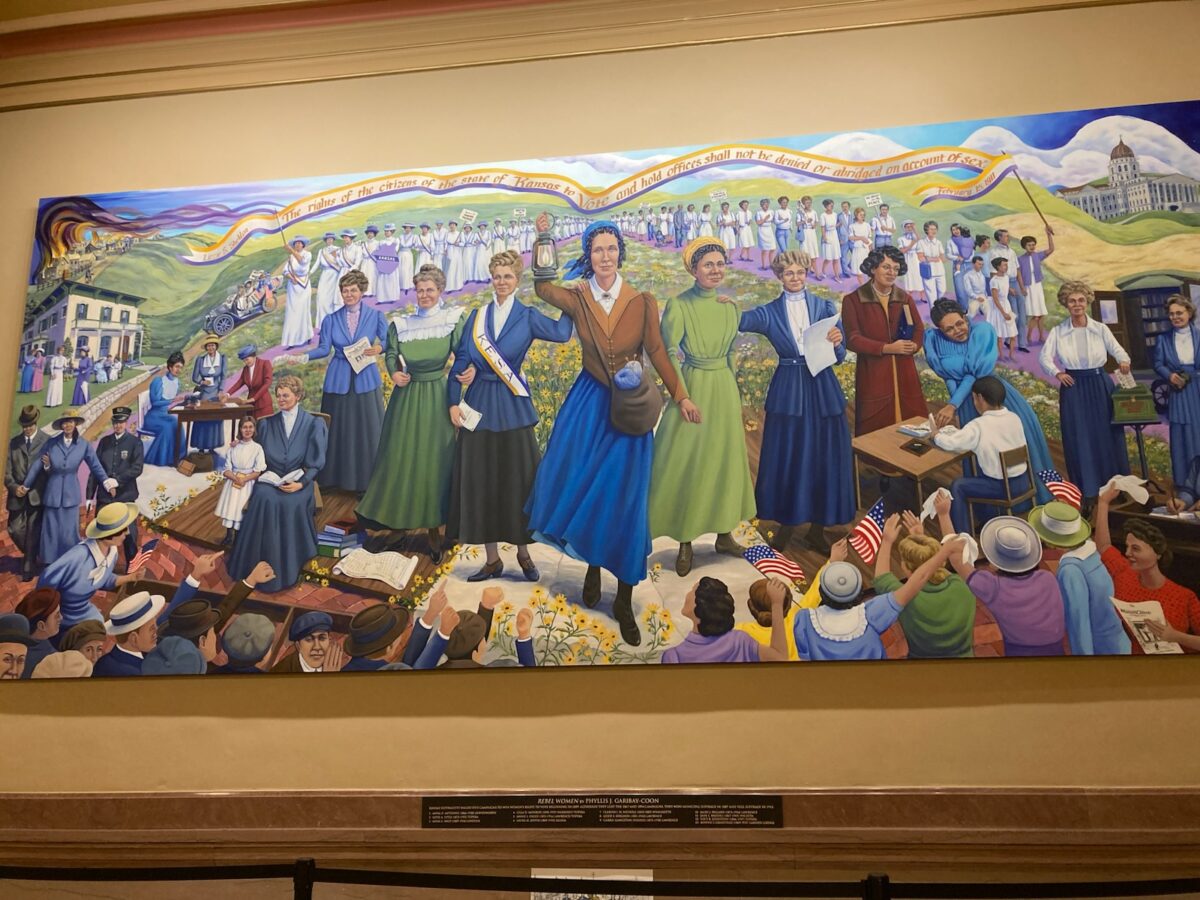
The project also captures history being made in the present. In a 2025 interview, artist Phyllis Garibay-Coon discussed her mural, Rebel Women, the first mural by a woman to be installed in the Kansas Statehouse.
Her work depicts the Kansas suffragists—the “rebel women” who paved the way for the Senators and Representatives interviewed elsewhere in the collection. Garibay-Coon’s interview bridges the gap between the 19th-century struggle for the vote and the 21st-century struggle for representation in public art.
“The Kansas suffragists were the most prominent figures… the families of those suffragists contributed to how I imagined the mural,” she explained.
This connection—between the artist, the subject, and the historical record—is exactly what the Kansas Oral History Project facilitates.
Why Oral History Matters for Women’s History Month
If we rely on the House and Senate journals, we see the what of history—the laws, the dates, the votes. But oral history gives us the why and the how and the perspective of the who behind those facts. Explore more interviews of Kansas women in our collections.