
Topic: School finance

Interview of Kathleen Sebelius, October 28, 2022
Interviewed by Joan Wagnon and Duane Goossen
Kathleen Sebelius ran for the legislature to "go home." Her kids were ages two and five and she was eager to get out of a demanding job to spend more time at home--better work-life balance. In her 2022 oral history interview, she discussed the changes in the culture of the legislature and state government she experienced over the 30-plus years she served in public office. She observed that when both US Senate seats for Kansas came open in 1996, and Sam Brownback challenged incumbent Sheila Frahm for one of the seats, a fissure Show Morewas created in the Republican party. Sebelius observed the insurance industry being very partisan and tilted toward the industry interests. Her discussion of budget issues during her terms as governor reveals her problem-solving process, even though her time in office was bookended by recessions. School finance also posed some unique challenges during her administration because the Great Recession got in the way of the court's mandates. Phill Kline, the Kansas Attorney General at the time urged Republicans to do nothing regarding school finance. The BEST teams created in the Sebelius administration were important to solving the budget crisis. This interview concludes with discussion of her selections of Lt. Governors and her experiences at the US Department of Health and Human Services (HHS) and her activities after leaving government service.
Considered together, this interview, interviews of Sebelius by Dr. Bob Beatty of Washburn university conducted in 2004 and 2016, and KOHP interviews conducted in 2023 and 2026 present a unique look at Kansas policymaking. Show Less
Interview of Jim Denning, April 13, 2023
Interviewed by Alan Conroy
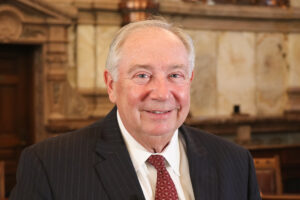
Jim Denning served four years as Majority Leader for the Kansas Senate. His interview reveals his Western Kansas leanings, despite having worked, lived and represented Johnson County. HIs legislative interests included health care policy, funding KPERS and school finance. He described Senate Bill 9--KU Cancer designation--as one of his important contributions. Denning found that Governor Brownback’s tax plan was creating problems for Kansas – “too deep and unsustainable.” His philosophy was, "At the end of the day, you have to govern." Throughout his tenure in the Senate, Medicaid expansion was a pressing issue, but Show Morehe didn’t like the way the bills were constructed, so he developed a Republican alternative that he thought would be a model for the country. His interview details how he kept the Democratic alternative from passing, but his own bill was caught up in abortion politics and failed to pass. Denning led the Senate during three special sessions: school finance, COVID, and repealing the Brownback tax plan. Show Less
Interview of Wayne Zimmerman, April 13, 2023
Interviewed by Dave Webb
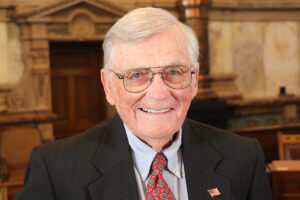
Wayne Zimmerman of Olathe returned to the Kansas Capitol many years after being elected in 1964 to the House of Representatives. Zimmerman is apparently the last surviving member of the class of 1965-66 House of Representatives that was elected prior to the historic One-Person-One-Vote decision. When he was reelected to a second term in 1966, he was elected to represent a district, not the county. Zimmerman served two terms in the Kansas House and later, after 4 years, a term in the Kansas Senate. In his interview, Zimmerman talked about farming in Johnson County, his military Show Moreservice as a pilot, and how the reapportionment court decision substantially changed the legislature. Schools remained a consistent legislative focus, even after substantial consolidation in the early 1960's. Wayne had no office, but did his legislative work at his desk on the floor in the House chambers. He had several stories to tell about how the legislature operated then. Show Less

Interview of Jim Gartner, February 16, 2024
Interviewed by Chris Courtwright
This interview sheds light on several activities related to the Kansas Legislature, particularly the role of lobbyist in decision making and the role of school boards in governance of education. It begins in 1967 with quite a tale of Gartner's service as a young Marine, wounded in VIetnam and how that impacted his career choices. A brief work experience building tires at Goodyear convinced him to get a college degree. Southwestern Bell Telephone hired him as one of the first male telephone operators in Kansas. He ended up as Vice President of External Affairs many years Show Morelater. He began his lobbying career in 1987 partnered with Denny Koch. Together they helped define deregulation and worked with both the legislature and the Kansas Congressional Delegation. In 2009 Gartner was appointed to the USD 437 school board to fill a vacancy. That's where he learned about school finance and governance. In 2016 Rep. Annie Tietze resigned and Gartner won that legislative seat. The House Taxation Committee was a logical appointment, given his lobbying background. The Brownback Tax Experiment was failing, and the legislature was eager to repeal it. Brownback vetoed the bill passed by the legislature; they quickly overrode his veto and restored more conventional tax policy. The interview concludes with a discussion of the food sales tax exemption proposed by Governor Kelly and Gartner's frustration with the legislative process and how it changed over the 30 years of his involvement. Show Less

Interview of Ed McKechnie, February 9, 2024
Interviewed by Chris Courtwright
This lengthy and wide-ranging interview is full of interesting stories about how the legislature worked when its leaders realized the House Democrats were in the majority by one vote (1990 election) with a new Democratic governor. The 1991-92 session was historic because of the major changes in property taxes and school finance. McKechnie built relationships across the aisle which helped him accomplish things and pass legislation. His interview is replete with descriptions of legislators with whom he worked. McKechnie served on the Kansas Bioscience Authority and after its demise, on the Kansas Board of Regents. Show More He discussed the transition of the University of Kansas Hospital to being designated a major cancer center. One particularly interesting story for football fans is about the major conference realignment that occurred from 2011 to 2012. He described in detail the negotiations over which university would stay or leave the Big XII. Ordinarily the Regents would not have been involved, but the impact of these decisions was too great to ignore. McKechnie also talks about the decisions the Regents made about raising tuition.
Highlights -- short excerpts from the interview