
Refine Your Results

Topic: Political culture
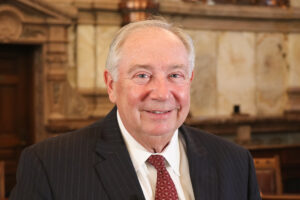
Interview of Jim Denning, April 13, 2023

Interviewed by Alan Conroy
Jim Denning served four years as Majority Leader for the Kansas Senate. His interview reveals his Western Kansas leanings, despite having worked, lived and represented Johnson County. HIs legislative interests included health care policy, funding KPERS and school finance. He described Senate Bill 9--KU Cancer designation--as one of his important contributions. Denning found that Governor Brownback’s tax plan was creating problems for Kansas – “too deep and unsustainable.” His philosophy was, "At the end of the day, you have to govern." Throughout his tenure in the Senate, Medicaid expansion was a pressing issue, but Show Morehe didn’t like the way the bills were constructed, so he developed a Republican alternative that he thought would be a model for the country. His interview details how he kept the Democratic alternative from passing, but his own bill was caught up in abortion politics and failed to pass. Denning led the Senate during three special sessions: school finance, COVID, and repealing the Brownback tax plan. Show Less

Interview of Eber Phelps, July 26, 2024

Interviewed by Chris Courtwright
Eber Phelps' interview covers the 18 years he served in the Kansas Legislature. Phelps paints a picture of the changes in the political culture and environment that occurred during his tenure. He blamed his loss in 2012 on the Brownback tax cuts, and his win in 2016 on the Brownback tax cuts. He lost because he voted against the tax experiment; he defeated Sue Boldra because of the problems the tax experiment caused in the Kansas economy and her insistence that nothing was wrong. The interview covers how Phelps became interested in politics, and the Show Morework he did on education and economic development. His work on the Insurance committee with chairman Bob Tomlinson stands in stark contrast to the current mode of work in the Legislature. The description of how the Mayor and city council found a way to solve a pressing water problem reveals his belief in community engagement. The interview closes with a discussion of how state government changed during his tenure. He noted there were 18 Democratic legislators elected from west of Salina when he was sworn in in 1996 and tax returns were filed on paper. Today, everything is online, and the makeup of the legislature is completely different.

Highlights -- short excerpts from the interview

Show Less
Picture of Kathleen Sebelius

Interview of Kathleen Sebelius, January 18, 2023

Interviewed by Rex Buchanan
In this 2023 interview of Kathleen Sebelius by Rex Buchanan, the former Kansas governor explored key energy and environmental issues and how they were addressed during her administration (2003-2009). Those issues included rejection of a new coal-powered electricity generation plant in western Kansas, voluntary protection of the 'heart of the Flint Hills' from wind farm development, and increased pressure on the state's dwindling water supplies. Sebelius attributes many of the energy and environmental approaches of her administration to the expertise and creativity of her cabinet, including Rod Bremby, Secretary of Show MoreHealth and Environment, former Governor Mike Hayden who served as Secretary of Wildlife and Parks in the Sebelius cabinet, and Joe Harkins, a trusted advisor. This interview was recorded by Dave Kendall for Prairie Hollow Productions, LLC. Portions of this interview were included in the documentary Hot Times in the Heartland. The Kansas Oral History Project, Inc. is grateful to former Governor Sebelius, Rex Buchanan, and Dave Kendall for granting permission to include this interview in the KOHP Energy & Environment collection of oral histories.

Highlights -- short excerpts from the interview

Considered together, this interview, along with 2004 and 2016 interviews of Sebelius by Dr. Bob Beatty of Washburn University, and KOHP interviews of Sebelius in 2022 and 2026 present a unique look at Kansas policymaking.

Show Less

Interviews of Mark Parkinson, December 14, 2010 and March 27, 2021

Interviewed by Bob Beatty and Amber Dickinson
These transcripts are from oral history interviews of former Kansas Governor Mark Parkinson conducted in 2010 and 2021 by Washburn University faculty members Dr. Bob Beatty and Dr. Amber Dickinson. The interviews explored Parkinson’s unconventional political path from Republican member of the Kansas House in 1991, to State Republican Party Chair in 1999, to the Democratic nomination to the office of Lieutenant Governor in 2006 and onto the office of Governor in 2009. He discussed the leadership and business-minded philosophy he employed as governor to guide the state through an economic recession. During the interviews Parkinson also highlighted Show Morepolicy achievements in renewable energy, public health, and transportation. He also reflected on the power of ideas, the role of luck and tenacity in a public career, and the complexities of governing during a period of partisan polarization.

____________________________________

Interviews of former Kansas governors conducted by Dr. Bob Beatty of Washburn University during the early decades of the 21st Century for the Kansas Governors Recorded History and Documentary Project provide a view of the lives, political philosophies, and governing styles of governors who led Kansas from the late 20th to the early 21st Century. Beatty generously granted the Kansas Oral History Project (KOHP) permission to house the transcripts of these interviews conducted with former governors John Anderson, William Avery, John Carlin, Bill Graves, Mike Hayden, Mark Parkinson, and Kathleen Sebelius. These interviews are a significant addition to the Kansas Governors collection, and the KOHP Board is grateful to Dr. Beatty for making the transcripts available for posting here. The article also linked below and downloadable, “ 'You Can Get a Hell of a Lot Done as a Governor': A Conversation with Former Governor Mark Parkinson," edited by Grant Armstrong, Bob Beatty, and Amber Dickinson, is excerpted from the 2010 and 2021 interviews. The article was published in the Spring 2022 issue of Kansas History: A Journal of the Central Plains and is reprinted here with permission. The questions were removed and footnotes added during preparation of the transcripts for publication as a journal article. The Kansas Oral History Project is grateful to the Kansas Historical Foundation for allowing us to post the article as part of the collection of interviews of Kansas Governors. Show Less
Sarah Kessinger

Interview of Sarah Kessinger, December 11, 2025

Interviewed by Jim McLean
In this 2025 oral history interview, Sarah Kessinger described her reporting career before taking on the challenge of publishing a weekly newspaper. Kessinger was Statehouse reporter for Harris News that served many community newspapers across Kansas. At the time of this interview, she was the editor and publisher of The Marysville Advocate. She observed that small, locally-owned newspapers look for ways to get the next generation to understand that “a newspaper is there as a resource for them to become better informed and better citizens in their community.” She also noted that, "there’s a lot Show Moreof rhetoric online that people believe, and that rhetoric doesn’t have to be vetted like we have to vet what we report and make sure that it’s accurate…we have a legal liability to report the truth.” She also highlighted as an issue confronting newspapers the lack of communication from national, state, and local elected officials. Kessinger questioned whether government officials realize the “damage they’re doing by shutting out the media and not being transparent.” In Kessinger's opinion, if media “can’t keep [important issues] in front of the public, then we all lose in the end. It’s a weaker society in general.”

Highlights -- short excerpts from the interview

Show Less
John Hanna

Interview of John Hanna, December 19, 2025

Interviewed by Jim McLean
John Hanna recalled his long career as one of the top journalists in Kansas in this 2025 interview with Jim McLean. Hanna described how covering the Kansas legislature has changed from the years when several reporters were able to cover multiple committees each day to now where a single reporter has “to tell big, broad stories to the largest audience possible.” He observed that there is “still a need for good journalism to help organize and make sense of what’s going on and to write about patterns and trends and context.” Hanna acknowledged the difficulty of maintaining Show Morethe AP style of balancing every story and giving each side equal coverage when you know one of the sides is demonstrably not true. He observed that there is an organized campaign by national groups that are getting legislatures to act and that it is “important for the reader to understand—where it’s coming from, how money is being spent, who benefits, who doesn’t.”

Highlights -- short excerpts from the interview

Show Less
Photo of Sheila Frahm

Interview of Sheila Frahm, September 17, 2004

Interviewed by Bob Beatty
During a 2004 interview former Lt. Governor and US Senator Sheila Frahm describes to Dr. Bob Beatty her recollections of serving as Lieutenant Governor with Governor Bill Graves. Frahm explores the collaborative partnership she had with Graves, recalling the process of creating an executive team and the patience required to work with a slow-moving legislature. She recalled Graves’ personal leadership style, noting that a successful governor must balance approachability and willingness to collaborate with the more solitary responsibility of making independent decisions for the state’s benefit. Frahm compared the leadership styles of other former governors whom she had Show Moreobserved. The interview paints a picture of the political culture of Kansas during the late 20th Century and the personal sacrifices inherent in a live of public service.

____________________________________

Dr. Bob Beatty of Washburn University generously granted the Kansas Oral History Project (KOHP) permission to house this transcript of his oral history interview of Sheila Frahm. The KOHP Board is grateful to Dr. Beatty for making this transcript available.

A 2020 interview of Sheila Frahm is included in the KOHP Women, Then and Now Project collection on this site. Show Less

Go to Top