
Topic: Political campaigns
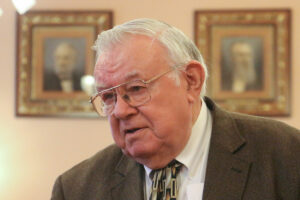
Interview of Ralph Skoog, July 17, 2015
Interviewed by Burdett Loomis
In his 2015 oral history interview, former Representative Ralph Skoog recalled a Kansas Legislature in transition. Skoog was initially elected to represent Topeka and Shawnee County in 1961, prior to the U.S. Supreme Court's Baker v. Carr 'one-person, one-vote' decision. His first 'district' was one-third of Shawnee County. When he returned to the House in 1967 after an unsuccessful campaign for Congress in 1964, he represented a more equal-size district of approximately 17, 000 residents of the County. Ralph recalls a Kansas legislature very much in transition at the beginning of the decline of rural domination Show Moreof the policymaking process and at the beginning of institutional change that came to fruition after the end of his last term. He recalls passage of important highway, prison, and school district consolidation legislation during his time of service in the House. Show Less
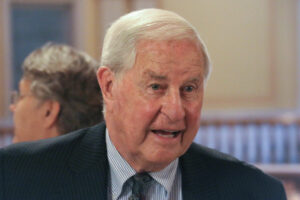
Interview of Robert (Bob) Storey, February 5, 2015
Interviewed by Burdett Loomis
In his 2015 oral history interview, Bob Storey recalled his service in the Kansas Senate from 1969-1976. His recollection was of a Senate in transition in terms of urban-rural influence on policymaking due to the one-person, one-vote principle enunciated by the U.S. Supreme Court in the mid-1960s. He recalled intricacies of interactions among Senate leaders and governors and occasional intrigue in Senate leadership elections. He also reflected on improvements in the functioning of state government during the years when reorganization and modernization of many state functions took place.
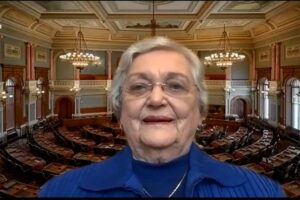
Interview of Ardena Matlack, April 8, 2021
Interviewed by Joan Wagnon
Ardena Matlack described the Kansas House of Representatives in the 1970’s when few women were in the Kansas Legislature. During her second term she experienced being in the majority as a Democrat—something that seldom occurred in Kansas. While in the majority, she served on the Federal and State Affairs committee as Vice-Chair, and moved up to chair the committee the second year of her term. The committee dealt with the Equal Rights Amendment (ERA), abortion, liquor, and other controversial issues. She also served on the House Judiciary Committee. Her discussion of gerrymandering shows the Show Moredifficulty of dealing with redistricting that led to her husband losing his Senate seat and encouraging her to run for the House. She also dealt with environmental and water issues, particularly in Sedgwick County. Matlack worked with Treasurer Joan Finney to get the first Unclaimed Property law passed. Show Less
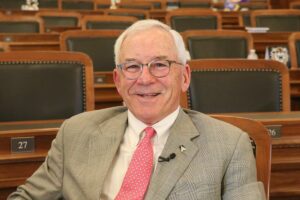
Interview of Mike O'Neal, April 16, 2021
Interviewed by Alan Conroy
Former Speaker Mike O'Neal's interview covers his 28 years in the Kansas House and his impact as Chair of the House Judiciary Committee on the Kansas legal system, both criminal and civil. In fact, O'Neal chaired the House Judiciary Committee three different times totaling 13 years and also served as Chairman of the House Education Committee and a redistricting committee in 2002. He has been involved with workers compensation issues and medical malpractice. O'Neal explains his own evolution in thinking as he, and his constituents, became more conservative. He candidly discusses his race for Speaker of the Show MoreHouse and compares the leadership styles of other speakers with whom he served. O'Neal left the House in 2012 after finishing his second term as Speaker to take a position with the Kansas Chamber of Commerce as its chief executive officer. After four years with the Kansas Chamber he retired to open his own legal consulting and governmental relations firm, O'Neal Consulting, LLC. Show Less
Interview of Joe Knopp, October 15, 2021
Interviewed by Alan Conroy
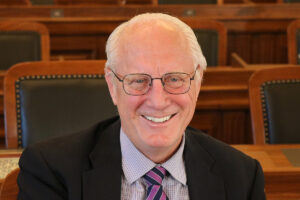
Joe Knopp's interview takes place 33 years after he left the legislature in 1988 after losing a close election and short-circuiting his political career. His recollections are still vivid and his interview describes a legislature that has changed considerably in recent years.
Knopp served from 1981 through 1988 and during that time as chair of the House Judiciary Committee was involved in many significant issues: medical practice, corporate hog farming, changes in the DUI law, death penalty, reapportionment, severance tax. As Majority Leader he dealt with a growing split in the Republican caucus --led by the Rebels. Show More He tried to get votes for a special session on a new highway plan. He describes in detail the process of getting elected to a leadership position and how he won by one vote. He talks candidly about balancing his personal views with those of his constituents, particularly on liquor and gambling issues --and he speaks analytically about losing the election in 1988 and again in 2012 when he ran for the Senate. Good insights for anyone contemplating a run for public office. Show Less
Interview of Ben Scott, January 14, 2022
Interviewed by Joan Wagnon
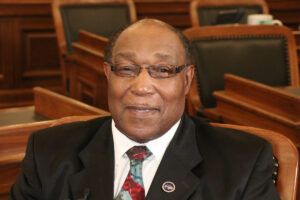
Ben Scott describes his life of service as an activist for schools and the community as well as his church. Scott's early experiences with segregation and racism informed his later activities as a member of the Board of Education in Topeka as the district sought to achieve racial balance in its public schools. The desegregation plans he and Sherman Parks Jr. developed in 1990's were instrumental in dismissing the federal lawsuit against the district. Scott was a leader in the Topeka and Kansas NAACP. He pointed out their priorities were finding enough Black teachers as Show Morewell as improving housing. Racial profiling was another NAACP concern that he carried to the Kansas legislature along with his concerns about student achievement and teachers having enough resources. In his interview, Scott talks candidly about racism in the juvenile justice system, racial profiling, Critical Race Theory (CRT), and the role of the church in dealing with racism. His hopes for continued legislative service were derailed by loss of election in 2016; however, he still pushes for developing standards for teaching Black history.
Highlights -- short excerpt from the interview