
Topic: Redistricting
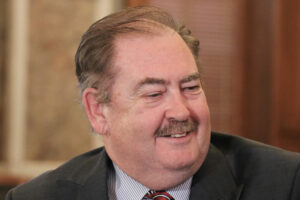
Interview of Tim Shallenburger, September 25, 2020
Interviewed by Alan Conroy
This interview with Tim Shallenburger, former Speaker and twelve-year House member is packed full of interesting anecdotes covering his philosophy of leadership, antics in the House, battles fought and won. Shallenburger was the first "conservative" Speaker following a wave of conservatives being elected beginning in the early 1990's. He candidly discusses why he ran for office in a largely Democratic district, how he moved up in the leadership and developed relationships with other legislative leaders in both House and Senate. Early in his time in the House, Shallenburger was part of a group known as the "rebels". Show More He watched other people's leadership styles and learned how to be a leader himself, first getting elected Speaker Pro Tem and then Speaker, beating Speaker Bob Miller in a "not-so-close" race. Shallenburger learned how to count votes. He doesn't see himself as having an "agenda", other than being fair as a leader. Shallenburger describes the rules changes the rebels made in the House when Jim Braden was Speaker to allow more bills to be heard or pulled out of committee. Bill Graves was Governor throughout all four years of Shallenburger' s term as Speaker. Shallenburger left the legislature to become State Treasurer. After 2010 he served as legislative liaison for Governor Brownback. Shallenburger talks openly about his relationships with numerous governors and senate leaders. The interview closes with a discussion of redistricting. Show Less
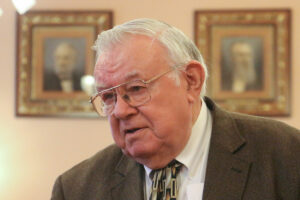
Interview of Ralph Skoog, July 17, 2015
Interviewed by Burdett Loomis
In his 2015 oral history interview, former Representative Ralph Skoog recalled a Kansas Legislature in transition. Skoog was initially elected to represent Topeka and Shawnee County in 1961, prior to the U.S. Supreme Court's Baker v. Carr 'one-person, one-vote' decision. His first 'district' was one-third of Shawnee County. When he returned to the House in 1967 after an unsuccessful campaign for Congress in 1964, he represented a more equal-size district of approximately 17, 000 residents of the County. Ralph recalls a Kansas legislature very much in transition at the beginning of the decline of rural domination Show Moreof the policymaking process and at the beginning of institutional change that came to fruition after the end of his last term. He recalls passage of important highway, prison, and school district consolidation legislation during his time of service in the House. Show Less
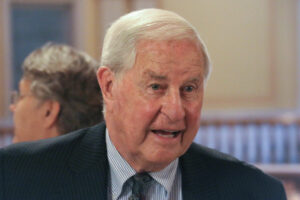
Interview of Robert (Bob) Storey, February 5, 2015
Interviewed by Burdett Loomis
In his 2015 oral history interview, Bob Storey recalled his service in the Kansas Senate from 1969-1976. His recollection was of a Senate in transition in terms of urban-rural influence on policymaking due to the one-person, one-vote principle enunciated by the U.S. Supreme Court in the mid-1960s. He recalled intricacies of interactions among Senate leaders and governors and occasional intrigue in Senate leadership elections. He also reflected on improvements in the functioning of state government during the years when reorganization and modernization of many state functions took place.
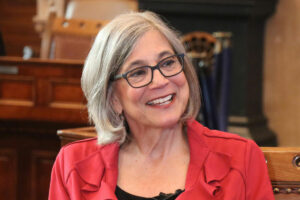
Interview of Susan Wagle, December 18, 2020
Interviewed by Alan Conroy
Former Kansas legislator Susan Wagle describes her interest in politics as "evolving over time." In this interview she candidly talks about her journey to become the first woman to break the glass ceiling and be elected to the top leadership position in the Kansas Senate. And she held onto the Senate Presidency for two terms. Wagle cites several events as having shaped her decision to run: getting a free pregnancy test and learning it was from an abortion clinic; seeing the huge property tax bills resulting from classification and reappraisal and how they angered people; enactment Show Moreof bingo legislation that affected he business negatively--all of which led to awareness that government could have an impact on families and businesses. Once in the Legislature, Wagle developed legislation to control property taxes. When an incumbent left a Senate seat, Wagle moved to the other chamber. She formed alliances in both the House and Senate with a group of conservative legislators enabling her to attain leadership positions. Wagle authored the Woman's Right to Know Act and solicited support from a prochoice Senator to get it passed--the first pro-life legislation. As a committee chair Wagle felt she had greater ability to pass bills that were needed. The issues she addressed ranged from protecting ground water from corporate hog farming, to tax-limiting measures, to ethics. Wagle credits her many years of service to listening to her constituents on issues such as taxation, quality of life, and education. In the closing of this interview, Wagle talks about her last year with COVID which she describes as "horrific" and disruptive. She reflects on her accomplishments changing the Board of Healing Arts and dealing with the Bioscience Authority. Show Less
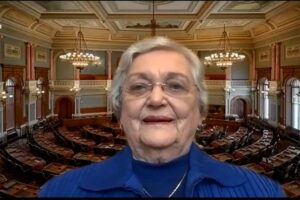
Interview of Ardena Matlack, April 8, 2021
Interviewed by Joan Wagnon
Ardena Matlack described the Kansas House of Representatives in the 1970’s when few women were in the Kansas Legislature. During her second term she experienced being in the majority as a Democrat—something that seldom occurred in Kansas. While in the majority, she served on the Federal and State Affairs committee as Vice-Chair, and moved up to chair the committee the second year of her term. The committee dealt with the Equal Rights Amendment (ERA), abortion, liquor, and other controversial issues. She also served on the House Judiciary Committee. Her discussion of gerrymandering shows the Show Moredifficulty of dealing with redistricting that led to her husband losing his Senate seat and encouraging her to run for the House. She also dealt with environmental and water issues, particularly in Sedgwick County. Matlack worked with Treasurer Joan Finney to get the first Unclaimed Property law passed. Show Less
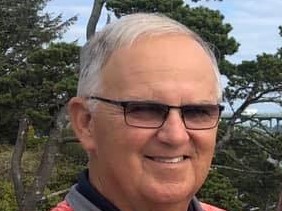
Interview Series of Don Hill by Janice Huston, Spring, 2017
Interviewed by Janice Huston
In a wide-ranging series of interviews conducted by Jan Huston of the Lyon County Historical Society, former Representative Don Hill talks candidly about his experiences over 14 years of service to the 60th district in the Kansas Legislature (2003-2016). During those 14 sessions Hill experienced a sea-change in legislative culture as well as a profound shift in political philosophy among its leaders. Hill worked closely with three governors - Sebelius, Parkinson, Brownback-- and several Speakers of the House. His interviews reveal the intricacies of creating public policy and making change happen. For Show Morestudents of Kansas government, this set of interviews is invaluable to understanding the shifts in leadership which occurred during this period, as well as policy failures and successes with tough issues such as Medicaid expansion, a 10-year highway plan, and expansion of a coal-fired plant in the Garden City area. Show Less
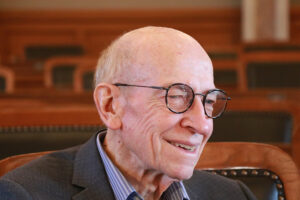
Interview of James (Jim) Maag, September 28, 2021
Interviewed by Joan Wagnon
The Kansas Oral History Project reviewed the original transcript of Dr. Burdett Loomis's interview of former Kansas State Representative Jim Maag and decided to recapture part of the interview on video for inclusion in a civic education series about the Kansas legislature. This videoed interview follows the original Loomis interview, asking similar questions. A transcription of the video is also posted here.
In the original 2014 oral history interview, Jim Maag reflected on his service in the Kansas House of Representatives (1969-1976) including his term as Speaker pro tem (1975-1976). Maag's years in the House Show Morespanned a time of significant change and modernization of the Kansas Legislature and its processes. He provided a view into the evolution of the Legislature into a more professional organization. He commented on the bipartisan approaches to policymaking during that era when the urban-rural split affected legislative dynamic more often than purely partisan considerations. Maag was witness to the impact of the U.S. Supreme Court's one person, one vote decision as well as the increased number of women legislators, and the reduced number of attorneys among the House members. Jim's recollections draw a vivid picture of an institution in transition. His connection with the Legislature continued in his role of legislative liaison for Governor Bennett and later as a lobbyist for the Kansas Bankers Association. Show Less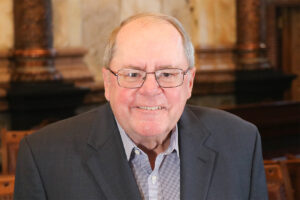
Interview of Anthony Hensley, September 16, 2022
Interviewed by Alan Conroy
Senate Minority Leader Anthony Hensley was first elected to the Kansas House of Representatives in 1976 at the age of 22. He moved to the Senate in 1992, finishing an unexpired term of Senator Nancy Parrish. His interview covers his 44 years in the House and Senate, and almost every issue the legislature dealt with in those years: taxes, reapportionment, school finance and labor issues, to name a few. His story about negotiating with Dick Bond to increase funding for schools is a "must read". Hensley's description of how the Show MoreBrownback tax cuts were enacted after the Senate reconsidered its vote to kill them is a lesson in how parliamentary maneuvering between House and Senate can have unexpected consequences.
Highlights -- short excerpts from the interview