
Refine Your Results

Topic: Public Radio

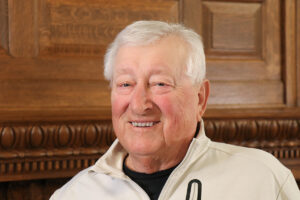
Dale Goter

Interview of Dale Goter, January 6, 2026

Interviewed by McLean Jim
In this 2026 oral history interview, Dale Goter looked back at the evolving landscapes of Kansas journalism and state politics. Goter, a veteran journalist who later became the lobbyist for the City of Wichita, offered a unique perspective on how the relationship between the press and elected officials shifted over several decades. He described a "golden age" of Statehouse news coverage when major news organizations maintained fully staffed bureaus in Topeka. That presence allowed for rigorous, daily coverage of the Kansas Legislature, which Goter characterized as essential for maintaining public accountability. He expressed concern over the subsequent decline of coverage, Show Morenoting that the loss of dedicated statehouse reporters left a void sometimes filled by partisan messaging rather than objective reporting. Goter stated that as a journalist, “You’re always going after the power structure because that’s where the power is, and that’s where the abuse of power is.” Journalists are "conditioned to look for controversy. You’re looking for conflict, controversy, and corruption. That puts you at odds with government all of the time. You’re perceived as a liberal because you’re going against government.” Goter shared his thoughts on changes in the Statehouse culture. He points out that there used to be a “level of oratory that took place on the Senate floor, people like Ed Reilly, . . . Frank Gaines, and Tom Rehorn. They could get up. They were stem winders." Goter transitioned from the press gallery to a role as lobbyist for Wichita in 2006. He described the nuances of lobbying for the city from a ‘public good’ perspective not commonly found among the ranks of lobbyists. Goter explained that effective lobbying relies on building long-term relationships and providing credible information to lawmakers, a process that became increasingly difficult due to rising political polarization.

Highlights -- short excerpts from the interview

Show Less
Picture of Kathleen Holt and Quentin Hope

Interview of Kathleen Holt and Quentin Hope, August 14, 2026

Interviewed by Mary Galligan
In their 2026 oral history interview, Kathleen Holt and Quentin Hope recounted the establishment of High Plains Public Radio (HPPR) in western Kansas. During the interview Holt and Hope recalled how the station began in the late 1970s as a grassroots community project to create a source of intellectual and cultural connection in a sparsely populated region. They described overcoming technical and financial hurdles, repurposing an old school building and a former library to create studios, and placing radio equipment atop grain elevators to expand the reach of the station’s signal. They emphasized that the station was Show Morebuilt with a pioneering spirit of shared resources, relying on personal local credibility and a vast network of dedicated volunteers. Holt and Hope highlight HPPR's evolution into a regional resource that, at the time of the interview, served the western one-third of Kansas and parts of nearby Colorado, Oklahoma and Texas. Holt and Hope concluded their interview by expressing the wish that future generations sustain this civic legacy by adapting to new types of media while maintaining the core mission of strengthening the community.

Highlights -- short excerpts from the interview

Show Less
photo of Bill Kurtis

Interview of Bill Kurtis, September 26, 2026

Interviewed by Jim McLean
In this 2026 oral history interview, veteran journalist and native Kansan, Bill Kurtis reflected on his upbringing, his roots in local broadcasting, and his pivotal "take cover" warning during the 1966 Topeka tornado. During the interview, Kurtis and interviewer Jim McLean highlighted Whirlwind, Kurtis's 2025 memoir. Kurtis acknowledged that his voice was an advantage for his broadcasting career but described how his education prepared him to take advantage of opportunities when they arose. Kurtis explained how his Washburn University law degree prepared him to cover historic murder trials, such as those of Richard Speck and Charles Manson, Show Moreand to spearhead an investigative documentary on the health impact of Agent Orange. The conversation also touched on his transition into entertainment and comedy, including his narration in the film Anchorman: The Legend of Ron Burgundy and his long-running role on NPR's Wait, Wait, Don't Tell Me. Show Less
Go to Top