
Refine Your Results

Topic: News Services
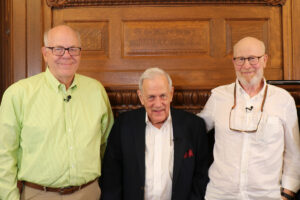
Photo of Dave Ranney, John Marshall, and Mike Shields

Interview of John Marshall, Mike Shields and Dave Ranney, July 30, 2025

Interviewed by Jim McLean
In this 2025 oral history interview, Jim McLean explored with John Marshall, Dave Ranney, and Mike Shields some of the issues they covered as Statehouse reporters and how news coverage has changed over the last fifty years. The three reporters, who all worked at Harris News, describe providing in-depth coverage, such as Marshall’s descriptions of school finance debates, Shields’ work on Kansas water issues, and Ranney’s articles on social services issues that impacted Kansans’ lives. Marshall noted that through Ranney’s reporting on social issues, “we found that for the first time we could raise the consciousness of almost the Show Moreentire community of Kansas. Made this an issue. Made this something that people talked about and were concerned with, especially legislators.” They shared their thoughts on how Harris News made “Kansans aware of Kansas” and the importance of covering local stories about local people and not just Topeka, Kansas City, and Wichita. They noted that today “we’ve lost the quality control of the information being presented out there.” They also recognized Dale Dennis, formerly at the Kansas Department of Education, and Richard "Dick" Ryan, former Director of the Kansas Legislative Research Department, as sources of detailed information to ensure that Kansans received accurate and reliable news from the Statehouse.

Highlights -- short excerpts from the interview

Show Less
Sarah Kessinger

Interview of Sarah Kessinger, December 11, 2025

Interviewed by Jim McLean
In this 2025 oral history interview, Sarah Kessinger described her reporting career before taking on the challenge of publishing a weekly newspaper. Kessinger was Statehouse reporter for Harris News that served many community newspapers across Kansas. At the time of this interview, she was the editor and publisher of The Marysville Advocate. She observed that small, locally-owned newspapers look for ways to get the next generation to understand that “a newspaper is there as a resource for them to become better informed and better citizens in their community.” She also noted that, "there’s a lot Show Moreof rhetoric online that people believe, and that rhetoric doesn’t have to be vetted like we have to vet what we report and make sure that it’s accurate…we have a legal liability to report the truth.” She also highlighted as an issue confronting newspapers the lack of communication from national, state, and local elected officials. Kessinger questioned whether government officials realize the “damage they’re doing by shutting out the media and not being transparent.” In Kessinger's opinion, if media “can’t keep [important issues] in front of the public, then we all lose in the end. It’s a weaker society in general.”

Highlights -- short excerpts from the interview

Show Less
Picture of Kathleen Holt and Quentin Hope

Interview of Kathleen Holt and Quentin Hope, August 14, 2026

Interviewed by Mary Galligan
In their 2026 oral history interview, Kathleen Holt and Quentin Hope recounted the establishment of High Plains Public Radio (HPPR) in western Kansas. During the interview Holt and Hope recalled how the station began in the late 1970s as a grassroots community project to create a source of intellectual and cultural connection in a sparsely populated region. They described overcoming technical and financial hurdles, repurposing an old school building and a former library to create studios, and placing radio equipment atop grain elevators to expand the reach of the station’s signal. They emphasized that the station was Show Morebuilt with a pioneering spirit of shared resources, relying on personal local credibility and a vast network of dedicated volunteers. Holt and Hope highlight HPPR's evolution into a regional resource that, at the time of the interview, served the western one-third of Kansas and parts of nearby Colorado, Oklahoma and Texas. Holt and Hope concluded their interview by expressing the wish that future generations sustain this civic legacy by adapting to new types of media while maintaining the core mission of strengthening the community.

Highlights -- short excerpts from the interview

Show Less
Go to Top